
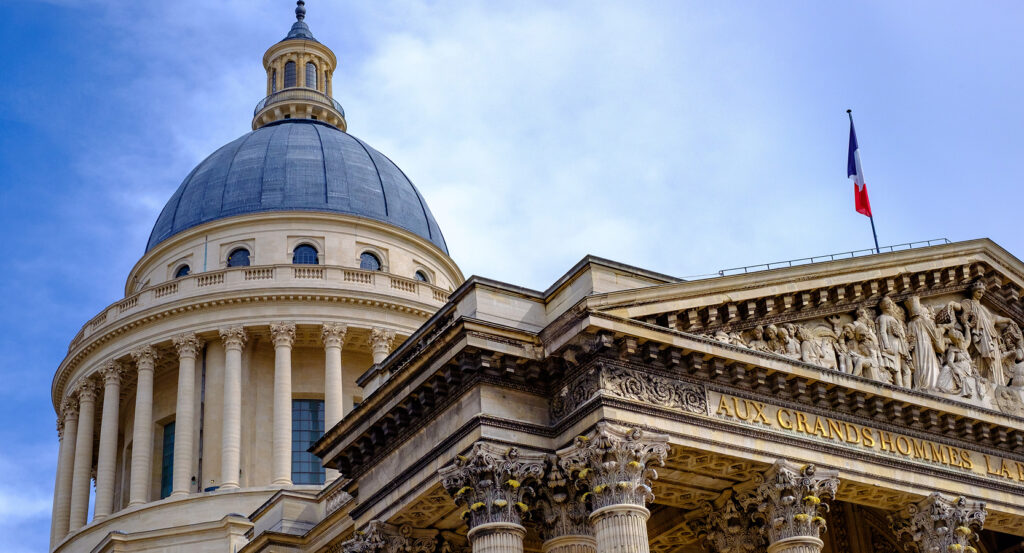
Why you should experience Foucault's Pendulum at Panthéon in Paris, France.
Foucault's Pendulum at Panthéon is a groundbreaking scientific exhibit where the Latin Quarter's intellectual heritage, Enlightenment ideals, grand architecture, and scientific discovery transformed one of France's greatest monuments into the site of one of history's most elegant physics demonstrations.
Set beneath the Panthéon's soaring dome along Place du Panthéon near Rue Soufflot and just steps from the Crypt, this remarkable installation captivates visitors as a massive brass pendulum swings silently across the marble floor, gradually rotating its plane of motion to reveal the Earth's continuous rotation through one of the simplest and most profound scientific experiments ever conceived. Towering Corinthian columns, vast neoclassical interiors, and the pendulum's measured movement create an atmosphere where science, architecture, and philosophy converge beneath one of Paris' most iconic landmarks. Every swing reinforces humanity's enduring pursuit of knowledge. The result is an experience defined by scientific brilliance, historical significance, and one of France's most celebrated demonstrations of physics.
What you should know about Foucault's Pendulum at Panthéon.
Foucault's Pendulum at Panthéon is best known for demonstrating the Earth's rotation through the revolutionary experiment performed by French physicist Léon Foucault on March 31, 1851, when he suspended a 28-kilogram brass bob from a 67-meter wire beneath the Panthéon's dome, allowing the pendulum's oscillation to provide the first simple visual proof that the Earth rotates beneath it. Building upon a smaller experiment first conducted days earlier in the cellar of the Paris Observatory, Foucault selected the Panthéon for its exceptional 83-meter dome and uninterrupted interior height, creating one of the most influential public scientific demonstrations in history. As the pendulum continued swinging in a nearly constant plane while the Earth rotated, observers watched its path gradually shift by 11 degrees per hour at Paris' latitude, slowly toppling a circular arrangement of markers placed around its base. The experiment instantly established Foucault's international scientific reputation, earned him the Copley Medal from the Royal Society in 1855, and permanently transformed the pendulum into one of physics' most enduring educational symbols.
Although the original apparatus no longer survives, the Panthéon now displays a faithful modern reconstruction that continues demonstrating the same physical principles beneath Jacques-Germain Soufflot's grand eighteenth-century dome. The pendulum hangs within one of Europe's greatest examples of Neoclassical architecture, where engineering precision, grand proportions, and scientific history reinforce one another in extraordinary fashion. Surrounding the exhibit are the resting places of Voltaire, Rousseau, Victor Hugo, Marie Curie, Alexandre Dumas, and other distinguished figures whose contributions shaped French intellectual life, deepening the symbolic relationship between scientific discovery and national achievement. Every oscillation demonstrates how experimental physics, mathematical elegance, architectural vision, and Enlightenment thought combined to produce one of the most influential scientific demonstrations ever presented to the public.
How to fold Foucault's Pendulum at Panthéon into your trip.
Foucault's Pendulum at Panthéon works as the intellectual centerpiece of an exploration through the Latin Quarter's celebrated historic landmarks.
Begin at the Panthéon Crypt, where France's greatest writers, scientists, and statesmen introduce the monument's extraordinary historical legacy before witnessing Foucault's Pendulum beneath the great dome. Continue to the Church of Saint-Étienne-du-Mont, whose remarkable Gothic and Renaissance architecture provides another perspective on the neighborhood's rich heritage. Conclude at the Jardin du Luxembourg, where elegant gardens provide a memorable finale celebrating the remarkable relationship between science, history, architecture, and civic life that defines the Left Bank. The progression moves naturally from national mausoleum to revolutionary scientific demonstration before concluding through two defining Latin Quarter landmarks, revealing why Foucault's Pendulum remains one of Paris' most profound cultural experiences.
Where your story begins.
Foresyte Travel reveals places that feel extraordinary long before you arrive.
Experience premium editorial crafted for luxury travelers.














































































































