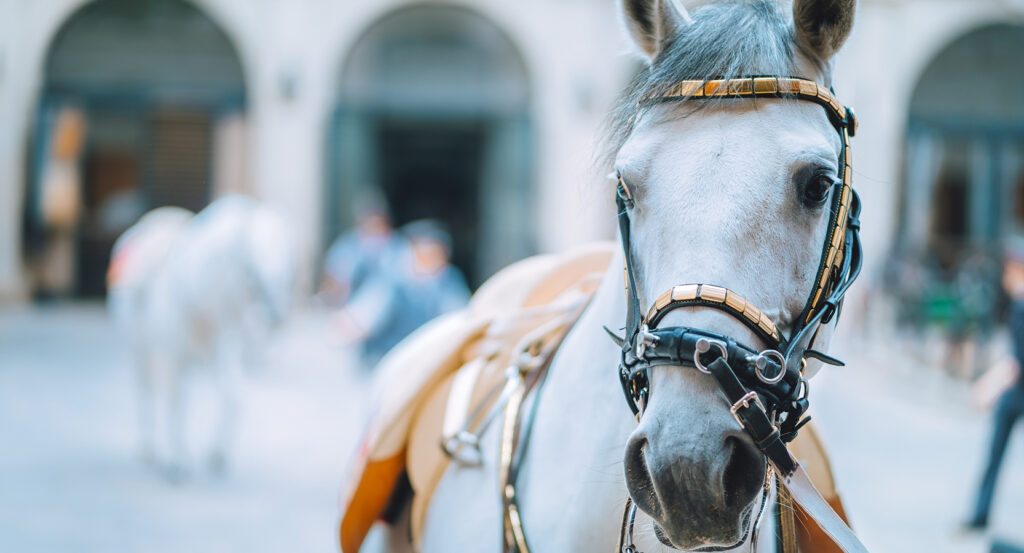
Why you should experience Winter Riding School in Vienna, Austria.
The Winter Riding Hall at Hofburg Palace is not merely is Vienna's cathedral of grace, where centuries of equestrian artistry unfold beneath chandeliers.
Step through the grand archways, and the first thing that strikes you is the light: soft, diffused, cascading through high arched windows onto immaculate white sand. The hall's sweeping Baroque interior, built between 1729 and 1735 by architect Joseph Emanuel Fischer von Erlach, was designed not just for riding, but for spectacle. Gilded balconies curve around the arena, supported by Corinthian columns and draped in the imperial insignia of the Habsburgs. Every inch of it exudes ceremony, from the frescoed ceilings to the ornate gallery where Emperor Charles VI once presided over performances. Here, the Spanish Riding School performs its legendary Haute École, a ballet of horses and riders that has remained unchanged for centuries. Watching the white Lipizzan stallions glide, rear, and pivot in perfect harmony feels less like witnessing training and more like seeing history breathe. The rhythmic sound of hooves echoes against marble, blending discipline with poetry. It's not a performance; it's devotion, to craft, to tradition, to the unspoken bond between horse and rider that has defined Austrian culture for generations.
What you didn't know about Winter Riding School.
The Winter Riding Hall is one of Europe's most extraordinary architectural and cultural achievements, a masterpiece of design built to elevate horsemanship to art.
Commissioned by Emperor Charles VI as part of the Hofburg's expansion, it was intended to symbolize imperial control, intellect, and refinement. The hall was completed in 1735 and immediately became the stage for the Spanische Hofreitschule, the Spanish Riding School, an institution tracing its roots back to 1572. Its purpose was far greater than entertainment: it embodied the Habsburg belief that mastery over the horse reflected mastery over oneself. Even today, the smallest details of the hall are steeped in ritual, from the placement of the imperial portrait overlooking the arena to the ceremonial uniforms of the riders, tailored in the same 18th-century style. Few visitors realize that the Lipizzan stallions, raised at the Piber Stud Farm in Styria, spend years in training before ever stepping hoof on this sand. The hall's acoustics are a marvel, the curvature of its vaults designed to amplify the precise rhythm of hooves and breath, so every movement resonates like a musical phrase. During World War II, the hall was miraculously preserved, and the horses, evacuated under perilous conditions, were later returned to Vienna in an operation so dramatic that General Patton himself became part of the story. Today, the hall remains one of the last arenas in the world where imperial ritual still meets living tradition, untouched by modern intrusion.
How to fold Winter Riding School into your trip.
To experience the Winter Riding Hall at its fullest, plan your visit around the performances of the Spanish Riding School, a spectacle as moving as it is meticulous.
Morning training sessions, held most weekdays, offer an intimate glimpse behind the curtain: riders refining their movements in quiet concentration while classical music floats through the vaulted hall. For the full performance, book tickets well in advance, the White Ballet showcases the Lipizzan stallions performing the airs above the ground, their gravity-defying leaps choreographed with the precision of an orchestra. Arrive early to admire the hall's architecture before the lights dim, and take a seat in the upper balcony for the best view of the symmetrical perfection below. Afterward, explore the adjoining courtyards of the Hofburg, where the stables and tack rooms reveal another layer of tradition preserved in time. For a more personal connection, visit the Piber Stud Farm in Styria or the Heldenplatz area where riders often warm up the horses before shows. Pair your visit with a stop at the Sisi Museum or a stroll through the Imperial Apartments for context on the dynasty that elevated this equestrian art to imperial ritual. Whether you come for the history, the architecture, or the sheer beauty of motion, the Winter Riding Hall is Vienna distilled, precise, passionate, and timelessly poised between discipline and dream.
Hear it from the Foresyte community.
Just enough life around you not to be overwhelming. Right pace.
Where your story begins.
Start your planning journey with Foresyte Travel.
Experience immersive stories crafted for luxury travelers.