Why you should experience Wien Museum Otto Wagner Pavillon Karlsplatz in Vienna, Austria.
The Otto Wagner Pavillon Karlsplatz is far more than remnants of Vienna's transport history, they are exquisite declarations of an era when design, engineering, and philosophy aligned to redefine modernity itself.
Standing like jeweled gateways between the 19th and 20th centuries, these pavilions, the most famous being those at Karlsplatz, embody the moment when Vienna stepped into its golden age of Secessionist innovation. Designed by Otto Wagner, the visionary architect who championed functional beauty, the pavilions were built in 1898 as part of the Stadtbahn, Vienna's early urban railway system. Their façades, clad in green and white marble panels, are crowned with delicate gilded ornamentation and stylized sunbursts, hallmarks of Wagner's belief that modern architecture should balance logic and lyricism. Step inside, and you feel the pulse of turn-of-the-century Vienna: brass fixtures gleaming under glass canopies, floral motifs spiraling across metalwork, and symmetry so precise it feels musical. The Karlsplatz pavilions are now preserved as monuments to design genius, one housing a Vienna Museum branch, the other functioning as an exhibition space, but they still whisper of trains, movement, and a future imagined through beauty. They are, in essence, time machines disguised as buildings, symbols of the optimism that once electrified an empire.
What you didn't know about Wien Museum Otto Wagner Pavillon Karlsplatz.
The Otto Wagner Pavilions were revolutionary in both form and philosophy, a radical departure from the historicist architecture that dominated Vienna before the dawn of the 20th century.
Wagner's concept of “utility with artistry” guided every detail. He rejected excessive ornamentation for ornament's sake, insisting that decoration should emerge naturally from structure and function, an idea that would later influence movements from Art Deco to Bauhaus. The pavilions' metal frameworks, hidden behind marble cladding, represented cutting-edge technology at the time. The green hue of their façades wasn't merely aesthetic; it reflected Wagner's belief that color could harmonize architecture with nature. Their sunflower motifs, etched in gold and iron, symbolize energy and renewal, perfect metaphors for a city embracing electricity, modern transit, and artistic liberation. When the Karlsplatz line ceased operation in 1918, the pavilions narrowly escaped demolition, saved only by public outcry and growing recognition of their architectural importance. The western pavilion was later transformed into a small Wagner museum, showcasing original blueprints, models, and furniture that reveal his genius for blending practicality with poetry. The eastern pavilion, now a café and gallery, still carries the hum of conversation and culture that has surrounded it for more than a century. Few realize how deeply these modest-sized buildings shaped Vienna's global identity, they were prototypes for the city's fusion of infrastructure and art, proving that even the everyday could be extraordinary.
How to fold Wien Museum Otto Wagner Pavillon Karlsplatz into your trip.
Experiencing the Otto Wagner Pavilions is like walking through a threshold between worlds, the end of empire and the birth of modern Europe.
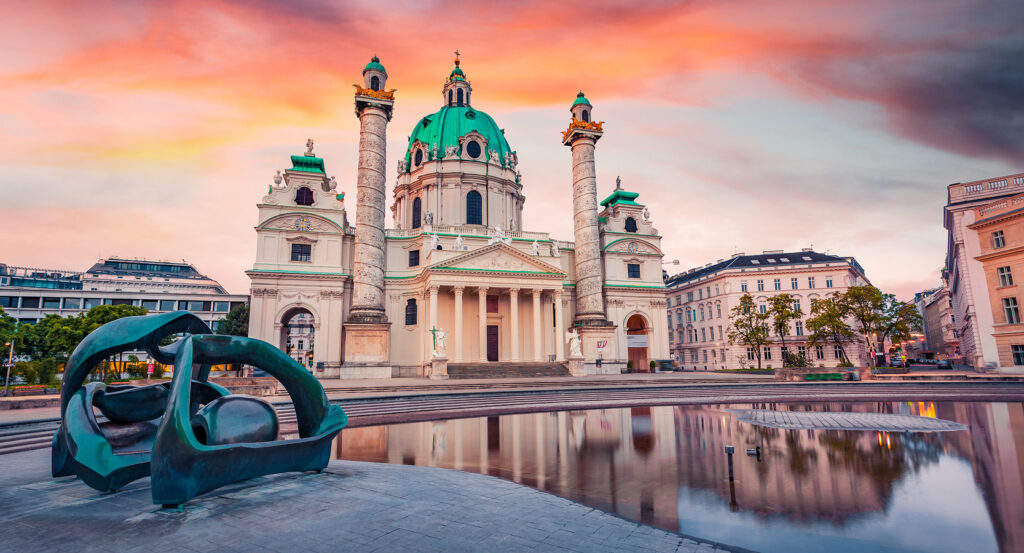
Begin at Karlsplatz, where the twin pavilions face each other across the plaza, flanked by the reflection pond of Karlskirche. Approach slowly to appreciate the play of light on their gilded details, especially in the morning when the sun hits the brass and marble at just the right angle. Step into the western pavilion first, the museum, and spend time with the models of Wagner's other masterpieces, such as the Postal Savings Bank and Kirche am Steinhof, to understand his vision of “architecture for a new age.” Then, cross to the eastern pavilion for a coffee or glass of Grüner Veltliner at the café, where you can sit beneath the original wrought-iron chandeliers and watch Vienna move past, trams, students, artists, and musicians weaving the same pulse of progress Wagner once celebrated. If you're following Vienna's Art Nouveau trail, the Karlsplatz pavilions are your perfect prologue; continue on to Naschmarkt to see Wagner's Majolikahaus or to Steinhof to witness his spiritual apex. Visit at dusk, when the green marble deepens and the gold flourishes catch the fading light, the pavilions seem to glow from within, like lanterns of a city that never stopped believing in the beauty of forward motion.
Where your story begins.
Start your planning journey with Foresyte Travel.
Experience immersive stories crafted for luxury travelers.