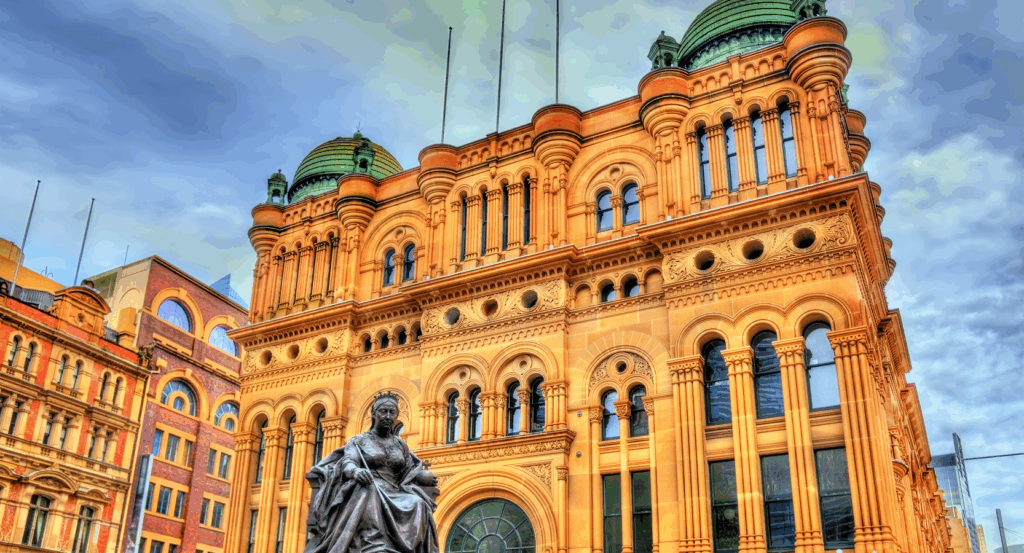
Why you should experience the Royal Clock at the Queen Victoria Building in Sydney.
The Royal Clock inside the Queen Victoria Building is a marvel of craftsmanship and imagination, a suspended theatre of time that transforms history into movement, sound, and wonder.
Hanging from the vaulted ceiling near the southern end of the QVB, this intricate masterpiece draws every eye upward. The clock itself resembles a miniature medieval castle in the sky, spires, battlements, and arches meticulously carved in timber and gilded with brass. Every hour, its chimes ripple through the atrium as a procession of animated scenes unfolds inside, dramatizing moments from Britain’s royal past. Kings and queens glide through archways, trumpets sound, and light spills from tiny windows, illuminating centuries of monarchy in motion. Beneath the building’s copper dome, the Royal Clock becomes a living heartbeat of rhythm and ritual, one that pulls time backward for a few enchanted minutes each hour. It’s not simply a clock; it’s a story told in gears and grace, a reminder that beauty, like history, is a matter of careful timing.
What you didn’t know about the Royal Clock.
The Royal Clock is the twin counterpart to the Great Australian Clock, and together they form the narrative spine of the QVB, two visions of history suspended in perpetual dialogue.
Commissioned during the building’s grand restoration in the 1980s and completed in 1986, the Royal Clock was conceived by architect George McRae’s spiritual successors as both homage and counterpoint. Where the Great Australian Clock explores Australia’s journey through dual perspectives, the Royal Clock focuses on England’s royal lineage, a mechanical chronicle spanning nearly a thousand years. Designed and built by clockmaker Christopher Cook, it features six animated scenes that re-enact pivotal moments in British history: King John signing the Magna Carta, the execution of King Charles I, Henry VIII with his six wives, and the Battle of Hastings among them. Each sequence is framed within arched windows that light up sequentially as the clock’s music box plays period choral themes. The craftsmanship borders on obsessive, every figure hand-painted, every hinge and cog custom-forged to ensure seamless motion. The entire mechanism is driven by counterweights concealed above the ceiling, which descend with silent precision as the dioramas perform. Few visitors notice the architectural detail surrounding it, the way the sandstone arches and stained-glass windows of the QVB mirror the Gothic Revival aesthetic of the clock itself, making it feel as though the building was designed to host it. Its chime sequence, composed specifically for the QVB’s acoustics, fills the entire atrium with layered resonance, soft enough not to overpower but rich enough to linger. More than decoration, the Royal Clock serves as an allegory for the building’s own resurrection, an empire reborn, rendered in wood and brass instead of stone and crown.
How to fold the Royal Clock into your trip.
To truly experience the Royal Clock, you have to surrender a few minutes to its rhythm, to let yourself be still while time performs for you.
Begin at the ground floor beneath the southern dome of the Queen Victoria Building and look up: the clock hovers like a suspended palace, its miniature turrets glowing under the soft dome light. Arrive five minutes before the hour to secure a good vantage point from the central atrium or the first-floor balcony. When the bells begin their prelude, lift your gaze and watch the scenes unfold one by one, the music swelling, the tiny doors opening, the figures gliding through their story of monarchy and myth. For the best view, move to the second-floor gallery, where you can see directly into the clock’s chambers as each diorama activates in sequence. The show lasts about three minutes, and when it ends, a hush usually falls before the crowd disperses, proof that everyone feels, if only briefly, transported. Combine this visit with a stop at the Great Australian Clock nearby to witness how the two instruments frame contrasting histories, one imperial, one national, both eternal. If you have time, stay until the next hour’s chime; the repetition never feels redundant, only deeper. Afterward, wander through the QVB’s galleries, listening to the lingering echo of the bells, a sound that threads through sandstone, glass, and copper, binding every corner of the building in time. The Royal Clock doesn’t just tell history, it keeps it alive, hour after hour, for those willing to look up and listen.
Hear it from the Foresyte community.
Vibe is just old money pretending it’s casual. You walk in for coffee and suddenly feel like you should be wearing gloves and pearls.
Where meaningful travel begins.
Start your journey with Foresyte, where the planning is part of the magic.
Discover the experiences that matter most.