
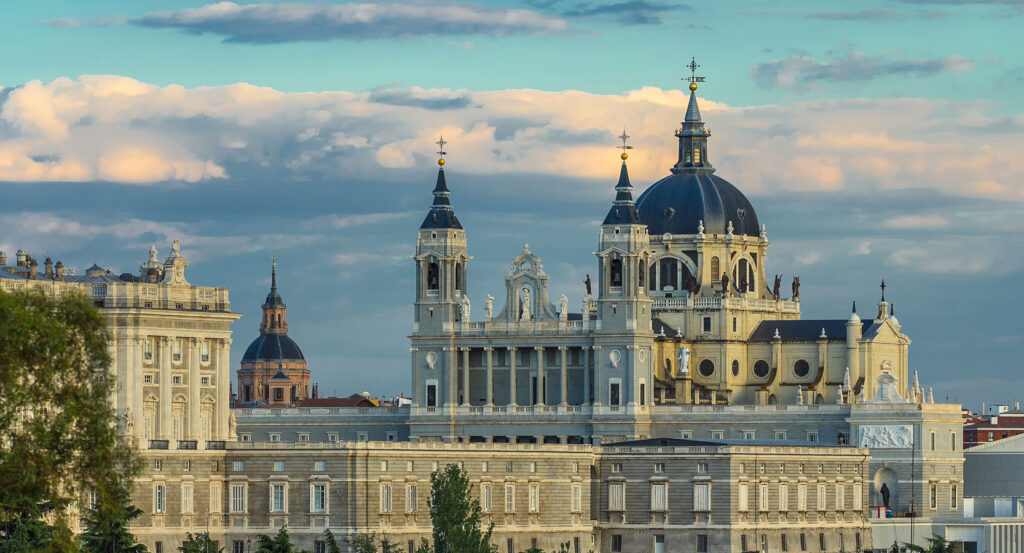
Why you should experience Catedral de Santa María la Real de la Almudena in Madrid, Spain.
Catedral de Santa María la Real de la Almudena, or Almudena Cathedral, rises over Madrid like a hymn in stone, a fusion of faith, resilience, and royal symbolism that defines Spain's capital.
Standing directly across from the Royal Palace, its neoclassical façade and twin bell towers command the city's historic heart, while its domed crown glows gold beneath the Castilian sun. But the Almudena isn't just a cathedral; it's a story of endurance. Madrid, unlike most European capitals, lacked a grand cathedral for centuries. Its spiritual life once revolved around smaller churches, leaving the capital of a Catholic empire without a sacred monument worthy of its stature. That changed in the late 19th century, when work began on this long-awaited masterpiece, a process that spanned more than a hundred years, marked by wars, political upheaval, and redesigns that mirrored Spain's own turbulent evolution. To stand before the Almudena is to witness a living chronicle of Madrid's faith and ambition. Step inside, and the cool hush of marble and incense greets you. Sunlight filters through modern stained glass, painting soft color across white stone columns. The atmosphere is at once regal and intimate, a space that honors both crown and congregation, past and present.
What you should know about Catedral de Santa María la Real de la Almudena.
Almudena's foundations tell a story as layered as Madrid itself, born of legend, shaped by politics, and consecrated by history.
Its name, “Almudena,” traces back to al-mudayna, the Arabic word for “citadel,” referencing the ancient Moorish fortress that once stood nearby. According to legend, when King Alfonso VI recaptured Madrid from Muslim rule in 1085, a hidden statue of the Virgin Mary was miraculously discovered within the old city walls, untouched for centuries. That statue became the spiritual heart of Madrid, and the inspiration for the cathedral that would one day bear her name. Yet construction didn't begin until 1883, under architect Francisco de Cubas, who envisioned a neo-Gothic church to complement the Royal Palace. Over time, the project evolved, neoclassical on the outside, neo-Gothic within, and crowned with a neo-Romanesque crypt, creating a rare architectural synthesis that mirrors Spain's cultural mosaic. Interrupted by the Spanish Civil War and only completed in 1993, the Almudena stands as both monument and metaphor, a structure that matured with the nation itself. That same year, Pope John Paul II consecrated the cathedral, the first in Spain to receive such an honor directly from a pontiff. Beneath its marble floors lies the crypt, among Madrid's best-kept secrets, an ethereal maze of Romanesque columns, flickering candles, and over 400 tombs belonging to noble families and city luminaries. The Almudena also houses a museum chronicling its creation, with royal wedding garments, architectural plans, and sacred relics that connect faith to artistry. And it remains deeply tied to Spanish monarchy: in 2004, King Felipe VI and Queen Letizia were married here, linking centuries of royal and religious tradition in a single ceremony that united modern Spain with its ancient heart.
How to fold Catedral de Santa María la Real de la Almudena into your trip.
Visiting Almudena Cathedral is as much a cultural experience as a spiritual one, a moment to see Madrid from both ground and sky.
Start at Plaza de la Armería, the grand square shared with the Royal Palace. From here, admire the cathedral's grand façade, perfectly aligned with the palace gates, an architectural discussion between crown and church that defines Madrid's skyline. Step through the bronze doors, which are adorned with scenes of the city's patron saints, and let your eyes adjust to the cool, glowing interior. The contrast between the traditional Gothic layout and the modern stained-glass palette is striking, blues, yellows, and golds illuminating sleek, pale stone. Walk slowly down the nave toward the high altar, where a modern mosaic of the Virgin of Almudena gleams in energetic tiles, her gaze serene yet commanding. Take time to explore the side chapels, each a blend of devotion and artistry, from intricate marble carvings to paintings of Madrid's saints and martyrs. Then descend into the crypt, a world away from the bright upper nave, where candlelight flickers against centuries-old tombs and the scent of wax and stone fills the air. When you reemerge, climb to the cathedral's dome for one of the most panoramic views in Madrid. The city stretches endlessly, terracotta rooftops, the gleaming dome of the Palace, and the Sierra de Guadarrama mountains in the distance. As you stand there, the hum of Madrid fades beneath you, replaced by the toll of bells echoing across centuries. For a seamless afternoon, pair your visit with a walk through the Sabatini Gardens or the Campo del Moro park below the Royal Palace, tranquil green escapes that frame the cathedral in every season. End your day at sunset, when the Almudena's façade glows soft and amber, the city bathed in quiet reverence. Catedral de Santa María la Real de la Almudena isn't just Madrid's cathedral, it's its soul in stone, a monument to faith, endurance, and the beauty born when time and devotion work hand in hand.
Where your story begins.
Foresyte Travel reveals places that feel extraordinary long before you arrive.
Experience premium editorial crafted for luxury travelers.














































































































