Why Yiribana Gallery matters.
Yiribana Gallery at Art Gallery of New South Wales in Sydney is a meeting place between worlds, where ancient voices speak through modern light and color to remind Australia who it truly is.
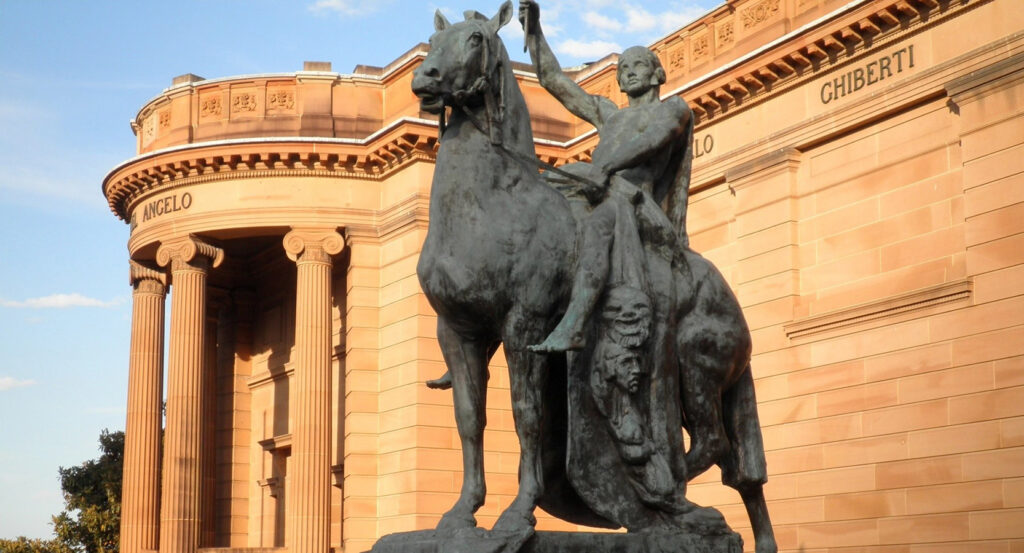
Located within Art Gallery of New South Wales, Yiribana Gallery holds one of the most powerful and moving collections of Indigenous art in the world. Yiribana” means “this way” in the language of the Eora people, an invitation that feels like both a direction and a calling. Step inside, and you are immediately enveloped by deep ochres, shimmering dots, woven textures, and painted rhythms that pulse with life and memory. The air feels sacred, thick with story and songline. Every piece, whether a desert canvas stretching across an entire wall, a carved ancestral figure, or a video installation reimagining Country through movement and sound, carries an unbroken lineage that stretches back more than 60,000 years. Unlike any other gallery in Australia, Yiribana does not merely display art; it captures a worldview, a philosophy of connection between land, people, and spirit. To stand in this space is to feel time bend, as if the continent itself is speaking directly through pigment and pattern, telling stories long silenced but never forgotten.
What defines Yiribana Gallery.
Yiribana Gallery represents one of the most significant institutional acknowledgments of Aboriginal and Torres Strait Islander art in modern Australian history.
When it first opened in 1994, it was the first major permanent gallery within a state art institution dedicated solely to Indigenous art, a revolutionary gesture that redefined the national narrative. In 2022, the gallery was relocated and reimagined as part of the Sydney Modern Project, giving Yiribana a new home within the Gallery's expansion, now larger, brighter, and positioned prominently at the heart of the museum. This relocation was symbolic: a long-overdue shift from the periphery of Australia character to its center. The collection spans works from across the continent, from Western Desert dot paintings that map sacred landscapes, to Yolŋu bark paintings that translate ancestral law into visual form, to contemporary expressions of resistance and renewal from urban Indigenous artists. Highlights include Emily Kame Kngwarreye's Big Yam Dreaming, a vast, monochrome meditation on the interconnectedness of all life; Lin Onus's Fish and Leaves, where humor and political insight coexist; and bark paintings from Arnhem Land whose patterns are prayers to the land itself. But Yiribana's importance extends beyond its walls: it has become a hub for community collaboration, education, and cultural dialogue. Many of the works are selected and curated in partnership with the artists and their communities, ensuring that each story is told on its own terms. The Gallery also serves as a research and preservation space for endangered techniques and visual languages, an act of cultural continuity as much as display. Few visitors realize that the gallery's design was guided by Indigenous architects and cultural advisors, using natural materials and soft lighting that echo the calm of Country. Even the layout resists the linear logic of Western museums; it moves in circles and crossings, reflecting the cyclical nature of Indigenous cosmology.
How Yiribana Gallery fits.
To experience Yiribana Gallery is to engage in quiet listening, not just to what hangs on the walls, but to what hums beneath them.
Begin your visit through the main atrium of the Art Gallery of New South Wales, then follow the gentle descent into the Sydney Modern wing, where glass and light open into the earth-toned embrace of Yiribana. The shift in energy is palpable. Move slowly through the space, there is no rush, no single direction to follow. Let your eyes trace the dots and lines, the ochres and whites, the woven grasses and sculpted forms that each carry their own geography. Pause before the expansive canvases that seem to breathe, or sit quietly before a bark painting and watch how its patterns begin to move as you adjust your gaze. Engage with the texts, but don't let them confine your experience, the deeper understanding comes not from explanation, but from attention. Consider visiting during one of the gallery's Art After Hours programs, when curators and artists give talks that bridge traditional stories with contemporary voices. For families, guided tours offer ways to introduce children to the idea of Country, that land is not owned, but lived with. Photographers will find the blend of light and texture a quiet marvel, especially in the late afternoon when sunlight filters through the glass facade. Allow an hour to absorb the space, and longer if you wish to pair your visit with the adjoining Australian art collection upstairs, where you can witness how Indigenous and colonial narratives intersect, diverge, and finally, converse. Before leaving, stand at the gallery's threshold and look outward toward the harbor, the same waters that once divided worlds and now, through art, bring them back together. Yiribana reminds you that this continent's oldest art is not ancient in spirit, it is eternal, still speaking, still creating, still guiding us this way.
Where your story begins.
Foresyte Travel reveals places that feel extraordinary long before you arrive.
Enjoy editorial crafted for luxury travelers.
Foresyte may earn a commission when you book.