Why Austrian Parliament matters.
Austrian Parliament is a marble tribute to democracy, wisdom, and the classical ideals that shaped modern Europe.
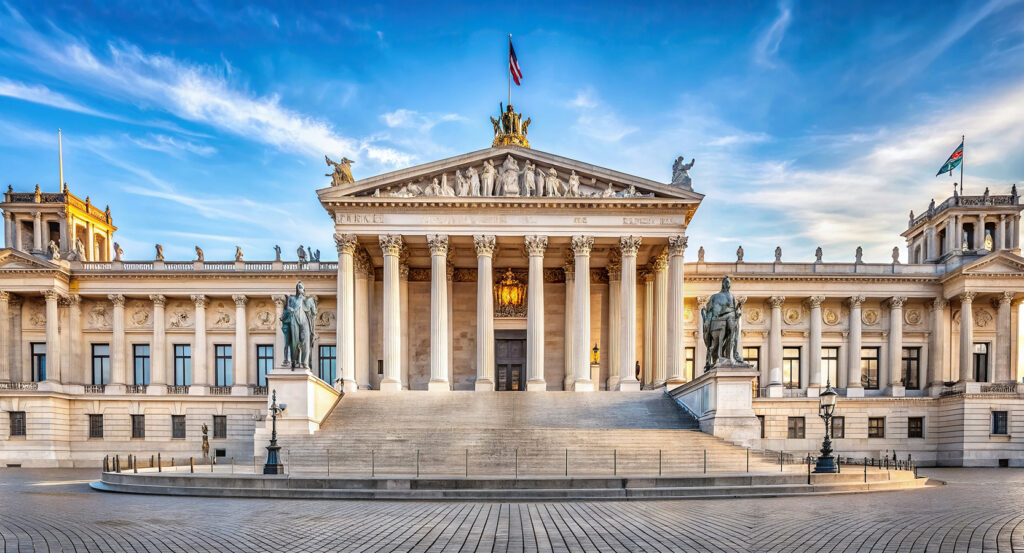
Rising regally along Vienna's Ringstrasse, this neoclassical masterpiece was designed by Theophil Hansen in the late 19th century, a time when the Austro-Hungarian Empire sought to project unity, intellect, and progress through architecture. Completed in 1883, the building was inspired by the temples of ancient Greece, the birthplace of democracy, and that lineage is immediately evident in its sweeping colonnades, Corinthian capitals, and expansive scale. At its center stands the iconic Pallas Athena Fountain, where the Greek goddess of wisdom and justice presides over the Austrian state, her gilded spear and helmet glinting beneath the Viennese sun. Behind her, a grand flight of marble steps leads to the main portico, where bronze chariots crown the roofline, and sculpted allegories of law and liberty guard the entrances. Step inside, and the grandeur continues: vast halls adorned with red marble, gilded ceilings, and statues of philosophers and statesmen who shaped the notion of governance. Every architectural line seems to say the same thing, that democracy is not chaos, but an art form, one that must be tended with balance, knowledge, and reverence. Even amid Vienna's architectural wealth, the Parliament stands apart, not for its opulence, but for its symbolism, reminding every visitor that power, when rooted in reason, can be beautiful.
What defines Austrian Parliament.
Beneath its classical poise lies a story of resilience, reform, and rebirth that mirrors Austria's own evolution through the ages.
When Theophil Hansen conceived the building, he envisioned it as a bridge between imperial authority and civic participation, a physical space where the people's voice could coexist with the grandeur of empire. To achieve that, he turned to Greek architectural principles, which embodied balance, logic, and proportion, the same virtues he believed should guide governance. The interior design followed suit, with halls named for reason and justice, and chambers bathed in natural light meant to symbolize transparency. But history tested those ideals. The Parliament was heavily damaged during World War II, its roof collapsed, and many of its sculptures shattered. In the postwar years, as Austria redefined itself as a modern republic, the building became a symbol of renewal. Painstakingly restored, it resumed its role as the home of the National Council and the Federal Council - Austria's bicameral legislature, and once again became the beating heart of the nation's democracy. The Pallas Athena Fountain, untouched by war, came to represent resilience itself: wisdom standing unbroken amid ruin. Inside, Hansen's architectural ingenuity still shines. The grand assembly hall, with its Corinthian columns and gilded rosettes, was modeled after an ancient Greek theater, designed so that every seat carries equal sightlines, a subtle metaphor for equality before the law. Meanwhile, the Hall of Pillars remains one of Vienna's architectural gems, a forest of marble and gold where the blend of light and shadow feels almost sacred. Recent renovations have equipped the Parliament with modern technology and energy-efficient systems, seamlessly integrated into its historic fabric. Yet despite these modern touches, the spirit of the building remains timeless, a fusion of art, politics, and philosophy that continues to define Austria's civic identity.
How Austrian Parliament fits.
Visiting Austrian Parliament offers more than an architectural encounter, it's an immersion into the living rhythm of Austrian democracy.
Begin your visit along Vienna's Ringstrasse, where the Parliament stands between the Hofburg Palace and the Volksgarten, framed by manicured gardens and classical monuments. The building's white marble exterior gleams especially bright in the morning light, while the Pallas Athena Fountain provides the perfect foreground for photography or quiet reflection. Guided tours, offered in multiple languages, take visitors through the main chambers, the Hall of Pillars, and the grand staircases that lead to the galleries overlooking parliamentary debates. The blend of solemn ceremony and everyday governance feels almost cinematic, the same corridors once walked by imperial ministers now echo with the voices of elected representatives. Don't miss the visitor center, Demokratikum, a recent addition designed to bring Austria's political system to life through interactive exhibits and historical artifacts. For those interested in architecture, the tour reveals fascinating details: Hansen's use of color to mimic ancient Greek aesthetics, the symbolic alignment of columns and statues, and the integration of natural light to foster openness. Step outside afterward and stroll through the neighboring Volksgarten, where blooming roses and distant bells from the Rathaus create an atmosphere of serenity. From the park, you can look back at the Parliament's symmetrical façade, its columns glowing in the late afternoon sun, and understand why it has become one of Vienna's most photographed landmarks. Visit again after dusk, when the façade is softly illuminated, and Athena's golden figure gleams like a star above the city, watching over the republic she so perfectly represents.
Where your story begins.
Foresyte Travel reveals places that feel extraordinary long before you arrive.
Enjoy editorial crafted for luxury travelers.
Foresyte may earn a commission when you book.