
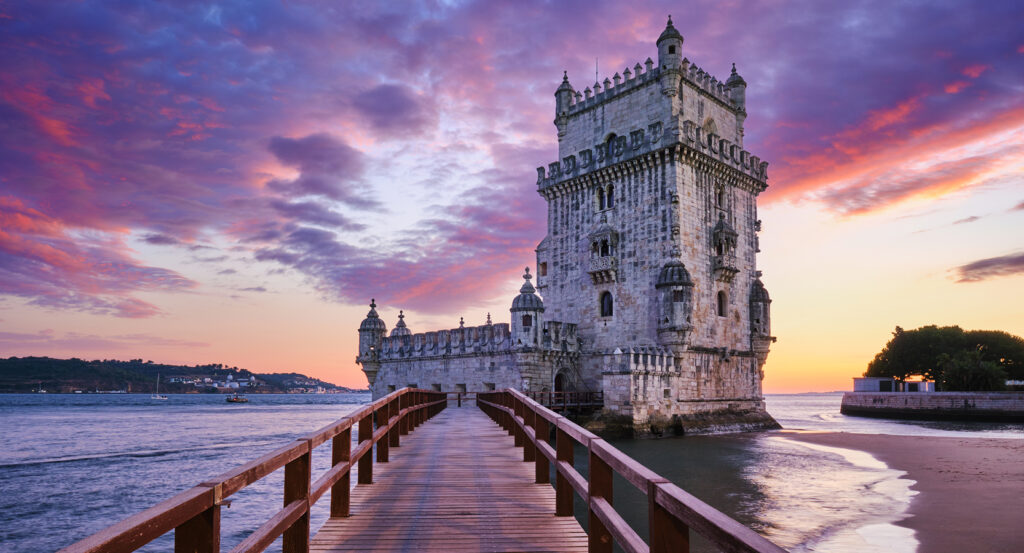
Why you should experience the Museum Exhibits of Belém Tower in Lisbon.
Within the walls of Belém Tower, history is not displayed, it's inhabited.
Each chamber, staircase, and archway becomes part of the exhibition, allowing visitors to move through Portugal's past as though they were stepping through time itself. What was once a fortress now serves as a living museum, its story told not through glass cases or placards, but through the silence of stone and the precision of light. Entering from the ramp that connects the tower to the riverbank, you descend into the cannon room, its vaulted ceiling heavy with centuries of salt air. The floor slopes gently toward the Tagus, designed to drain floodwater, an architectural whisper of the tower's defensive purpose. As you climb the narrow spiral staircase, the atmosphere shifts; the air grows warmer, drier, filled with sunlight filtered through arrow slits. Each level reveals a new layer of Lisbon's story: soldiers, governors, kings, and priests all occupied these same walls, leaving traces that still hum beneath your feet.
What you should know about the Museum Exhibits.
The interior of Belém Tower functions less as a traditional museum and more as a preserved anatomy of empire.
Each floor carries the residue of a different era. The lower battery, damp and echoing, once held cannons facing outward toward the river's mouth, now empty but still aligned with the same line of defense. The Governor's Hall above it retains its ribbed ceiling and arched windows, used today to display fragments of ornamentation and reliefs recovered from the tower's exterior. The King's Hall, directly above, opens to a vaulted loggia facing the water, a ceremonial space where royal envoys once blessed departing fleets. From its balcony, the sculpted ropes and armillary spheres of Portugal's maritime age are close enough to touch. Few realize that the tower's most symbolic carving, a small rhinoceros etched into the north façade, commemorates the first of its kind ever brought to Europe, a living emblem of the world Lisbon was beginning to discover. The upper levels reveal the human side of the structure: the chapel dedicated to Our Lady of Good Voyage, where sailors prayed before departure, and the watch chambers where guards once kept vigil through long nights over the river. These rooms are their own exhibits, textured, imperfect, and alive with history's fingerprints.
How to fold the Museum Exhibits into your trip.
Exploring the museum within Belém Tower is an experience best taken slowly, a vertical pilgrimage through Lisbon's memory.
Begin at the base, letting your eyes adjust to the dim light of the lower deck. The vaulted ceilings feel close, the air cool and mineral. Imagine the weight of cannon smoke once hanging here, the echo of waves striking the stone. Climb the spiral staircase carefully, its steps are narrow and uneven, polished smooth by centuries of passage. Pause at each landing; the acoustics shift subtly from chamber to chamber. In the Governor's Hall, stand beneath the high vaults and trace the carved motifs with your gaze, each line a metaphor for navigation and faith. As you ascend, the light grows softer, the stone warmer, until you emerge into open air at the roof terrace. From there, Lisbon stretches in all directions, bridge, river, and sea forming one vast compass. The tower's museum doesn't end here; it culminates in the view itself, where the present and the past dissolve together in wind and light.
Where your story begins.
Foresyte Travel reveals places that feel extraordinary long before you arrive.
Experience premium editorial crafted for luxury travelers.














































































































