Why Burnt Ends matters.
Burnt Ends is a wood-fired modern Australian barbecue restaurant where Dempsey Hill's former military estate meets Dave Pynt's open-fire cooking, custom-built ovens and a distinctive approach to transforming exceptional ingredients through embers, smoke and carefully controlled heat.
Set along Dempsey Road near Harding Road and a short drive from the Singapore Botanic Gardens, the restaurant occupies a converted low-rise building within the Dempsey dining enclave, surrounded by mature tropical trees, landscaped grounds and former military structures. Its industrial interior centers on an open kitchen equipped with substantial steel cooking apparatus. Counter seating faces the working hearth, placing diners directly opposite the chefs responsible for managing the fire. Exposed surfaces, dark finishes and closely arranged tables reinforce the restaurant's functional character. The result is a dining room whose physical organization makes the preparation of food over live fire the central event of the meal.
What defines Burnt Ends.
Burnt Ends is best known for chef-owner Dave Pynt's development of a modern barbecue restaurant built around custom-engineered wood-fired cooking equipment, a project that opened in Singapore's Chinatown district in 2013. Born in Perth, Western Australia, Pynt began his culinary career through professional training that introduced him to classical restaurant techniques and the demands of high-volume kitchens. His subsequent career took him to internationally influential restaurants, including Noma in Copenhagen, where René Redzepi's approach to ingredients and experimental cooking broadened his professional experience. He also worked at Asador Etxebarri in Spain's Basque Country, studying the fire-centered cooking of chef Victor Arguinzoniz. That apprenticeship proved consequential for his understanding of how different temperatures, fuel conditions and distances from the heat source affect the preparation of meat, seafood and vegetables. Pynt subsequently developed a barbecue project in London, operating a temporary restaurant known as Burnt Enz at the Climpson's Arch site in Hackney. The London operation brought together open-fire cooking, informal service and a changing menu built around ingredients suited to direct heat. Its reception encouraged the development of a permanent establishment in Singapore, where Pynt partnered with restaurateur André Chiang and other investors to establish Burnt Ends on Teck Lim Road. The restaurant opened with an unusually large custom-built oven and a cooking system designed to accommodate several temperature zones. Its early menu emphasized substantial cuts of meat, seafood, vegetables and small preparations cooked over wood, establishing a recognizable approach to contemporary barbecue within Singapore's restaurant industry. International recognition followed through appearances on Asia's 50 Best Restaurants list, bringing wider attention to Pynt's cooking and the restaurant's distinctive equipment. MICHELIN awarded Burnt Ends its first star in the 2018 Singapore guide, strengthening its reputation among the country's leading restaurants. The restaurant subsequently appeared on The World's 50 Best Restaurants list, extending its international standing beyond Southeast Asia. In 2021, Burnt Ends relocated to Dempsey Hill, occupying a larger property that accommodated expanded cooking facilities and additional dining spaces. The new establishment incorporated a bakery, extending the business into bread, pastries and other preparations connected with the restaurant's wider culinary operation. Pynt's expansion also included Burnt Ends Hospitality Group ventures, developing additional concepts associated with his approach to food and service. The restaurant's development established a sustained relationship between Australian barbecue traditions, Basque open-fire techniques and Singapore's international fine-dining industry.
How Burnt Ends fits.
Burnt Ends works as the culinary centerpiece for a Singapore itinerary connecting the preservation of tropical landscapes, the architectural heritage of colonial-era estates and the cultural institutions associated with the city's development as a regional center for art and history.
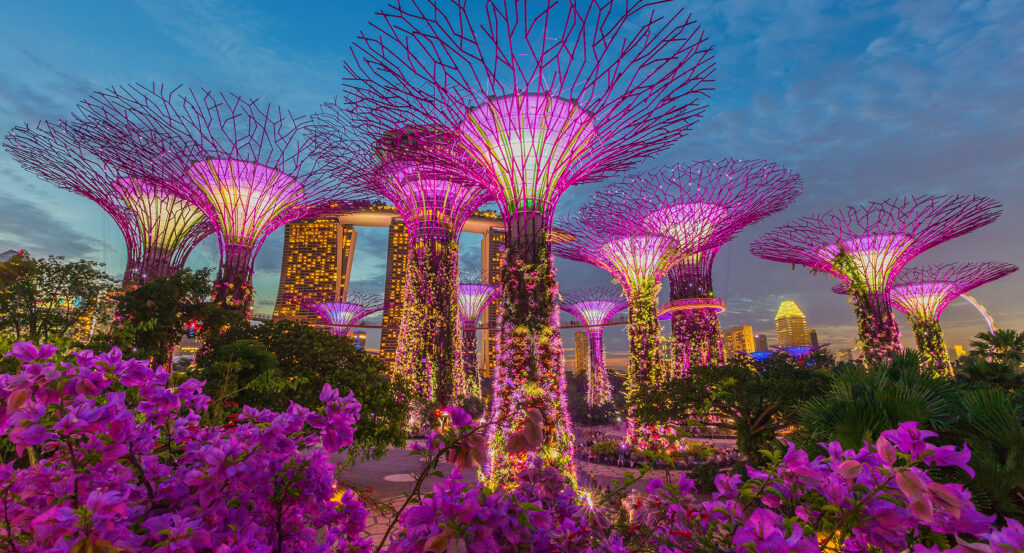
Begin at Singapore Botanic Gardens, the historic tropical garden established in 1859 and inscribed on the UNESCO World Heritage List in 2015. The gardens developed through the work of botanists and horticulturalists who advanced the scientific cultivation of tropical plants, including research that contributed to the expansion of rubber production across Southeast Asia. Its grounds contain extensive collections of palms, ginger plants and tropical trees, organized around landscaped lawns and water features. The National Orchid Garden maintains an important collection of cultivated orchids, including hybrids named in honor of visiting dignitaries. The gardens preserve the relationship between scientific research, colonial agricultural development and public recreation within Singapore's urban landscape. Continue to Museum of Ice Cream Singapore, situated within a converted colonial-era building in the Dempsey area. The attraction introduces a sequence of themed rooms organized around the history, preparation and cultural associations of ice cream. Its installations incorporate large-scale sculptural objects, brightly colored environments and interactive activities designed around familiar frozen desserts. The museum's Singapore location opened in 2021, becoming the brand's first international outpost following its establishment in the United States. Its placement within the former military estate connects contemporary recreational development with the adaptive reuse of historic structures. Conclude at National Museum of Singapore, the country's oldest museum institution, whose origins extend to the nineteenth-century Raffles Library and Museum. Its principal building opened in 1887, incorporating a neoclassical façade and a prominent central dome. The museum's collections and exhibitions examine Singapore's political, social and cultural development through artifacts, photographs and historical installations. An extensive redevelopment completed in 2006 introduced contemporary exhibition facilities while preserving the historic building's principal architectural features. Its permanent galleries trace the city's development through colonial administration, wartime occupation, independence and subsequent national growth. The progression moves from the scientific cultivation of tropical landscapes through the adaptation of colonial-era buildings and culminates in the historical collections documenting Singapore's development into a modern city-state.
Where your story begins.
Foresyte Travel reveals places that feel extraordinary long before you arrive.
Enjoy editorial crafted for luxury travelers.