
Why Largo do Carmo matters.
Carmo Square is where Lisbon exhales, a quiet, sunlit plateau suspended above the city's chaos.
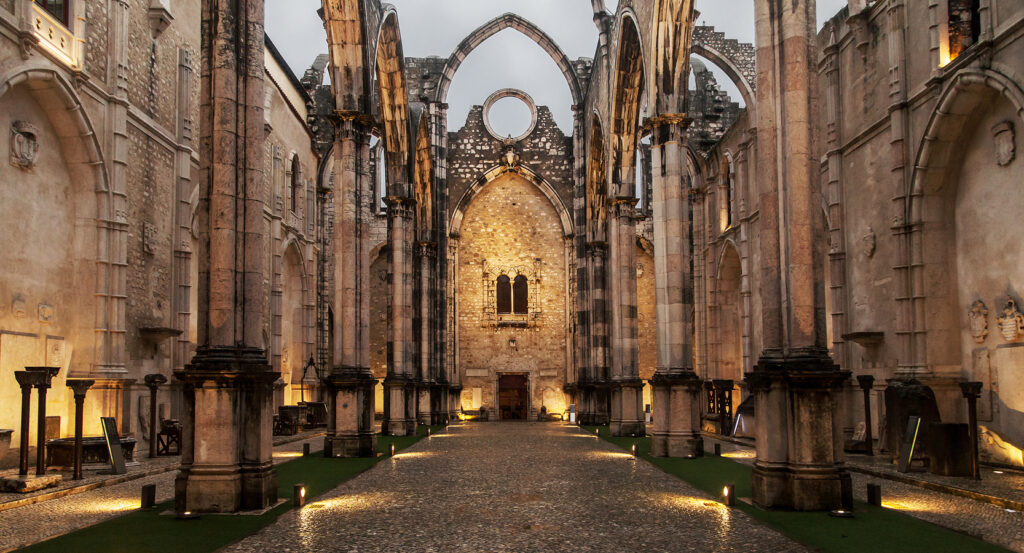
Framed by jacaranda trees, the elegant façades of 18th-century buildings, and the skeletal arches of the Carmo Convent Ruins, it feels like a pause in time. The space is modest in scale but immense in feeling: the hum of distant trams, the scent of coffee from the nearby cafés, the faint toll of church bells carried by the breeze. You can sense Lisbon's layers here, its sorrow, its survival, its rhythm of renewal. The square sits at the intersection of history and everyday life: tourists resting on stone benches, locals chatting in the shade, pigeons tracing circles in the air. Above it all, the ruins rise like a crown of memory, silent but ever-present. Carmo Square is not just a meeting point; it's a threshold, between eras, between revolutions, between the city Lisbon was and the one it continues to become.
What defines Largo do Carmo.
Carmo Square, or Largo do Carmo, is one of Lisbon's most symbolically charged spaces.
While today it radiates serenity, its cobblestones once echoed with gunfire and the chants of freedom. On April 25, 1974, this square became the final stage of the Carnation Revolution, the peaceful uprising that ended decades of dictatorship in Portugal. Here, inside the headquarters of the National Guard stationed beside the convent, Prime Minister Marcelo Caetano surrendered to rebel forces led by General António de Spínola. Crowds filled the square, carnations in their rifles, tears in their eyes. The moment was broadcast live across the nation, and Carmo Square became forever engraved in Portuguese memory as the cradle of democracy. Long before that, it served as a tranquil aristocratic plaza, a vantage point overlooking Baixa that escaped much of the 1755 earthquake's destruction. Its classical buildings, especially the former police barracks, still bear architectural traces from the Pombaline reconstruction period. Few realize that beneath the cobblestones lie remnants of earlier urban layouts, preserved layers of medieval Lisbon sealed beneath modern life.
How Largo do Carmo fits.
Begin your visit from the Santa Justa Lift, whose upper walkway opens directly onto the square, offering your first panoramic view of the ruins and rooftops.
Step into the square and pause, there's something grounding about its proportions, its openness, its balance of shade and light. Sit for a coffee at Café Lisboa, tucked into the old Guard Barracks, and watch the rhythm of Lisbon flow past. Then walk toward the convent's entrance and trace your fingers along the old stone walls that bore witness to revolution and rebirth. Visit late afternoon, when the sun softens and the jacaranda petals scatter across the cobblestones like confetti. Musicians often play quietly in the corner, their songs drifting through the air with a kind of melancholy hope that feels uniquely Portuguese. When night falls, the square glows under warm lamplight, the arches of the convent silhouetted against the stars. Carmo Square isn't just a plaza, it's a memory you can walk through, a still moment in the restless heart of Lisbon where the past continues to breathe.
Where your story begins.
Foresyte Travel reveals places that feel extraordinary long before you arrive.
Enjoy editorial crafted for luxury travelers.
Foresyte may earn a commission when you book.














































































































