
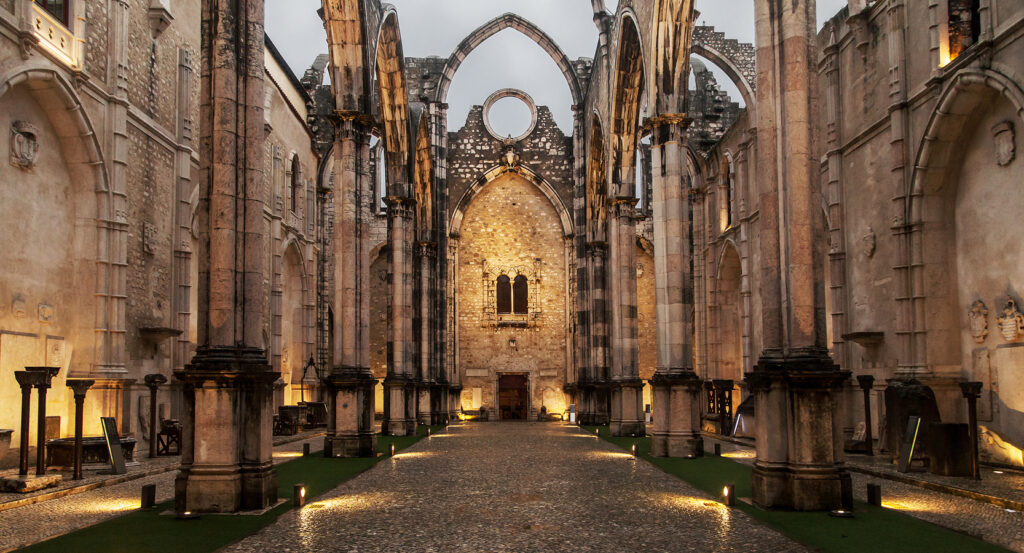
Why you should experience Carmo Archaeological Museum in Lisbon, Portugal.
The Carmo Convent Ruins are Lisbon's most hauntingly beautiful reminder of both destruction and endurance, a Gothic skeleton open to the sky, whispering of faith, fire, and rebirth.
Perched on the hill of Chiado, the former Carmo Convent (Convento da Ordem do Carmo) stands as one of Portugal's most striking architectural relics, a church without a roof yet full of spirit. Built in 1389 under the patronage of Nuno Álvares Pereira, a national hero and general, the convent was once the grandest example of Gothic architecture in Lisbon. Its soaring arches, pointed vaults, and ornate windows once rivaled any cathedral in Europe, until the fateful morning of November 1, 1755, when a massive earthquake and ensuing fire reduced much of the city to rubble. The convent's roof collapsed, its nave shattered, and its cloisters turned to ash. But instead of erasing the structure from the city's story, the ruins became a living monument, a place that refuses to forget. Walking through the open-air nave today, sunlight pours through where the vaulted ceiling once stood, illuminating the delicate tracery of stone that still frames the sky. The effect is spiritual, cinematic, as if heaven itself has become the church's new roof. In the midst of Lisbon's modern hum, the Carmo Ruins are a portal to the city's soul, where faith and fragility coexist in sublime silence.
What you should know about Carmo Archaeological Museum.
The story of the Carmo Convent is one of resilience, reinvention, and reverence, a symbol of Lisbon's ability to rise from its own ashes.
When the earthquake struck in 1755, it devastated nearly every major religious structure in the city. While others were rebuilt, the Carmo Convent was left in partial ruin, intentionally preserved as a reminder of the catastrophe that reshaped Lisbon's identity. In the decades that followed, the site evolved into something more profound: not merely a ruin, but a tribute to human endurance. The Gothic arches that remain intact are architectural marvels, balanced so delicately that they seem to float above the broken nave. Inside, visitors will find the Carmo Archaeological Museum (Museu Arqueológico do Carmo), founded in 1864 by the Portuguese Association of Archaeologists. It houses an extraordinary collection spanning millennia, from pre-Roman artifacts and medieval tombs to azulejos (hand-painted tiles), statues, and even South American mummies that bear witness to Lisbon's role in global exploration. These relics, framed by the broken ribs of Gothic stone, create a surreal contrast between the sacred and the historical, the eternal and the ephemeral. The museum's layout intentionally preserves the ruins' atmosphere, dim light, cool stone, and the echo of footsteps, allowing each artifact to speak softly against the weight of time. Even the convent's surviving apse and rose windows still carry the elegance of their medieval craftsmanship, serving as a reminder that beauty can survive catastrophe. In many ways, Carmo represents Lisbon itself: scarred, but still singing.
How to fold Carmo Archaeological Museum into your trip.
To visit the Carmo Convent Ruins is to step into Lisbon's open-air cathedral of memory, a space where architecture, history, and emotion converge.
The ruins sit atop the Chiado district, directly above the bustle of Rossio Square and the Baixa. You can reach them easily by foot, tram, or by taking the Elevador de Santa Justa, the elegant iron lift that connects Downtown Lisbon to the upper levels of the city, its viewing platform opens directly onto the convent grounds. Begin your visit by entering the nave, where the pointed arches rise like ribs against the blue Portuguese sky. Let the silence wash over you; despite being roofless, the space still feels consecrated. Each arch frames a different view, of clouds, of pigeons circling, of the Atlantic light that defines Lisbon's magic. Inside the adjoining museum, take your time exploring its eclectic collection. Marvel at the Roman mosaics, medieval sarcophagi, and Gothic tombstones carved with intricate heraldry. Pause before the eerie yet fascinating South American mummies, rare finds that connect Lisbon's age of exploration to distant worlds. Don't miss the fragments of tiles and sculptures salvaged from other buildings lost to the earthquake; here, every broken piece finds new purpose. If you step outside again, the courtyard offers sweeping views over the city, terracotta rooftops cascading toward the river, the hum of trams below, the distant glimmer of the Tagus. Plan the visit in the late afternoon, when the sun casts golden light through the arches, transforming the ruins into a living canvas of shadow and stone. Evening concerts and cultural events are occasionally held here, when the site fills once more with music, reviving the sound that once echoed through its aisles centuries ago. The Carmo Convent Ruins are not a place of loss, but of transformation. To stand here is to feel Lisbon's heartbeat, ancient, wounded, and im alive.
Where your story begins.
Foresyte Travel reveals places that feel extraordinary long before you arrive.
Experience premium editorial crafted for luxury travelers.














































































































