Why you should experience the Castle Ramparts Viewpoint at Castelo de São Jorge in Lisbon.
The ramparts of São Jorge are Lisbon's open-air cathedral, a place where the city and the sky blur into one unbroken horizon.
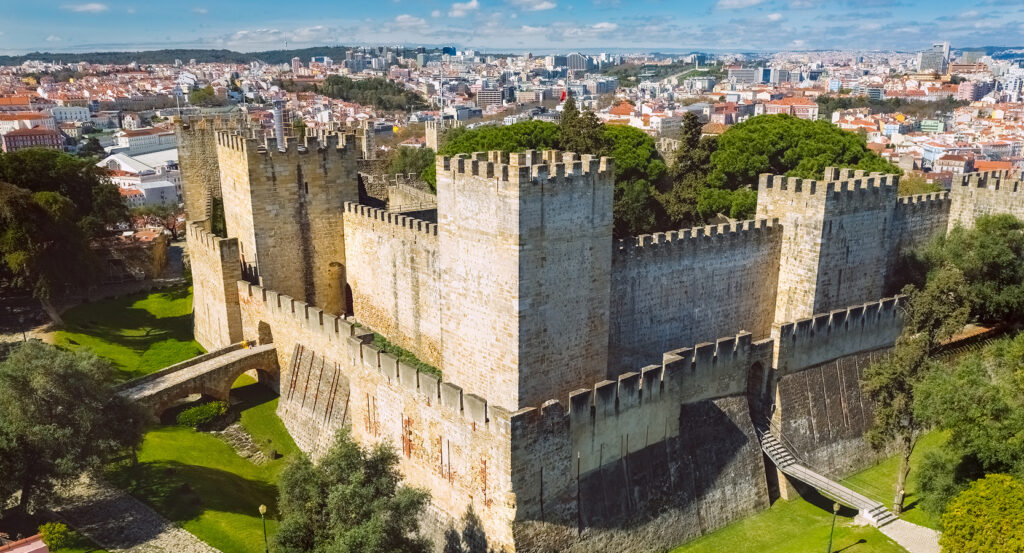
Climb the worn stone steps and the noise of the streets falls away. Suddenly, all that remains is wind and light. From the ramparts, Lisbon stretches in every direction: the terracotta roofs of Alfama tumbling downhill, the white dome of the Pantheon catching the sun, and the Tagus shimmering like a vein of silver cutting through the city. The view feels eternal, unchanged, unhurried, almost mythic. You can trace the evolution of Lisbon from up here: medieval alleys, baroque churches, tiled façades glowing in the late-afternoon light. The air smells faintly of dust and salt, and when the wind moves through the pines below, it carries the same whisper that has circled these walls for nearly a thousand years. To stand on the ramparts is to understand why Lisbon endures, not through power, but through perspective.
What you didn't know about the Castle Ramparts Viewpoint.
The ramparts you walk today are descendants of fortifications that have guarded Lisbon since the 11th century.
Built originally by the Moors and later reinforced by Christian kings, they were never purely military, they were strategic vantage points for reading the city, its people, and the sea beyond. The ramparts trace the outline of the fortress in a jagged ring, connecting eleven surviving towers. Each section offers a distinct rhythm of view: the north walls frame the city's hills; the western bastions open toward the river and bridge; and the southern wall, the highest of all, gives the illusion of floating above the Tagus. Their construction reveals the pragmatic genius of medieval defense, thick limestone walls fused with volcanic rock, layered with parapets and merlons for archers. Yet there's poetry in the engineering: narrow slits doubling as sightlines, angles designed not just for protection but for beauty. Few visitors realize that the positioning of the southern rampart aligns directly with the course of the sun at equinox, when day and night divide the city in perfect balance. At that moment, Lisbon glows evenly from river to ridge, the entire skyline caught in the same breath of light. The ramparts are more than ruins; they are instruments of time, built to measure the city's endurance.
How to fold the Castle Ramparts Viewpoint into your trip.
Visiting the ramparts is one of Lisbon's simplest, purest experiences, a slow walk above history.
Enter the castle grounds through the main gate and head straight toward the central courtyard. From there, stone stairways lead upward in several directions, follow the one that hugs the outer wall. The climb is brief but steep, the steps uneven and warm from centuries of feet. Once on top, walk the entire perimeter if possible. Each turn of the wall offers a new revelation, from the white sails on the Tagus to the tiled roofs clustered like coral below. Bring no agenda other than stillness. Visit in the late afternoon, when the sun begins to lean westward and Lisbon glows gold against the river's blue. Sit along the parapet and feel the wind move through your hair, the same wind that once carried the sound of bells, the scent of gunpowder, and the distant echo of empire. As the light fades, the city begins to shimmer; the bridge flickers to life, and the castle's silhouette sharpens against the cobalt sky. When you finally descend, you'll carry with you the same calm the Moors, kings, and soldiers must have known, the realization that from this height, everything makes sense.
Where your story begins.
Start your planning journey with Foresyte Travel.
Experience immersive stories crafted for luxury travelers.