
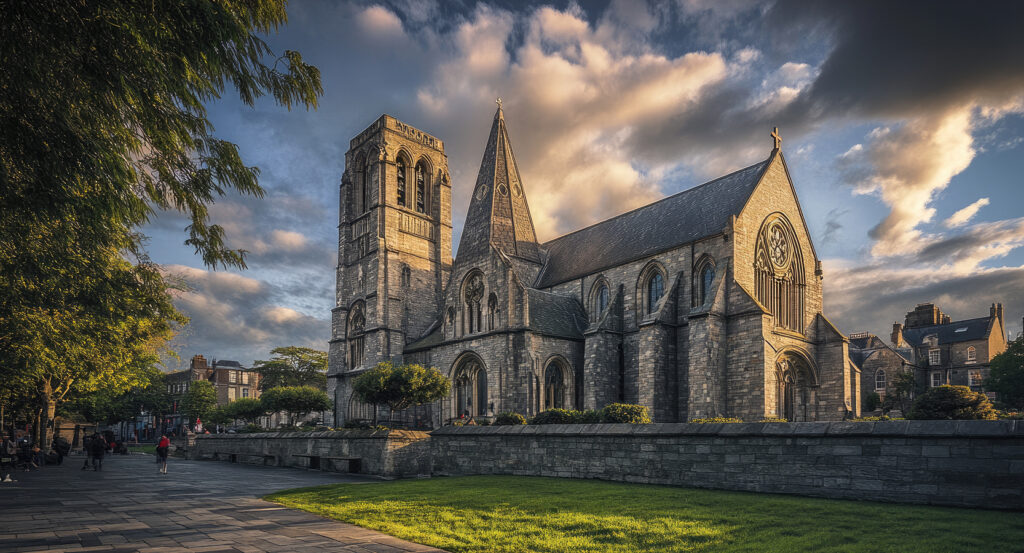
Why Christ Church Cathedral matters.
Christ Church Cathedral is the beating heart of Dublin's thousand-year story, where faith, architecture, and legend intertwine beneath vaulted stone and candlelight.
Perched on a gentle rise above the River Liffey, its grey façade commands both reverence and awe, a monument that has watched the city evolve from Viking stronghold to modern capital. Step inside, and the noise of Dublin fades into a sacred hush. Light filters through medieval stained glass, illuminating soaring Gothic arches and intricate stone carvings that have stood since the 12th century. The scent of ancient wood and polished brass hangs in the air as soft footsteps echo through the nave. Christ Church is both grand and deeply personal, a place where time folds inward, where the same hymns that once stirred Norman knights now drift gently across centuries. Founded 1030 by the Viking king Sitric Silkenbeard, the cathedral was later rebuilt by the Anglo-Normans and expanded under English rule, becoming the ecclesiastical anchor of Ireland's capital. Its mix of Romanesque solidity and Gothic grace captures the layered soul of Dublin itself: resilient, elegant, and ever-evolving. And yet, despite its expansive history, there's a warmth here, a sense of continuity, of humanity persisting quietly through the ages. Whether you come for prayer, history, or stillness, Christ Church holds space for all of it, wrapping each visitor in the echo of something eternal.
What defines Christ Church Cathedral.
Behind its solemn façade lies a story as complex and enduring as Ireland's own, among conquest, collapse, rediscovery, and faith reborn.
Originally built as a wooden Norse church, Christ Church was reimagined in stone by the Normans in the 12th century under Archbishop Laurence O'Toole, Dublin's patron saint. It quickly became the seat of both religious and political power, serving as the cathedral of the Archbishop of Dublin and the center of the city's medieval life. Beneath its floors lies one of the largest crypts in Britain or Ireland, a vast, candlelit chamber dating to the 1100s, where artifacts, relics, and even mummified curiosities are preserved. Among them are the famed “Cat and Rat,” two naturally mummified animals discovered within the cathedral's organ pipes, now resting behind glass like a strange parable of eternity. For centuries, Christ Church stood as the spiritual counterpart to St. Patrick's Cathedral, sometimes rivals, sometimes allies, in shaping Ireland's religious landscape. Its connection to England's monarchy runs deep: in 1541, Henry VIII's reformation turned it into an Anglican cathedral, and his son Edward VI commissioned an English Bible for its pulpit. Yet even through turbulent centuries, rebellion, famine, and independence, Christ Church remained a gathering place for Dubliners of all faiths and none. The cathedral has hosted coronations, royal visits, and even film productions (most famously The Tudors), each layering new chapters atop its ancient foundation. Few realize that the choir school here, among the oldest in Europe, first performed Handel's Messiah in 1742, a piece that has since circled the world. Every stone, every arch, every note sung within its walls carries echoes of that long continuum, a living discussion between past and present.
How Christ Church Cathedral fits.
To truly experience Christ Church Cathedral, let it unfold slowly, not as a checklist stop, but as a meditation through history and grace.
Begin by approaching it from Dublin's medieval quarter, where narrow lanes wind upward from the river. As you reach the forecourt, pause beneath the stone bridge that links the cathedral to the adjacent Synod Hall, now home to the Dublinia museum, and imagine the pilgrims who once crossed that same arch centuries ago. Inside, take your time with the details: the mosaic floors that shimmer beneath the pews, the carved misericords tucked beneath the choir stalls, the sunlight that pools in the chancel like liquid gold. Follow the spiral staircase down to the crypt, a cool, echoing world of history and mystery. Here, ancient manuscripts and silver chalices sit beside curious relics, each one whispering of lives long passed but not forgotten. If you visit at midday, linger for the choral prayer; the voices of the choir rise in perfect harmony beneath the stone dome, filling the space with a sound that feels otherworldly. When you emerge, step outside into the garden behind the cathedral for sweeping views across Dublin's skyline, a reminder of how this one church has witnessed the city's every transformation. Nearby cafés and pubs offer a chance to reflect with a pint or a pastry in hand, the cathedral's bells still tolling softly in the background. And if you're lucky enough to visit in December, attend the annual Christmas carol service, an experience so pure and resonant that even locals describe it as transcendent. Christ Church Cathedral isn't merely Dublin's oldest building, it's its conscience. Within its stone walls, the story of Ireland's faith, struggle, and endurance plays out like a living hymn. To stand in its nave is to feel history breathing, a gentle, eternal rhythm that reminds you that time itself is sacred, and that even in a changing world, some sanctuaries never lose their light.
Where your story begins.
Foresyte Travel reveals places that feel extraordinary long before you arrive.
Enjoy editorial crafted for luxury travelers.
Foresyte may earn a commission when you book.














































































































