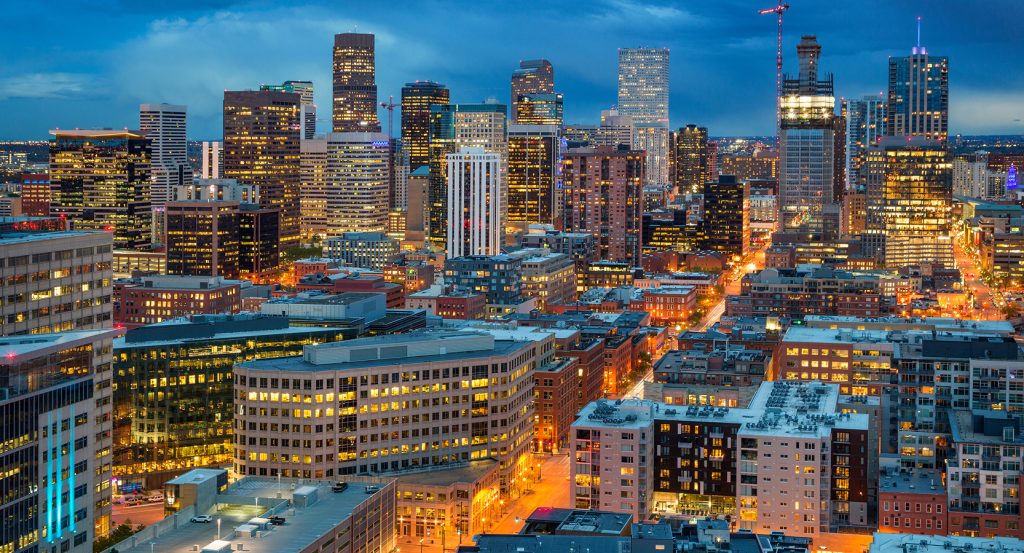
Why Coors Field matters.
Coors Field is a storied Major League Baseball stadium where Lower Downtown's railroad heritage meets the architectural traditions of American ballparks, the sporting history of the Colorado Rockies and the transformation of Denver's former warehouse district into a major entertainment destination.
Set along Blake Street near 20th Street and just steps from McGregor Square, the ballpark occupies a prominent position along the northern edge of Downtown, where historic brick warehouses, former railroad properties and contemporary entertainment developments establish the surrounding urban landscape. A red-brick exterior, exposed structural steel, arched openings and asymmetrical grandstands connect the stadium's architecture with the industrial character of the surrounding neighborhood. The playing field sits beneath expansive seating decks, with the Rocky Mountains visible beyond the outfield from selected sections and a distinctive row of purple seats marking the elevation of one mile above sea level. Rooftop gathering areas, concession stands, public concourses and the stadium's surrounding pedestrian streets support the atmosphere of Major League Baseball within one of Denver's most historically significant commercial districts. The result is a ballpark defined by its distinctive high-altitude playing conditions, historically inspired architecture and central role in the development of Denver's professional sports culture.
What defines Coors Field.
Coors Field is best known as the home of the Colorado Rockies, the Major League Baseball franchise whose arrival established Denver as a National League city and introduced professional baseball at the highest level to Colorado's Front Range. The Rockies were awarded an expansion franchise in 1991, joining the National League alongside the Florida Marlins as part of Major League Baseball's expansion into new metropolitan markets. Denver's pursuit of a franchise followed decades of professional baseball activity, including the Denver Bears and Denver Zephyrs, whose minor league operations established an extensive local sporting tradition. The Rockies began play in 1993 at Mile High Stadium, sharing the large multipurpose facility associated with the Denver Broncos. Their inaugural season attracted extraordinary attendance, demonstrating the substantial regional demand for Major League Baseball and strengthening support for a purpose-built stadium. The Colorado Baseball Stadium District was established to oversee the development of a permanent home for the franchise, with public financing supported through a regional sales tax. The stadium site was selected within Lower Downtown, a former commercial and warehouse district whose historic buildings and transportation infrastructure had become central to Denver's emerging preservation and redevelopment efforts. HOK Sport, subsequently known as Populous, designed the ballpark through an architectural approach that incorporated traditional baseball proportions and materials associated with the surrounding industrial landscape. Construction began in 1992, introducing a major civic development intended to connect professional sports with the revitalization of Denver's central neighborhoods. Coors Field opened on April 26, 1995, with the Rockies defeating the New York Mets in an extra-inning game that established the stadium's inaugural sporting milestone. Its opening contributed substantially to the commercial redevelopment of Lower Downtown, encouraging investment in restaurants, hospitality businesses and residential properties near the stadium. The Rockies reached the postseason in 1995, becoming one of the fastest expansion franchises to qualify for Major League Baseball's playoffs. The stadium subsequently hosted the 1998 Major League Baseball All-Star Game, bringing the league's premier midseason exhibition to Denver. The Rockies advanced to the World Series in 2007, establishing the franchise's first National League championship following a dramatic late-season run. Coors Field hosted another All-Star Game in 2021, reinforcing its position among the country's principal Major League Baseball venues. Its historical significance rests on the establishment of permanent major league baseball infrastructure in Colorado and the stadium's substantial influence on the commercial and cultural redevelopment of Downtown.
Denver's elevation establishes one of the most consequential environmental characteristics of Coors Field, influencing the movement of baseballs, the design of the playing surface and the strategic decisions associated with games played at the stadium. The ballpark stands at an elevation exceeding 5,200 feet above sea level, where reduced atmospheric density changes the aerodynamic forces acting on a baseball in flight. Lower air resistance allows batted balls to travel greater distances, contributing to the stadium's longstanding reputation for high-scoring games and substantial offensive production. The reduced density of the air also affects the movement of pitched baseballs, altering the behavior of breaking pitches and complicating the technical demands placed on pitchers. These environmental conditions influenced the ballpark's original dimensions, with an unusually expansive outfield designed to accommodate the greater distances achieved by batted balls. The playing field incorporates deep power alleys and a substantial center-field distance, creating an extensive defensive landscape for outfielders. The large outfield contributes to the frequency of extra-base hits, connecting the stadium's architectural configuration with its distinctive statistical characteristics. The Rockies introduced a baseball humidor in 2002, storing game balls under controlled temperature and humidity conditions to address the effects of Colorado's dry climate on their physical properties. The system became an important technical feature of the stadium's operations, influencing discussions concerning equipment preparation and competitive conditions throughout Major League Baseball. The ballpark's architectural character incorporates a traditional brick exterior designed to complement the historic commercial buildings of Lower Downtown. Arched windows, exposed steel elements and carefully proportioned masonry surfaces establish a visual connection with the surrounding warehouse district. The stadium's asymmetrical seating arrangement responds to the configuration of the site and the surrounding urban streets, producing a distinctive relationship between the grandstands and the downtown landscape. A row of purple seats encircles the upper deck at the precise elevation of 5,280 feet, marking Denver's celebrated mile-high geography within the spectator environment. The Rooftop, an entertainment area introduced in 2014, transformed a portion of the upper right-field seating deck into a social gathering space incorporating bars, standing areas and extensive views across the stadium. Its development contributed to the evolution of contemporary ballpark hospitality, creating additional opportunities for social activity within the stadium environment. Coors Field's distinctive importance emerges from the relationship between its high-altitude playing environment, historically inspired architecture and sustained contribution to the sporting and commercial culture of Denver.
How Coors Field fits.
Coors Field works as the sporting centerpiece for a Lower Downtown itinerary connecting Denver's professional baseball heritage with the historic transportation infrastructure, preserved commercial architecture and contemporary public spaces that shaped the neighborhood's redevelopment.
Begin at McGregor Square, the mixed-use development occupying the block immediately southwest of Coors Field. Its contemporary architecture incorporates restaurants, hospitality businesses, residential spaces and an extensive outdoor plaza organized around a substantial digital screen. The development was created through a partnership involving the Colorado Rockies, establishing a complementary entertainment district closely associated with the ballpark's operations. The complex's name honors former Rockies president Keli McGregor, whose leadership contributed substantially to the franchise's institutional development. Continue to Union Station, the historic railroad terminal located southwest of the stadium within Lower Downtown. The Beaux-Arts station building opened in 1914, establishing a major transportation gateway connecting Denver with regional and transcontinental railroad networks. Its expansive central hall incorporates large windows, historic architectural details and a carefully restored interior accommodating restaurants and public gathering spaces. A substantial redevelopment completed in 2014 transformed the surrounding district into an integrated transportation center serving commuter rail, regional buses and pedestrian connections. The station's preservation contributed to the revitalization of Lower Downtown, connecting the neighborhood's railroad heritage with contemporary residential and commercial development. Conclude at Dairy Block, the historic commercial district occupying a collection of restored buildings along Wazee Street near the stadium. The development incorporates former industrial and commercial properties associated with Denver's early twentieth-century food production and distribution economy. Its principal historic structure belonged to the Windsor Dairy operation, connecting the property with the city's commercial food history. Restaurants, bars, specialty retailers and hospitality businesses occupy the adapted buildings, with a pedestrian alley establishing a concentrated public gathering environment. The redevelopment preserves substantial elements of the district's historic brick architecture, connecting contemporary dining and entertainment with the industrial character of Lower Downtown. The progression moves from the ballpark's contemporary entertainment district through Denver's historic railroad gateway and culminates in the preserved commercial buildings that establish the architectural character of the surrounding neighborhood.
Where your story begins.
Foresyte Travel reveals places that feel extraordinary long before you arrive.
Enjoy editorial crafted for luxury travelers.
Foresyte may earn a commission when you book.