Why Denver International Airport matters.
Denver International Airport is among the world's most ambitious aviation hubs where Denver International Airport's engineering innovation, expansive public art, global connectivity, and architectural vision create one of America's most recognizable transportation landmarks.
Set along Peña Boulevard 25 miles northeast of Downtown near the Westin Denver International Airport and just steps from the University of Colorado A Line station, this immense aviation complex combines an internationally acclaimed tensile-fabric terminal, expansive public art installations, expansive concourses, and one of the largest airport campuses in the world. Its soaring white roofline, dramatic mountain-inspired architecture, light-filled interiors, and exceptional scale establish an unmistakable gateway to the Rocky Mountain West. Every arrival reflects the airport's remarkable blend of engineering, design, and public art. The result is an airport defined by architectural distinction, operational excellence, and one of the world's most recognizable aviation facilities.
What defines Denver International Airport.
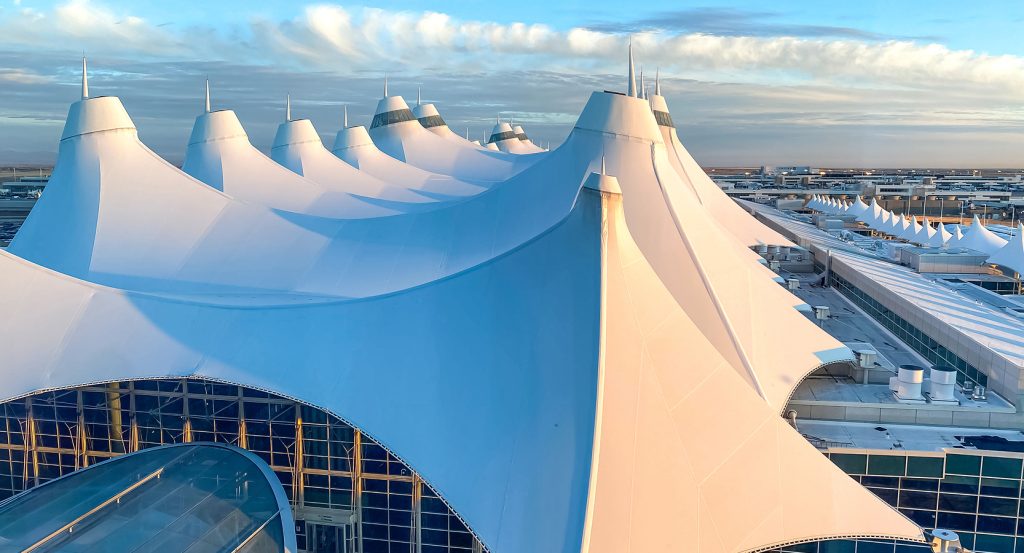
Denver International Airport is best known for opening on 28 February 1995 following one of the largest infrastructure projects in United States history, replacing Stapleton International Airport with a purpose-built aviation hub designed to accommodate long-term growth across the Rocky Mountain region. Covering 33,531 acres (52.4 square miles), the airport is the largest airport by land area in North America and the second largest in the world, providing extraordinary capacity for future expansion. The iconic Jeppesen Terminal, designed by Curtis W. Fentress of Fentress Architects, features a tensile-fabric roof inspired by the snow-capped peaks of the Rocky Mountains and the teepees of the Great Plains, becoming one of the most recognizable airport terminals ever constructed. Denver International Airport operates six runways, including Runway 16R/34L, which extends 16,000 feet (4,877 meters) and remains the longest public-use runway in North America, allowing unrestricted operations by fully loaded long-haul aircraft in Denver's high-altitude environment. The airport serves as a major hub for United Airlines, Southwest Airlines, and Frontier Airlines, connecting hundreds of destinations while consistently ranking among the world's busiest airports by passenger traffic. Beyond aviation, the airport has become internationally known for its extensive public art collection, including Blue Mustang, murals, sculptures, rotating exhibitions, and one of the largest airport public art programs in the United States. Continuing multibillion-dollar expansion projects, including the Great Hall Program and additional concourse development, reinforce Denver International Airport's position as one of the world's leading aviation gateways while preparing the facility for sustained passenger growth throughout the coming decades.
The architectural composition integrates expansive tensile structures, expansive daylight-filled interiors, advanced passenger circulation, automated train systems, and highly adaptable aviation infrastructure into one of the most efficient airport environments in North America. The Jeppesen Terminal's flowing roof structure, generous public spaces, integrated art program, and intuitive wayfinding establish a distinctive character while supporting the operational demands of a major international hub. Continuous investment in terminal modernization, sustainability initiatives, airfield expansion, and passenger amenities reinforces the airport's role as both an engineering landmark and one of the world's premier transportation facilities. Every element demonstrates how architecture, aviation engineering, public art, and long-range infrastructure planning combine to create one of the most influential airports of the modern era.
How Denver International Airport fits.
Denver International Airport works as the gateway to an exploration of Denver's cultural and architectural highlights.
Begin at the Westin Denver International Airport, where the airport's striking contemporary architecture introduces the scale and ambition of the aviation campus before continuing to Denver International Airport. Continue to The Art Collection at Denver International Airport, whose celebrated permanent installations naturally deepen the exploration of the airport's internationally recognized public art program. Conclude at Union Station, where Denver's historic transportation hub provides a memorable finale celebrating the city's remarkable evolution from railroad crossroads to one of North America's leading transportation centers. The progression moves naturally from contemporary aviation architecture to world-class public art before concluding through one of Denver's defining historic landmarks, revealing why Denver International Airport remains among the world's most remarkable airport destinations.
Where your story begins.
Foresyte Travel reveals places that feel extraordinary long before you arrive.
Enjoy editorial crafted for luxury travelers.
Foresyte may earn a commission when you book.