Why you should experience Foucault Pendulum in Paris, France.
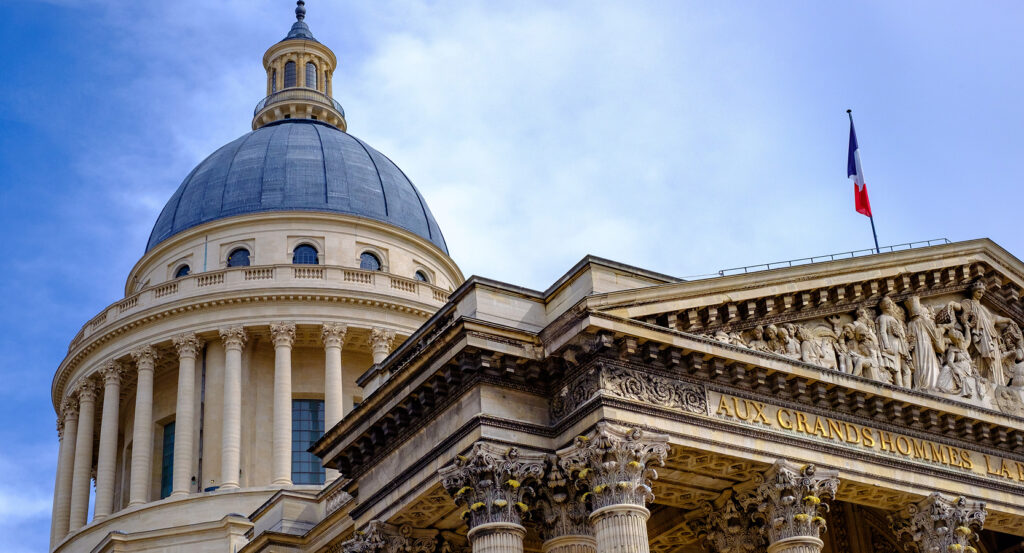
Foucault Pendulum at Panthéon in Paris is one of those rare experiences that makes you feel the earth's motion, not metaphorically, but literally.
Suspended from the Panthéon's dome by a slender cable, the pendulum traces a slow, hypnotic circle over a polished marble floor, its brass bob gliding silently through space. It swings in a steady rhythm, a universal heartbeat that proves, with breathtaking simplicity, that our planet spins beneath our feet. To stand beneath it is to witness proof of a cosmic truth rendered visible by nothing more than gravity, time, and elegance. Conceived by physicist Léon Foucault in 1851, the experiment transformed the Panthéon from a mere monument to an observatory of the universe. The pendulum is not just science, it's performance art, its motion a visual poem about movement, certainty, and awe. Watching it feels like slipping into the flow of eternity, as if every oscillation carries within it the whisper of centuries, a reminder that all human ambition unfolds against the steady rhythm of the cosmos.
What you didn't know about Foucault Pendulum.
What's less known is how Foucault's experiment became a philosophical emblem, a fusion of science, art, and existential wonder.
The pendulum was first demonstrated not at the Panthéon, but at the Paris Observatory, where Foucault sought a tangible way to prove Earth's rotation, something no telescope could capture. His idea was both radical and poetic: let the world's motion reveal itself through stillness. When Napoleon III later authorized its installation in the Panthéon, it symbolized a national reconciliation between reason and faith, the cathedral of intellect hosting a silent testament to the laws of nature. The pendulum's movement isn't driven by machinery or magnetism but by Earth itself, an invisible choreography between gravity and momentum. Even now, few realize that the plane of its swing appears to rotate only because the planet is turning beneath it. It's an illusion that reveals the truth, and that paradox, that beauty born of simplicity, has made the pendulum one of Paris's most quietly profound attractions.
How to fold Foucault Pendulum into your trip.
To fold Foucault Pendulum into your Paris journey, treat it as a moment of stillness amid the city's grandeur.
Visit in the late morning, when sunlight pours through the Panthéon's windows and dances across the polished brass sphere, illuminating each arc of its path. Stand beneath the dome and watch as time slows, it's a rare sensation, the humbling recognition that everything moves, even when we don't. Combine your visit with a stop at the nearby Rue Mouffetard market, a vibrant counterpoint to the pendulum's serenity, life in all its motion and color playing out above ground while the quiet evidence of Earth's rotation swings below. Or, linger longer in the Latin Quarter's cobblestoned calm, reflecting on the idea that the universe's grandest truths often reveal themselves not in thunder or spectacle, but in a single, perfect motion, constant, silent, undeniable.
Where your story begins.
Start your planning journey with Foresyte Travel.
Experience immersive stories crafted for luxury travelers.