Why Fort Fremont matters.
Fort Fremont is a formidable coastal fortification where St. Helena Island's maritime character meets the disappearing-gun technology, concrete batteries and harbor-defense strategy that reshaped American coastal warfare during the Spanish-American War era.
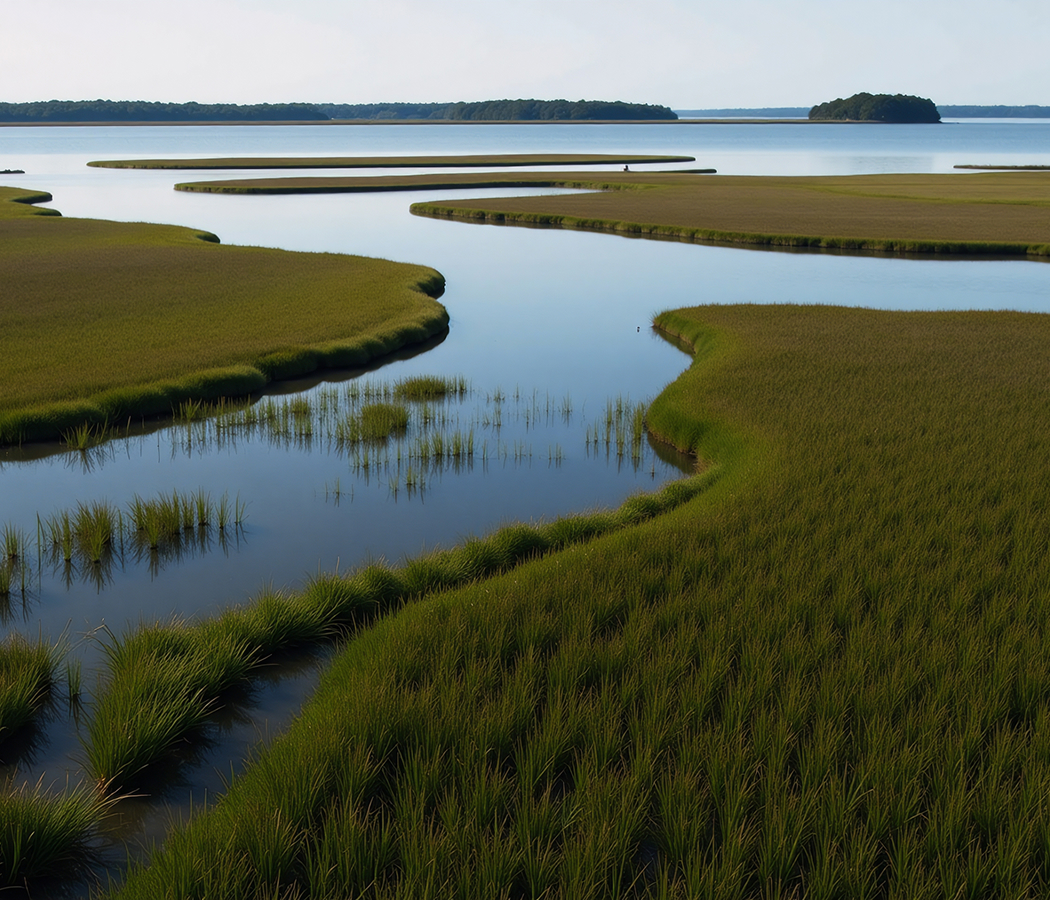
Set along the southwestern shore of St. Helena Island near Land's End Road and just inland from Port Royal Sound, the fort occupies a wooded coastal tract facing the broad water approaches between the Sea Islands and the protected harbor beyond. Concrete gun positions rise from a low maritime landscape where defensive works were embedded behind earthworks facing the sound. Battery platforms, ammunition rooms and surviving structural openings make the military geometry legible across the preserve. Live oaks and coastal vegetation now occupy ground once filled by barracks, workshops, officers' quarters and support buildings. The result is a compact military landscape where massive concrete defenses remain physically connected to the waterway they were built to protect.
What defines Fort Fremont.
Fort Fremont is best known for preserving one of the few substantially intact American coastal-defense installations created during the Spanish-American War era. The U.S. Army Corps of Engineers built the fort in 1899 as part of the defenses protecting Port Royal Sound, whose naval dry dock and coaling station gave the harbor strategic importance to the Atlantic Fleet. The post took its name from John C. Frémont, the explorer, military officer and 1856 Republican presidential nominee. Its military reservation eventually covered 170 acres and supported a community of up to 110 personnel through barracks, officers' quarters, a hospital, stable, mess hall, bakery, commissary, post exchange and engineering buildings. Battery Jesup carried three 10-inch breech-loading rifles on disappearing carriages, placing heavy artillery behind concrete parapets overlooking the sound. Battery Fornance supplemented those weapons with two 4.7-inch rapid-fire guns designed to defend the controlled minefield against smaller vessels. Army organization at the post changed repeatedly, passing through Battery K of the 2nd Artillery and successive Coast Artillery companies during the first decade of the twentieth century. Federal retrenchment brought the installation out of commission in 1912, ending its brief active life before the artillery itself disappeared. Two of Battery Jesup's 10-inch guns were sent to France in 1918 during World War I, the third went to Sandy Hook Proving Ground, and Battery Fornance's weapons departed for Aberdeen Proving Ground in 1920. Federal ownership ended with the property's sale into private hands in 1921, leaving the concrete batteries as the principal survivors of a military installation built during the United States' rapid turn toward overseas naval power.
Battery Jesup reveals the engineering logic behind the fort with unusual clarity. Each 10-inch rifle fired a projectile weighing between 510 and 617 pounds to a maximum range of eight miles, with a firing rate of one round per minute. A large lead counterweight beneath each emplacement raised the gun above the parapet after crews received azimuth and elevation instructions from the fire-control system. Recoil drove the weapon backward and downward after firing, simultaneously lifting the counterweight and returning the gun behind concrete protection for reloading. Battery Fornance answered a different threat through pedestal-mounted 4.7-inch guns firing directly over their parapet at rates reaching six rounds per minute and ranges reaching 6.3 miles. Their 45-pound projectiles were intended for smaller craft attempting to interfere with the harbor minefield. Electrical generation, running water, telephone communication, searchlights and fire-control equipment placed the artillery within a larger technical system extending beyond the visible gun positions. The fort's controlled underwater mines were maintained by specialized Army vessels, including mine planters built to deploy and service explosive defenses across navigable channels. Fort Fremont preserves the physical architecture of an era when American harbor defense combined concealed heavy artillery, rapid-fire weapons, electrical communication and underwater explosives into a coordinated coastal-defense system.
How Fort Fremont fits.
Fort Fremont works as the anchor for a St. Helena Island outing connecting one of the South's earliest schools for formerly enslaved people, an eighteenth-century tabby church ruin and a surviving Gullah Geechee worship tradition rooted in the island's freed communities.
Begin at Penn Center, whose institutional history started in 1862 when northern missionaries opened a school for formerly enslaved people during the Union occupation of the Sea Islands. Eighty pupils attended the first classes at Brick Church, and the school purchased land from freedman Hastings Gantt in 1864 before completing a three-room school building the following year. Penn School later expanded from formal education into community health, agricultural support and social programs, becoming Penn Center after its school function ended in 1948. During the 1960s, Martin Luther King Jr. and Southern Christian Leadership Conference members used the campus as a retreat during planning connected with the March on Washington and the Poor People's Campaign. Continue to Chapel of Ease, built 1740 for Anglican planters whose distance from Beaufort made regular attendance at the parish church difficult. Tabby construction bound oyster shell, lime, sand and water into the surviving walls, preserving a building technique closely associated with the coastal Southeast. Population growth elevated the chapel to parish-church status in 1812, and northern missionaries used the building after Union occupation began during the Civil War. A forest fire destroyed the church in February 1886, leaving its walls and adjacent cemetery as the surviving complex. Conclude at Coffin Point Praise House, part of the small-building worship tradition developed among Gullah Geechee communities across the Sea Islands after emancipation. Praise houses supported religious gatherings, prayer meetings and community life at a scale distinct from larger churches, preserving practices whose roots extended through plantation-era African American worship into freed communities. Their endurance on St. Helena Island places intimate religious architecture within the same landscape where formerly enslaved families acquired land, established institutions and sustained Gullah Geechee cultural practices after the Civil War. The progression moves from emancipation-era education through colonial religious architecture transformed during wartime occupation and culminates in a Gullah Geechee worship form sustained within the island communities created after slavery.
Where your story begins.
Foresyte Travel reveals places that feel extraordinary long before you arrive.
Enjoy editorial crafted for luxury travelers.
Foresyte may earn a commission when you book.