
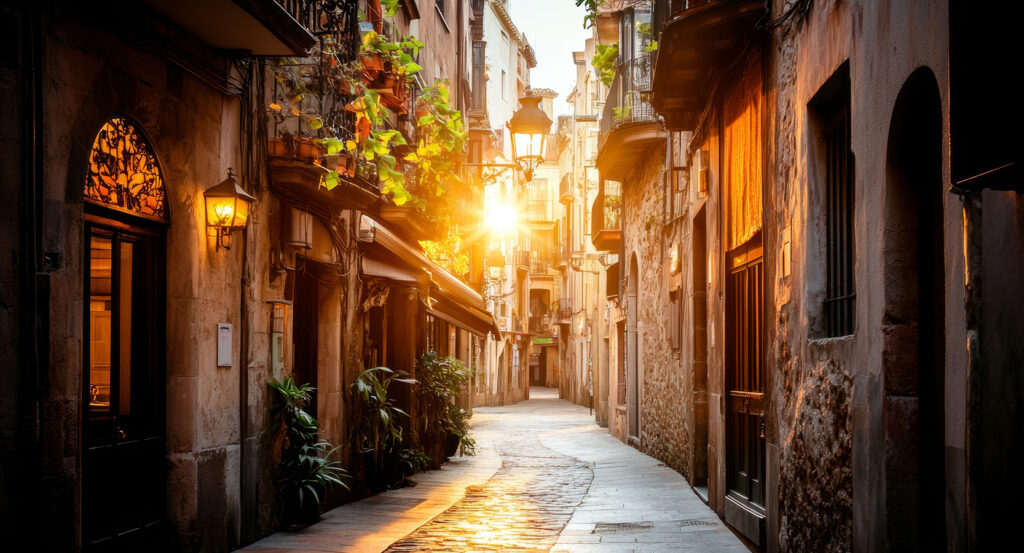
Why Plaça Sant Jaume matters.
Plaça Sant Jaume is where the pulse of Barcelona has beat for over two thousand years, a square that has witnessed empires, revolutions, and rebirths.
Situated at the heart of the Gothic Quarter, it serves as the symbolic and political center of the city, where ancient Roman ruins once marked the intersection of the colony's main roads. Today, that same crossroads hosts two facing giants: the Palau de la Generalitat, home to the Catalan government, and the City Hall of Barcelona. Their neoclassical façades frame a space where the past and present converge, where medieval arches meet modern banners, and where the city gathers to celebrate victories, protest injustices, or simply watch the world go by. The atmosphere here is dignified yet alive, a place that commands attention. Walking into Plaça Sant Jaume feels like stepping into the city's collective heartbeat, steady and unbroken through centuries of change.
What defines Plaça Sant Jaume.
The story of Plaça Sant Jaume begins long before Barcelona became the city we know today.
In Roman times, it was the site of the Forum of Barcino, the administrative and religious center of the colony. Archaeological remnants of that ancient plaza still lie beneath the modern one, a silent foundation to its enduring civic role. The square takes its name from a church once dedicated to Saint James (Sant Jaume), which stood here until the 19th century, when urban reform reshaped the Gothic Quarter's medieval fabric. Both the Palau de la Generalitat and City Hall evolved over centuries, Gothic roots hidden behind Renaissance and neoclassical façades, mirroring the layered character of Barcelona itself. The square has been the stage for countless defining moments: the proclamation of the Catalan Republic, speeches of solidarity, and festivals like La Mercè, when castellers (human towers) rise toward the sky in feats of unity and grace. Even the paving stones feel historic, polished smooth by the feet of generations who have come here to bear witness.
How Plaça Sant Jaume fits.
Plaça Sant Jaume isn't a place to rush through, it's a place to inhabit.
Start the visit in the morning, when sunlight pours into the square and the city's administrative buildings glow in warm tones of stone and stucco. Step close to the façades to appreciate their details: the sculpted coats of arms, the grand arches, and the subtle symmetry that ties both sides of the square together. On weekdays, you might glimpse official motorcades or journalists awaiting a statement, reminders that this is not a relic but a living seat of power. Return at night, when the crowds thin and the square hums with quiet electricity, its façades illuminated like twin beacons of heritage. From here, wander down Carrer del Bisbe and its neo-Gothic bridge, or toward Carrer Ferran's lively cafés and tapas bars. Plaça Sant Jaume is more than a landmark, it's the enduring stage upon which Barcelona's story continues to unfold, day after day, century after century.
Where your story begins.
Foresyte Travel reveals places that feel extraordinary long before you arrive.
Enjoy editorial crafted for luxury travelers.
Foresyte may earn a commission when you book.














































































































