Why you should experience Archibald Memorial Fountain in Sydney, Australia.
Archibald Memorial Fountain, or Archibald Fountain, is the lyrical centerpiece of Hyde Park, Sydney, a symphony of water, bronze, and mythology that captures the spirit of Sydney in motion.
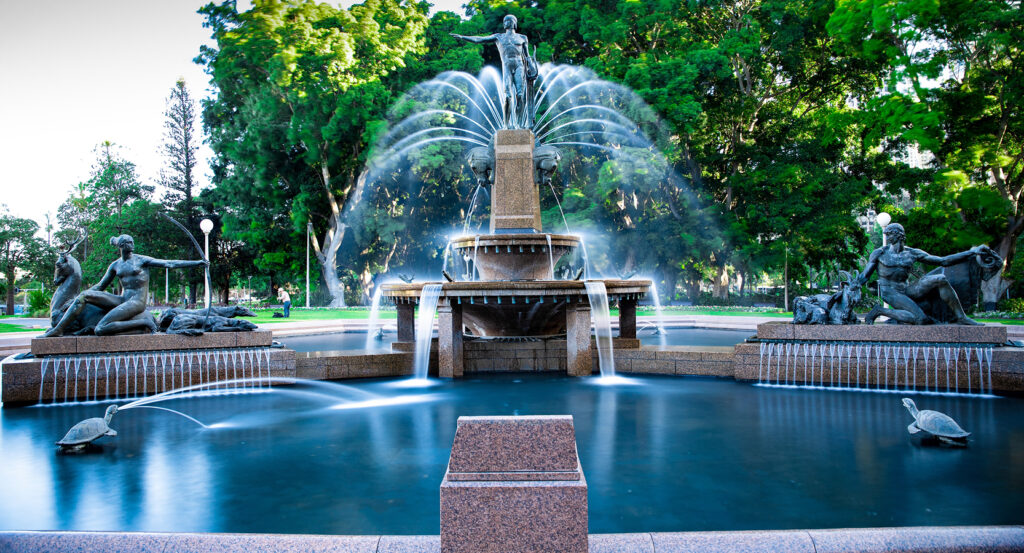
Framed by the cathedral spires to the east and the grand fig-lined promenade to the south, this Art Deco masterpiece radiates harmony and vitality. Jets of water arc gracefully around the central figure of Apollo, god of light and music, whose outstretched hand seems to summon both sunlight and song into the air. Designed in 1932 by French sculptor François-Léon Sicard, the fountain celebrates Franco-Australian friendship forged during World War I, yet its imagery transcends its commemorative origins. The blend of classical figures, Apollo, Diana, Theseus, and the Minotaur, transforms the square into a living allegory of strength, beauty, and renewal. By day, the fountain dazzles with movement and light; by night, it glows beneath soft illumination, its reflections rippling like gold across the pool. To stand before it is to witness the park's soul, poised, rhythmic, and eternal, an oasis where myth and modernity flow together.
What you should know about Archibald Memorial Fountain.
Though it is one of Sydney's most photographed landmarks, Archibald Memorial Fountain conceals an extraordinary web of artistic and symbolic meaning.
The fountain was commissioned by journalist and philanthropist J.F. Archibald, who left a bequest in his will to fund “a monument designed by a French artist to commemorate the association of Australia and France in the Great War.” His vision was as cultural as it was political, to link Sydney's character with the grace and intellect of European art. Sicard's winning design, completed in Paris and shipped piece by piece to Australia, combined mythological storytelling with allegorical depth. Apollo represents the arts, light, and civilization, forces that triumph over chaos. Diana, poised with her bow, symbolizes purity and nature; Theseus and the Minotaur embody courage and the eternal struggle between reason and barbarism. Beneath the surface, dolphins, tortoises, and horses spout jets of water, evoking the four elements, air, water, fire, and earth, uniting in balance. Every curve and gesture was meticulously calculated: Sicard studied the orientation of the Sydney sun to ensure the bronze would gleam at certain hours, and the basin's circular geometry mirrors the harmony between man and nature. The surrounding pavers were later added in patterns inspired by ancient mosaics, while the cascading water was tuned to produce a continuous, musical rhythm. Even the fountain's placement in the northern end of Hyde Park was deliberate, aligned on an axis that draws the eye southward to the ANZAC War Memorial, symbolically linking heroism and harmony. Over the decades, Archibald Memorial Fountain has witnessed countless public moments, from protests and parades to wedding photos and New Year's celebrations, becoming less a monument and more a heartbeat of the city. Restoration efforts in the late 20th century replaced the aging bronze nozzles and polished the marble basin, preserving its brilliance. Few realize that the fountain's mechanics, hidden underground, still use a gravity-fed circulation system modeled after early 20th-century French hydraulics, a tribute to its enduring craftsmanship.
How to fold Archibald Memorial Fountain into your trip.
Archibald Memorial Fountain is not just a landmark to see, it's a moment to feel, and the best way to experience it is to let yourself linger within its rhythm.
Enter Hyde Park from the Macquarie Street side, where the fountain immediately commands your attention amid the greenery. Visit midmorning when sunlight strikes the bronze figures at a low angle, or at twilight when the glow of St. Mary's Cathedral creates a dreamlike backdrop. Stand close enough to feel the mist on your skin and listen, the sound of cascading water seems to mute the world beyond the park. Circle the fountain slowly, pausing to take in each sculpture from multiple angles: Apollo's commanding gaze, Diana's poised elegance, Theseus' heroic strength. Notice how the city moves around it, businesspeople crossing paths with tourists, couples framed by the fountain's spray, children throwing coins into the pool as though it were enchanted. For photographers, golden hour offers a perfect reflection of cathedral light across the rippling surface, while nightfall transforms the space into a stage of soft illumination and shadow. Take 20-30 minutes to simply observe; the fountain rewards patience with subtleties you'll miss in a rush, the rhythm of droplets, the geometry of the jets, the way the figures seem to breathe as the light shifts. When you're ready to move on, follow the fig-lined avenue toward the ANZAC Memorial to complete the symbolic axis of Hyde Park, from light to remembrance. Or, grab a seat on the nearby benches and let the fountain's cadence wash through you, an unspoken reminder that even in a city built on ambition and speed, beauty and balance still flow quietly at its core.
Where your story begins.
Foresyte Travel reveals places that feel extraordinary long before you arrive.
Experience premium editorial crafted for luxury travelers.