
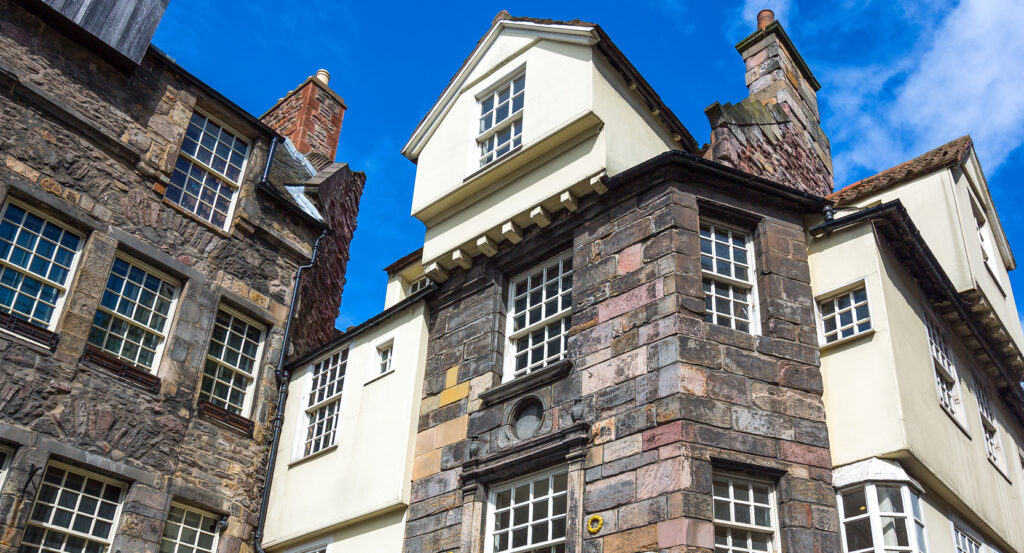
Why you should experience John Knox House in Edinburgh, Scotland.
John Knox House is a meticulously preserved historic house where Old Town's medieval streets, Reformation heritage, architectural craftsmanship, and centuries of Scottish civic life survive within one of Edinburgh's oldest buildings.
Set along the Royal Mile near St. Mary's Street and just steps from Canongate Tolbooth, this timber-framed residence reveals richly carved ceilings, painted interiors, narrow staircases, and centuries-old chambers where merchants, reformers, craftsmen, and civic leaders shaped the story of medieval and Renaissance Edinburgh. Intricately detailed oak beams, projecting upper stories, and weathered stone masonry preserve the atmosphere of the historic burgh while every room reflects the social, religious, and political transformation of sixteenth-century Scotland. Layers of architecture and history remain woven into every corner of the house.
What you should know about John Knox House.
John Knox House is best known as one of Edinburgh's oldest surviving medieval residences, with its oldest surviving fabric dating to 1470 and later expanded during the sixteenth century, preserving exceptional examples of Scottish burgh architecture while becoming closely associated with Protestant Reformation leader John Knox, who is traditionally believed to have lived in the house during the final months of his life in 1572, although definitive documentary evidence remains inconclusive. The building became the home of wealthy goldsmith and jeweler James Mossman during the mid-sixteenth century, whose work for Mary, Queen of Scots included crafting the Scottish Crown Jewels before his execution in 1573 following the Marian Civil War. Elaborately painted timber ceilings, hand-carved oak paneling, original fireplaces, crow-stepped gables, and projecting timber galleries demonstrate the craftsmanship characteristic of prosperous Edinburgh merchant houses during the late medieval and Renaissance periods. Extensive conservation undertaken during the nineteenth and twentieth centuries preserved the structure as surrounding sections of the Royal Mile underwent significant urban redevelopment, ensuring the survival of one of the capital's finest domestic historic buildings. Today the house is operated by the Scottish Storytelling Centre in partnership with the Church of Scotland, presenting exhibitions exploring the Scottish Reformation, John Knox's influence, Edinburgh's urban development, and the lives of the merchants, artisans, and religious figures connected with the property. Situated within Edinburgh's UNESCO World Heritage Site, the house continues supporting historical research, education, and architectural conservation while offering rare insight into everyday life inside one of Scotland's best-preserved medieval homes.
Centuries-old timber construction, carefully conserved interiors, original decorative details, and thoughtfully interpreted exhibition spaces reveal how domestic architecture reflected the wealth, beliefs, and ambitions of Edinburgh's merchant class. Historic rooms, carved inscriptions, painted ceilings, and surviving household features illuminate the political upheaval of the Reformation alongside the rhythms of ordinary urban life within Scotland's medieval capital. Continuing conservation, scholarly interpretation, and public education ensure the building remains an invaluable record of Edinburgh's architectural and religious history. Medieval craftsmanship, historic preservation, and cultural memory combine to create one of Scotland's most compelling historic houses.
How to fold John Knox House into your trip.
John Knox House works as part of an exploration through Edinburgh's historic Royal Mile and Old Town.
Begin at St. Giles' Cathedral, where Scotland's religious history provides essential context before exploring John Knox House and the story of the Scottish Reformation. Continue to Canongate Tolbooth, whose civic history deepens appreciation for the historic Canongate surrounding the house. Conclude at Palace of Holyroodhouse, where royal history provides a fitting finale connecting the political and religious transformations that shaped sixteenth-century Scotland. The progression moves naturally from ecclesiastical history to medieval domestic life before concluding at Scotland's royal residence, revealing why the Old Town remains the nation's historic heart.
Where your story begins.
Foresyte Travel reveals places that feel extraordinary long before you arrive.
Experience premium editorial crafted for luxury travelers.














































































































