Why St. Charles's Church matters.
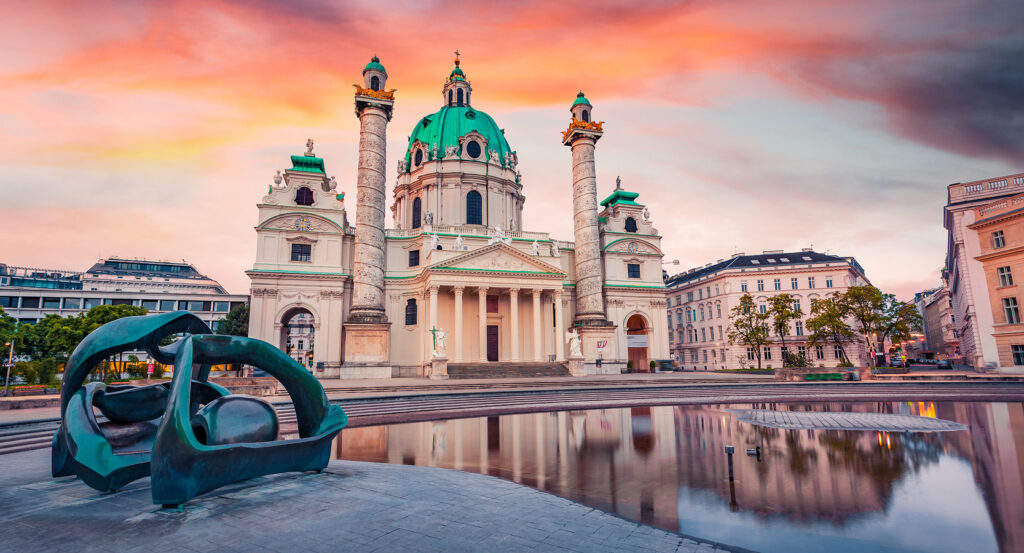
Set at the edge of Vienna's Karlsplatz, St. Charles' Church, or Karlskirche, rises like a dream carved from marble and light, blending baroque exuberance with mathematical precision in a way only Vienna could perfect.
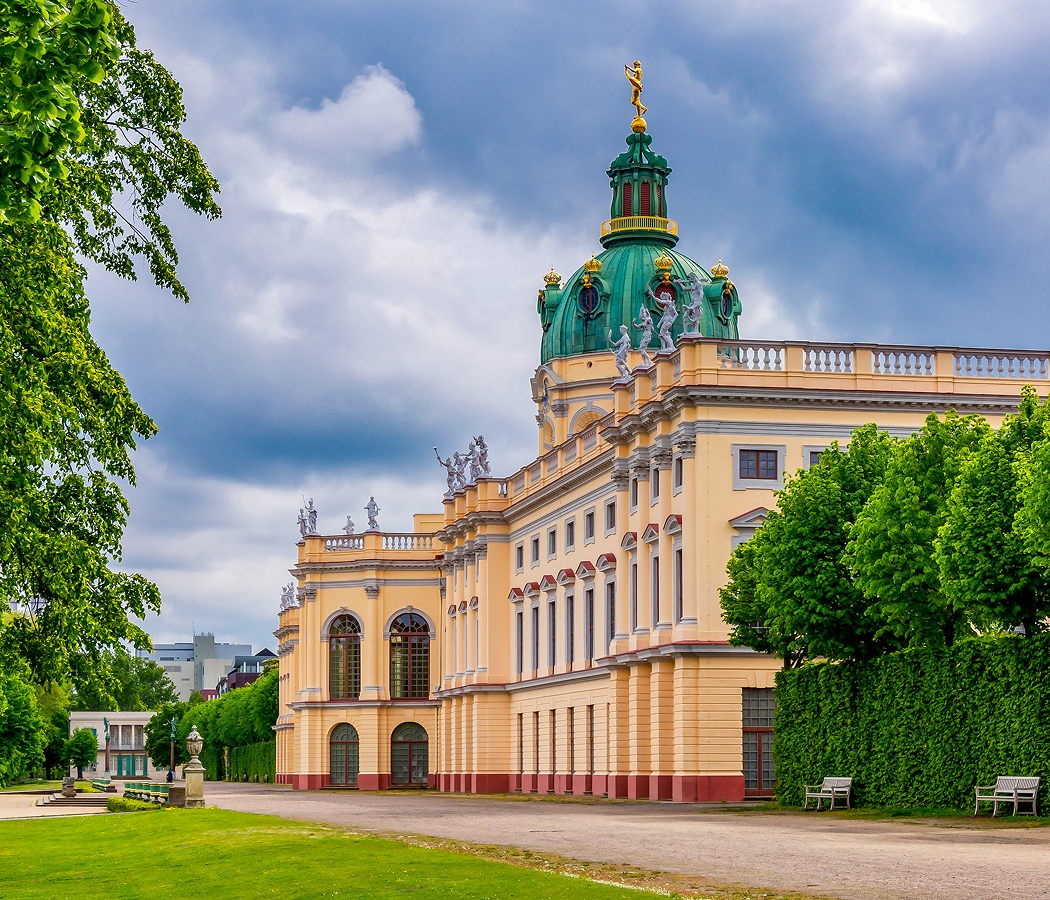
Its green copper dome dominates the skyline, crowned with the kind of symmetry that makes you pause mid-stride, the way you might stop to catch the final chord of a symphony. Step closer, and you're greeted by twin columns spiraling with reliefs of St. Charles Borromeo's life, a direct homage to Rome's Trajan Column but steeped in Austrian theatricality. Inside, the space swells with frescoes that bloom across the dome, a ceiling that seems to dissolve into heaven itself. The acoustics are almost sacred; every whisper lingers, every footstep carries a faint echo that feels musical. St. Charles's Church isn't merely a church, it's Vienna's soul rendered in stone and pigment, a space where faith and art blur until they become indistinguishable. At sunset, the façade catches fire with gold light, its reflection mirrored perfectly in the pool before it, and for a brief moment, it feels as if the city has stopped to breathe.
What defines St. Charles's Church.
Commissioned in 1713 by Emperor Charles VI in gratitude for Vienna's deliverance from the plague, St. Charles's Church was both an act of devotion and dynastic pride, a monument meant to honor God while proclaiming imperial power.
The emperor dedicated it to St. Charles Borromeo, a Milanese archbishop celebrated for aiding plague victims, intertwining personal piety with political symbolism. Architect Johann Bernhard Fischer von Erlach, later joined by his son Joseph Emanuel, fused classical elements with Viennese drama: a Roman dome, Greek portico, and Ottoman-inspired towers, reflecting Vienna's crossroads between East and West. The result was architecture as allegory, Europe's unity expressed through form. Few visitors realize the building endured war, neglect, and even fire; restoration efforts have revealed original pigments long hidden beneath centuries of soot. Its vast fresco by Johann Michael Rottmayr depicts the apotheosis of St. Charles Borromeo in a swirl of clouds and angels, a masterpiece that required scaffolding suspended high into the dome, now accessible via a glass elevator that lifts visitors directly beneath the fresco's glowing expanse. The view from there, eye-to-eye with painted cherubs, collapses the distance between earth and heaven in the most literal sense. Outside, the reflecting pool was a 20th-century addition that redefined the church's discussion with its surroundings, turning St. Charles's Church into one of Vienna's most photographed landmarks. Its mirrored symmetry by day and candlelit reflection by night reveal the church not as a relic, but as a living sculpture breathing with the city around it.
How St. Charles's Church fits.
To experience St. Charles's Church at its most transcendent, visit twice, once by daylight and once after dusk.
Begin your morning with coffee in nearby Karlsplatz, where the church's façade frames the skyline like a painting, then walk the short path toward its grand portico, letting the sound of the fountain pull you forward. Step inside and take your time adjusting to the shift in scale, your first breath will catch as the dome opens above you, its frescoes alive with light. Ride the interior elevator to the viewing platform, where Vienna unfurls in every direction and the details of Rottmayr's brushwork reveal themselves in astonishing intimacy. From here, even the smallest figures, an angel's curled hair, a streak of sunlight across a painted robe, carry divine precision. After descending, circle the exterior to admire the twin columns up close, reading the sculpted narrative spiraling upward like a stone gospel. In the late afternoon, find a seat by the reflecting pool as the golden hour ignites the copper dome. Musicians often gather nearby, their violins echoing softly across the square, and locals linger on the steps with gelato or wine. As night falls, the church glows like a lantern against the dark, a reminder that Vienna's baroque heart still beats strong. Whether you arrive as an art lover, a pilgrim, or simply someone chasing beauty, St. Charles's Church offers not just a view of the divine, but an invitation to feel it.
Where your story begins.
Foresyte Travel reveals places that feel extraordinary long before you arrive.
Enjoy editorial crafted for luxury travelers.
Foresyte may earn a commission when you book.