Why you should experience Egyptian and Near Eastern Collection in Vienna, Austria.
Descending into the Egyptian and Near Eastern Collection feels like crossing a threshold not just of geography, but of time itself, a descent from the imperial grandeur of Vienna into the beating heart of ancient civilization.
Within these softly lit halls, the air shifts, cooler, quieter, almost reverent. Stone sarcophagi line the aisles like silent sentinels, their hieroglyphs still whispering across millennia. Wooden coffins painted in vivid ochres and blues rest beside statues of gods and pharaohs whose faces have stared, unchanged, for over three thousand years. The galleries, arranged chronologically and thematically, trace the full arc of ancient life, from ritual and kingship to daily domestic rhythm. A colossal statue of Sekhmet radiates serene power; the mummy cases of priests and nobles evoke a haunting intimacy. The craftsmanship feels alive, every carving, every pigment testifying to a people obsessed with eternity. The Near Eastern galleries deepen this journey, carrying visitors beyond the Nile to the great Mesopotamian empires, the land of ziggurats and tablets, of Gilgamesh and Hammurabi. Cuneiform tablets sit under glass like fossilized thoughts, the earliest written laws of humankind etched in clay. Together, these rooms form a portal between Vienna's imperial present and the dawn of recorded history.
What you didn't know about Egyptian and Near Eastern Collection.
This collection predates the museum itself, an imperial inheritance that began in the 1820s, when Archduke Maximilian of Austria-Este began acquiring antiquities from Egyptian tombs and temples.
Over the next century collectors and scholars expanded it into one of Europe's finest archives of the ancient world. Today, it contains more than 17,000 artifacts, ranging from the Predynastic period through the Christian Coptic era, each piece a thread in the vast tapestry of human civilization. The mummified animals, cats, crocodiles, even ibises, offer a glimpse into the spiritual symbiosis between people and nature, while the amulets, papyri, and ushabti figurines reveal how the Egyptians conceived of death as an extension of life. The Near Eastern holdings, equally remarkable, include Assyrian relief fragments, cylinder seals, and inscribed boundary stones that once marked the frontiers of forgotten kingdoms. Few realize that the collection also plays a pivotal role in academic research: the museum collaborates with universities and archaeologists worldwide, digitizing inscriptions and conserving fragile artifacts that might otherwise vanish to time. The rooms themselves are masterfully arranged, dimly lit to preserve color and texture, yet designed to evoke the mystery and majesty of temple interiors. The effect is not theatrical but devotional, a curatorial rhythm that honors the ancient conviction that art, faith, and eternity are one.
How to fold Egyptian and Near Eastern Collection into your trip.
Plan to descend into the collection after exploring the upper galleries, the experience works best as a tonal shift, a quiet counterpoint to the splendor above.
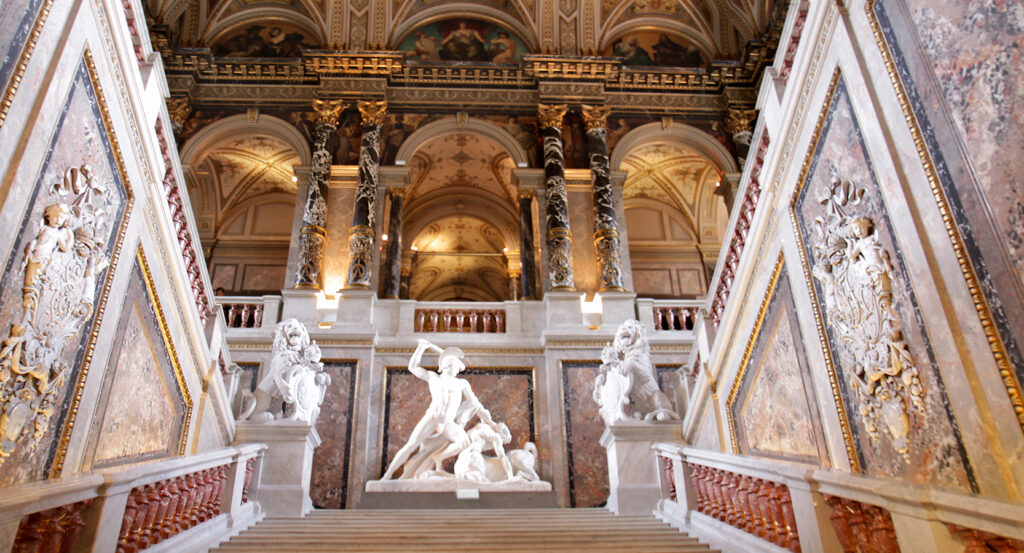
From the marble staircase of the Kunsthistorisches Museum, follow the signs to the lower level, where the ambient light and hush invite immediate introspection. Move slowly, this is not a gallery to rush. Start with the funerary displays, allowing the intricacy of the sarcophagi and mummified forms to reframe your sense of time. Pause before the Book of the Dead papyrus, its delicate hieroglyphs unfold like poetry about the human soul's passage through eternity. Continue into the Near Eastern wing, where the geometric precision of cuneiform and the mythic scale of Assyrian art feel both alien and astonishingly modern. The museum's layout encourages a spiral rhythm, looping back through dynasties and empires, reminding you how civilizations rise, fall, and endure through the written word. Before leaving, step briefly into the rotunda upstairs; the transition from stone reliefs to painted marble feels almost transcendent, as if you've climbed from antiquity into enlightenment. The Egyptian and Near Eastern Collection is more than a museum exhibit, it's a meditation on continuity, a journey through the origins of art, belief, and the eternal human desire to be remembered.
Where your story begins.
Start your planning journey with Foresyte Travel.
Experience immersive stories crafted for luxury travelers.