
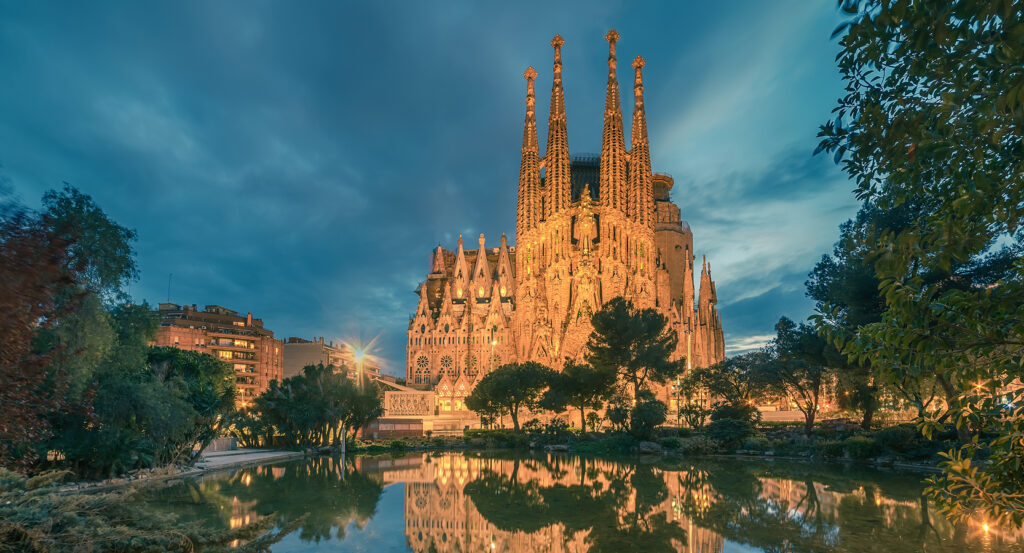
Why Passion Facade matters.
The Passion Façade is where La Sagrada Família bares its soul, stripped of ornament, carved in anguish, and utterly unique in its restraint.
If the Nativity Façade sings of joy and creation, the Passion Façade is its counterpoint, a stark meditation on sacrifice and suffering. Facing the setting sun, it captures the final days of Christ's life in forms so raw they seem to tremble with emotion. The lines are sharp, the shadows deep, the stone nearly skeletal. Designed by Antoni Gaudí to feel like “bones picked clean by time,” it was brought to life decades later by sculptor Josep Maria Subirachs, who translated Gaudí's vision into a brutalist symphony of faith and fear. As you approach, the sense of gravity is overwhelming, every column feels like a rib cage, every arch a heartbeat frozen mid-pulse. It's not beauty that moves you here, but truth. The façade doesn't just depict the Passion; it makes you feel it.
What defines Passion Facade.
The Passion Façade's creation spans generations and carries within it one of the most powerful artistic dialogues in modern history.
Gaudí began designing it in 1911, intending it to shock and humble visitors with its austerity, a deliberate contrast to the exuberance of the Nativity side. He envisioned six great columns supporting a massive portico, with three tiers representing the Last Supper, the Crucifixion, and the Resurrection. The sculptures, completed between 1987 and 2005 by Subirachs, remain fiercely faithful to that intent, even as they introduce a distinct, angular modernism. Their tension lies in contrast: Gaudí's organic warmth meets Subirachs' geometric severity, together expressing the agony and transcendence of faith. Few realize that the bronze door at the center is inscribed with the entire Gospel of Matthew, its letters forming a tactile scripture you can trace with your fingers. Look closely, and you'll find a subtle cipher: a magic square of numbers adding up to 33, the age of Christ at his death. Every inch of the Passion Façade is charged with meaning, not just as religious narrative, but as an architectural confession of humanity's fragility.
How Passion Facade fits.
To experience the Passion Façade in its full resonant gravity, visit in late afternoon when the sun begins to descend, Gaudí designed it so the light would cast long, somber shadows across the stone.
Stand at the base of the staircase and take in the full sweep of the façade from a distance first; the figures appear almost abstract, like fragments of anguish etched into a mountain. As you walk closer, the details unfold, Christ bound and scourged, Peter's denial, the heavy weight of the cross. Pause before the central figure of the crucifixion: the body is elongated and suspended against a stark background, a moment of suffering distilled to geometry. Step beneath the portico and look upward; the vaulted ceiling rises like a cavern of stone ribs, enclosing you in a silence that feels sacred. When you enter the basilica from this side, the transition from shadow into color, from death to resurrection, feels almost cinematic in its design. End your visit by circling to the opposite side of the basilica to view the Nativity Façade again; only then do you feel the full scope of Gaudí's genius, an architecture that holds both the sorrow and the splendor of the divine.
Where your story begins.
Foresyte Travel reveals places that feel extraordinary long before you arrive.
Enjoy editorial crafted for luxury travelers.
Foresyte may earn a commission when you book.














































































































