
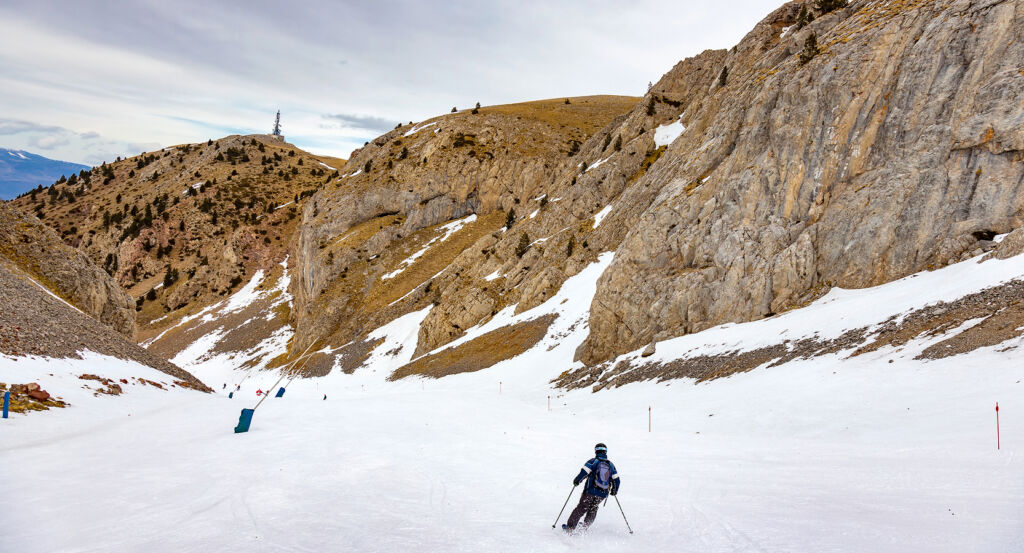
Why you should experience La Tosa d'Alp Summit in Masella, Spain.
The summit of La Tosa d'Alp in Masella, Spain, is where the Pyrenees open like a book, every ridge, valley, and distant peak telling a story that seems older than time itself.
Rising 2,536 meters above sea level, this mountaintop defines the character of Masella, not just geographically, but spiritually. The climb, whether by ski lift or hiking trail, feels like ascending into a different realm: the air thins, the silence deepens, and the world below shrinks into a patchwork of pine forests and rolling white fields. On clear days, you can see all the way across the Cerdanya Valley to the Montseny Massif and, farther still, the faint line of the Mediterranean. Up here, the wind hums like a prayer, and the sunlight scatters across snow so bright it seems to glow from within. Every turn of the head reveals something cinematic, the serrated silhouette of Pedraforca, the distant shimmer of Andorra, and the endless undulations of Spain's most ancient mountains. For locals, La Tosa d'Alp isn't just a summit, it's a symbol of resilience, perspective, and pure alpine beauty. To stand here is to feel the magnitude of the Pyrenees in your chest, where stillness and strength converge.
What you should know about La Tosa d'Alp Summit.
La Tosa d'Alp has been more than just a natural landmark, it's been the mountain that made Masella possible.
Long before chairlifts traced its flanks, shepherds and travelers crossed these slopes along medieval routes that connected Catalonia to the valleys of France. In the mid-20th century, engineers surveying the site realized that La Tosa d'Alp's orientation, facing north and shaded by natural ridgelines, created ideal snow conditions, laying the foundation for what would become one of Spain's most beloved ski resorts. The summit became the anchor of Masella's lift system, serving as the highest accessible point in the Alp 2500 domain, which links Masella to neighboring La Molina. The Telecabina Cadí-Moixeró and the Tosa d'Alp Chairlift carry visitors nearly to the peak, but the final stretch, a short, wind-burnished ridge, must be taken on foot. In winter, it's a pilgrimage for skiers seeking views that linger in memory; in summer, it's a hiker's paradise, alive with alpine flowers and the low rumble of distant cowbells. Scientists have studied its unique microclimate, noting how La Tosa's shape funnels cool air down toward the Cerdanya basin, creating the snow-sure conditions that define Masella's reputation. During the Spanish Civil War, the mountain even played a small but symbolic role as a lookout point for resistance groups navigating the rugged passes between Spain and France. Today, the summit remains one of the few places in the Pyrenees where history, sport, and serenity intertwine so completely, a peak that holds both geological and human stories in its stone.
How to fold La Tosa d'Alp Summit into your trip.
Reaching La Tosa d'Alp is less an excursion and more a rite of passage, a way to meet the mountain on its own terms.
In winter, take the Telecabina Alp 2500 from Pla de Masella to the upper station near the summit. From there, a short climb delivers you to the lookout, where a weathered cross marks the highest point. Bring your camera, or better yet, your stillness, because the view will do the talking. Early mornings are the most breathtaking, when the sun rises over the French border and the peaks glow like embers. For skiers, the descent from La Tosa is among the most exhilarating in the Pyrenees, with long, sweeping pistes like Coma Pregona and La Tosa Vermella cascading thousands of vertical feet back toward the base. Experienced riders often pause at the top of the Tosa Superior ridge to savor the panorama before dropping into broad, perfectly groomed runs framed by open sky. In summer, hiking trails wind up from Coma Oriola or La Molina, weaving through meadows filled with edelweiss, wild thyme, and juniper. The summit also serves as the trailhead for several routes across the Cadí-Moixeró Natural Park, including links to the GR-150 long-distance path. On calm days, it's not uncommon to see paragliders launching from the slopes, their colorful sails drifting over the valley like petals on the wind. Pack a picnic and linger, there's a small stone refuge just below the summit where you can shelter from the wind, enjoy local cheese and bread, and listen to the mountain's hush. If you stay until dusk, you'll see why locals speak of La Tosa d'Alp in reverent tones: as the sun dips behind the western peaks, the snow turns gold, then rose, then violet, the same colors that paint the Pyrenees in the oldest Catalan legends. For a few quiet minutes, the world feels infinite, and you remember that beauty doesn't need to shout to be unforgettable.
Where your story begins.
Foresyte Travel reveals places that feel extraordinary long before you arrive.
Experience premium editorial crafted for luxury travelers.














































































































