
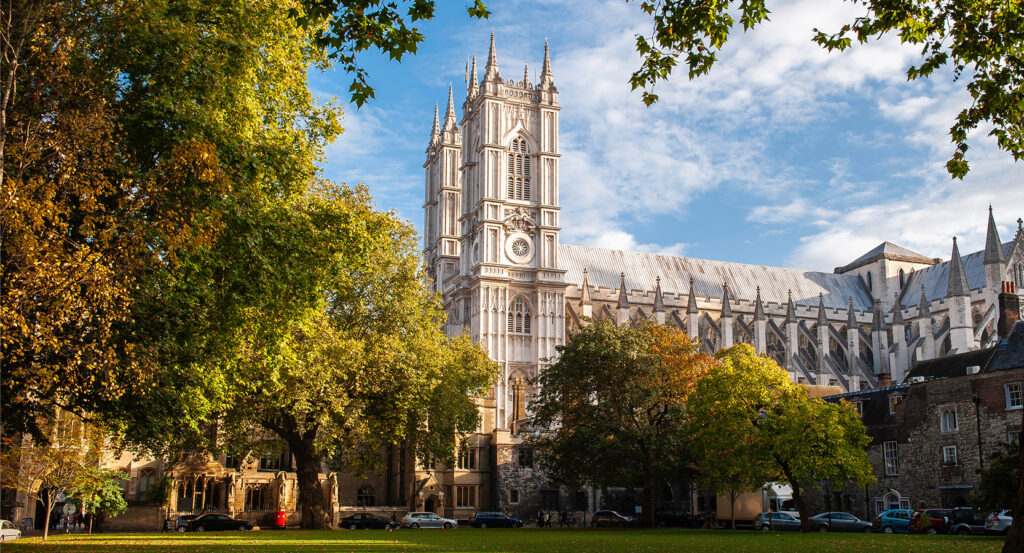
Why you should experience Lady Chapel at Westminster Abbey in London, England.
The Lady Chapel, officially known as the Henry VII Chapel, is Westminster Abbey's most breathtaking sanctuary, a radiant finale to the church's medieval architecture and an ode to divine craftsmanship.
Step beneath its lace-like fan vaulting and you'll feel as though the ceiling itself is suspended by faith alone. Every rib, pendant, and carved boss spirals heavenward, culminating in an illusion of lightness that defies the immense stone structure it supports. Commissioned by Henry VII in the early 16th century as both a shrine and a dynastic statement, the chapel captures late Perpendicular Gothic design at its most intricate. The walls are lined with heraldic banners of the Order of the Bath, fluttering above delicately carved wooden stalls that whisper of chivalric secrets and royal ceremony. The Lady Chapel isn't merely a place of worship, it's a poetic intersection of art, faith, and power, designed to glorify both God and monarchy in equal measure. Standing there, bathed in the fractured glow of stained glass, you sense the quiet authority of centuries condensed into stone and air.
What you should know about Lady Chapel at Westminster Abbey.
Beneath its beauty lies a deeper, often overlooked story, among royal legacy, innovation, and silent endurance.
Henry VII's Chapel was the first major building in England to embrace a new architectural technique: the fan vault, executed with such mathematical precision that it's still studied by architects today. The chapel also serves as a royal mausoleum; beneath the black marble tombs rest Henry VII and his queen, Elizabeth of York, their union having ended the Wars of the Roses and birthed the Tudor dynasty. At the eastern end lies the shrine of Saint Edward the Confessor, once a magnet for pilgrims seeking healing and divine favor. But the Lady Chapel's most profound detail may be the angelic carvings that cling to its walls, each unique, each with a human softness that transcends the coldness of stone. Centuries of restoration have never dimmed their expression; they remain serene, almost watchful, as if guarding both the living and the dead.
How to fold Lady Chapel at Westminster Abbey into your trip.
To fold the Lady Chapel into your visit, approach it as the Abbey's grand crescendo, the space where reverence deepens into reflection.
Enter through the nave and let your eyes adjust to the play of light filtering through stained glass, then pause before the bronze gates to take in the full geometry of the fan vaulting above. Visit early in the morning or late in the afternoon, when sunlight brushes the tombs in amber hues, revealing every carved feather and folded drapery in luminous relief. If you linger long enough, the sound of distant choir practice might carry through the air, a reminder that this is still a living chapel, not just a masterpiece preserved in amber. Before leaving, stand beneath the Tudor rose emblem at the center of the ceiling, the symbol of peace born from conflict, and let the space remind you that even in the most ornate displays of power, there's a heartbeat of humility reaching toward heaven.
Where your story begins.
Foresyte Travel reveals places that feel extraordinary long before you arrive.
Experience premium editorial crafted for luxury travelers.














































































































