
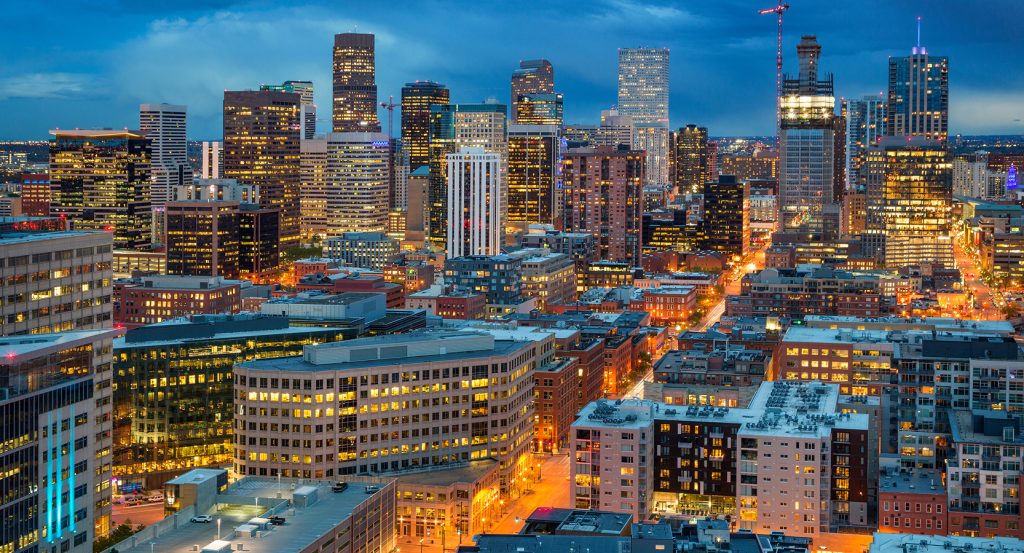
Why Lower Downtown matters.
Lower Downtown is a historic urban enclave where Downtown's railroad heritage meets the preserved mercantile architecture, independent hospitality, and cultural reinvention of the city's nineteenth-century commercial quarter.
Positioned between the Central Business District, Auraria, and the River North Art District, the neighborhood occupies Denver's historic northwestern downtown core, extending along Wynkoop, Wazee, and Blake streets between Cherry Creek and the railroad approaches that shaped the city's early commercial expansion. Brick warehouses, cast-iron storefronts, and substantial masonry buildings preserve the physical character of a district developed around wholesale commerce. Tall windows, former loading entrances, and broad interior floor plates reveal how merchants organized buildings for storage, distribution, and trade. Restaurants, galleries, offices, and residences occupy rehabilitated commercial structures, sustaining pedestrian activity across streets originally designed for freight movement. The result is a remarkably cohesive historic landscape where nineteenth-century architecture supports one of Denver's most established cultural and hospitality districts.
What defines Lower Downtown.
Lower Downtown is best known for preserving the commercial heart of Denver's railroad-era expansion and becoming a nationally influential example of historic urban rehabilitation. Gold discoveries along Cherry Creek and the South Platte River in 1858 brought prospectors, merchants, and suppliers into the region, establishing the settlement that developed into Colorado's principal commercial center. Early businesses concentrated near the waterways, supplying mining camps and agricultural communities across the Front Range. Denver's isolation from the transcontinental railroad initially threatened its economic prospects, prompting local business leaders to finance a connection to the national rail network. The Denver Pacific Railway reached the city in 1870, linking local merchants with eastern manufacturers and accelerating the movement of agricultural products, machinery, and consumer goods. Additional railroad connections strengthened Denver's role as a regional distribution center, encouraging wholesale companies to establish substantial warehouses near freight facilities. Commercial construction intensified during the 1880s and 1890s, producing buildings distinguished by brick masonry, cast-iron detailing, and architectural ornament associated with Victorian commercial design. Businesses specializing in hardware, agricultural equipment, groceries, and manufactured goods occupied the expanding district. The growth of rail transportation also encouraged hotels, restaurants, and service businesses catering to merchants and travelers. Industrial decentralization and changing freight practices gradually weakened the neighborhood's commercial position during the twentieth century, leaving numerous buildings vacant or deteriorating. Demolition pressures increased as downtown redevelopment favored automobile access and modern commercial construction. Preservation advocates organized campaigns to protect the surviving historic fabric, culminating in Denver's establishment of the Lower Downtown Historic District in 1988. The designation introduced architectural protections that encouraged rehabilitation and helped redirect private investment toward existing buildings. Lower Downtown subsequently became a prominent example of how preservation could support economic renewal across an entire urban district.
Dana Crawford played a consequential role in demonstrating the commercial possibilities of restoring Denver's historic buildings, extending lessons from her earlier rehabilitation of Larimer Square into the surrounding downtown area. Her work helped establish preservation as a practical development strategy during a period when older commercial properties faced substantial uncertainty. The Oxford Hotel became an important example of that approach, retaining architectural features associated with its original 1891 construction through successive periods of renovation. Its survival preserved a substantial piece of Denver's early hospitality history within the broader commercial district. Other property owners adapted former warehouses for residential lofts, professional offices, restaurants, and galleries, introducing new uses into buildings originally constructed for wholesale trade. The generous interior dimensions of those structures supported conversion, with high ceilings and substantial floor plates accommodating activities far removed from their original commercial purposes. Historic storefronts gained renewed importance as pedestrian-oriented businesses occupied ground floors once associated with merchandise handling. Preservation regulations encouraged retention of distinctive façades and architectural details, maintaining visual continuity across blocks developed during different decades. New construction increasingly responded to the scale and character of neighboring historic buildings, reinforcing the district's recognizable streetscape. The growth of independent restaurants and hospitality businesses contributed to the neighborhood's reputation as a major Denver dining destination. Residential conversions brought additional activity into former commercial buildings, strengthening the relationship between neighborhood businesses and the people living nearby. Lower Downtown's enduring character emerges from this sustained process of architectural preservation, commercial adaptation, and reinvestment in the city's historic urban fabric.
How Lower Downtown fits.
Lower Downtown works as the anchor for a Denver outing connecting the city's grand railroad terminal, the origins of its modern craft brewing movement, and the preservation of historic commercial architecture through contemporary cultural use.
Begin at Union Station, the transportation terminal whose first major building opened in 1881 before a fire destroyed its central portion in 1894. Reconstruction eventually produced the Beaux-Arts central hall completed in 1914 under architects Gove & Walsh, establishing one of Colorado's most distinguished transportation interiors. The station became a principal arrival point for passengers traveling between Denver and the national railroad network, supporting the city's commercial expansion and growing importance as a gateway to the Rocky Mountains. A major redevelopment completed in 2014 restored the historic building and integrated regional rail, commuter transportation, restaurants, and public gathering spaces into a coordinated metropolitan transit center. Continue to Wynkoop Brewing Company, the brewpub founded in 1988 by John Hickenlooper and business partners inside a rehabilitated commercial building. Its opening helped establish Colorado's modern craft brewing movement during a period when small independent breweries were beginning to challenge the dominance of large national producers. The business introduced brewing equipment and restaurant operations into a historic downtown property, demonstrating the commercial potential of combining local beer production with adaptive reuse. Hickenlooper subsequently served as mayor of Denver and governor of Colorado, giving the brewery an unusual connection to the state's political history. Conclude at Museum of Contemporary Art Denver, the institution founded in 1996 to provide a dedicated platform for contemporary visual art in the city. Its purpose-built building, designed by British architect David Adjaye and completed in 2007, introduced a distinctive contemporary architectural presence near the historic commercial district. The museum's galleries accommodate changing exhibitions of regional, national, and international artists, with its programming extending into performance, lectures, and public cultural events. Adjaye's design incorporates controlled natural light and a carefully organized sequence of exhibition spaces, allowing different forms of contemporary art to occupy a coherent architectural setting. The progression moves from Union Station's railroad infrastructure through Wynkoop Brewing Company's pioneering role in independent brewing and culminates at Museum of Contemporary Art Denver's architectural and cultural contribution, connecting successive chapters of Lower Downtown's commercial and artistic development.
Where your story begins.
Foresyte Travel reveals places that feel extraordinary long before you arrive.
Enjoy editorial crafted for luxury travelers.
Foresyte may earn a commission when you book.


























































































































