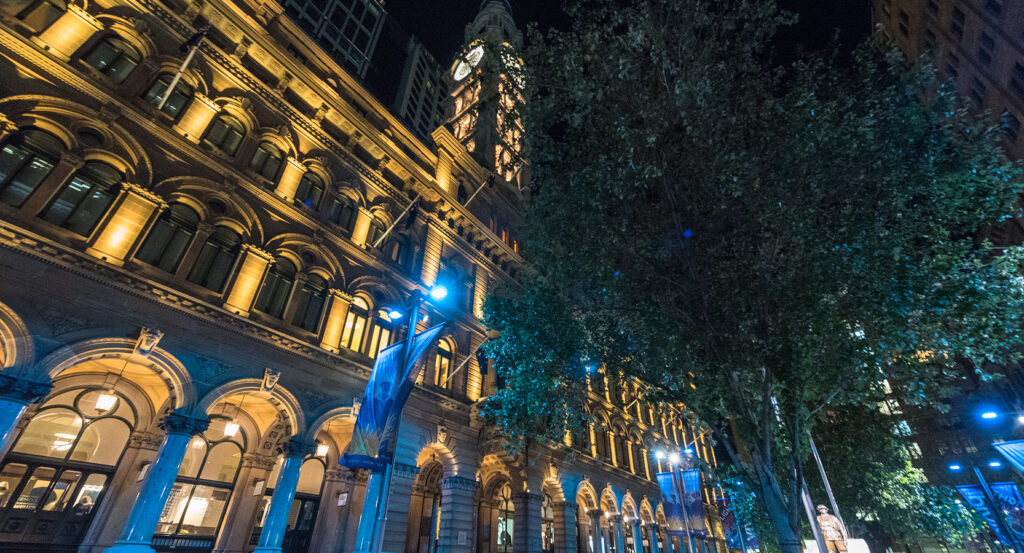
Why you should experience Sydney Masonic Centre in Sydney, Australia.
Sydney Masonic Centre is one of Sydney's most quietly commanding landmarks, a temple of symbolism hidden in plain sight among the city's grand avenues.
Unlike the surrounding banks and civic offices that wear their purpose proudly, the Masonic Building carries an aura of mystery, its façade stately yet enigmatic, its geometry almost whispering of sacred proportion. Built in 1938 for the United Grand Lodge of New South Wales, the structure fuses Art Deco elegance with Masonic allegory, presenting itself as both civic monument and esoteric sanctuary. Its exterior of sandstone and polished granite blends seamlessly into Martin Place's architectural rhythm, but look closer, you'll see carved compasses, square motifs, and subtle reliefs that speak to centuries of ritual tradition. Inside, the atmosphere shifts entirely: vaulted ceilings, rich timber paneling, and stained-glass windows bathe the interior in a warm, honeyed glow. It feels neither church nor office, but something between, a place designed for contemplation, ceremony, and connection. To stand before it is to sense that Sydney's architectural story isn't just written in commerce or politics, but in the pursuit of meaning itself.
What you didn't know about Sydney Masonic Centre.
The Masonic Building's story is one of precision, philosophy, and the quiet endurance of an ancient brotherhood within the pulse of a modern city.
Designed by architect F. Ernest Stowe and completed just before the outbreak of World War II, it served as the headquarters for Freemasonry in New South Wales, a movement that valued geometry not only as design but as moral language. The structure's proportions follow the Golden Ratio, and its alignment with Martin Place's central axis was deliberate, symbolizing balance between material progress and spiritual truth. The façade features stylized columns and bronze doors engraved with the Masonic Square and Compasses, symbols that, in architectural context, become both decorative and declarative. Within, the building contains several lodge rooms, each decorated according to Masonic tradition: checkerboard marble floors representing duality, celestial ceilings painted with constellations, and ornate wooden chairs carved with allegorical detail. One of the most remarkable spaces is the Grand Lodge Room, a chamber capable of seating hundreds beneath a domed ceiling encircled by zodiacal symbols. During the mid-20th century, the building hosted not just Masonic ceremonies but civic lectures, charity events, and even wartime coordination meetings, as Freemasons across Australia mobilized for the national effort. The postwar years saw it become a hub of cultural philanthropy, the lodges often funding scholarships, hospitals, and relief efforts from offices within these walls. Today, while many of the administrative functions have moved, the building remains in active use for meetings and special events, standing as one of the few surviving purpose-built Masonic halls of its era. Heritage listings protect its exterior and several key interior elements, preserving the dialogue between secrecy and openness that defines its mystique.
How to fold Sydney Masonic Centre into your trip.
Visiting the Masonic Building is like unlocking one of Sydney's architectural secrets, a glimpse into a world that has shaped the city quietly, symbol by symbol.
You'll find it near the midpoint of Martin Place, its sandstone exterior harmonizing with the Commonwealth Bank Building across the way. Approach slowly, this isn't a place you rush past. Notice the reliefs near the entrance and the bronze doors etched with geometric motifs; each line carries meaning. While general public access is limited, the building occasionally opens for heritage tours or open days organized by the Freemasons, which reveal its extraordinary interiors, the ceremonial rooms, the marble staircases, the stained glass emblazoned with emblems of wisdom and fraternity. If you're fortunate enough to join one, pay attention to the craftsmanship: the timberwork is all hand-carved, and the dome of the Grand Lodge Room rivals some of the city's great civic chambers. Even from outside, the building rewards observation, the way its Art Deco lines catch late-afternoon light, the play of shadow across its cornices, the quiet symmetry that seems to calm the street around it. Allocate about 20, 40 minutes to explore the façade and its details, or longer if you gain entry. Pair your visit with nearby stops like the Commonwealth Bank Building or the Cenotaph to trace the evolution of Martin Place from mercantile boulevard to symbolic heart. In doing so, you'll come to understand what makes the Masonic Building so compelling: it stands not as a relic of secrecy, but as a monument to the city's layered soul, one that balances the rational with the mystical, the visible with the unseen.
Hear it from the Foresyte community.
Just enough life around you not to be overwhelming. Right pace.
Where your story begins.
Start your planning journey with Foresyte Travel.
Experience immersive stories crafted for luxury travelers.