
Why Matsuhisa matters.
Matsuhisa is a contemporary Japanese restaurant where Vail Village's luxury alpine hospitality meets Nobu Matsuhisa's internationally influential Japanese-Peruvian cuisine, sophisticated dining traditions, and the architectural transformation of Colorado's premier mountain resort.
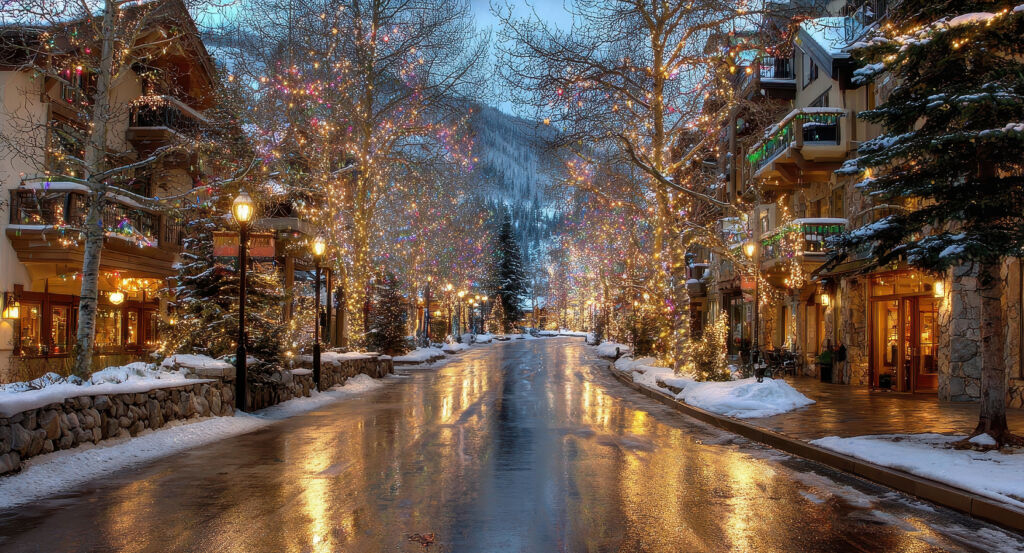
Occupying a prominent space within the Solaris development along East Meadow Drive, Matsuhisa stands near the northern entrance to Vail Village, with the pedestrian corridors surrounding Bridge Street extending southeast toward Gore Creek and Vail Mountain rising above the resort's commercial center. The restaurant incorporates substantial indigenous stone pillars, textured masonry walls, custom woodwork, and a prominent fireplace within a spacious dining room whose floor-to-ceiling windows frame panoramic views of the ski slopes. An expansive sushi counter introduces a direct connection with the kitchen's preparation of fresh seafood, and a separate bar provides a gathering space overlooking the surrounding dining areas. The interior combines contemporary architectural lines with natural surfaces associated with the Rocky Mountain landscape, establishing a distinctive relationship between Japanese culinary presentation and Colorado's alpine setting. During warmer months, the restaurant opens onto a broad outdoor terrace furnished with fire pits, extending its dining spaces toward the pedestrian activity of the village. The surrounding mixed-use complex incorporates luxury residences, shops, entertainment facilities, and a public plaza, placing the establishment within one of Vail's most substantial modern developments. The result is an expansive mountain restaurant whose stone architecture, panoramic glazing, and sophisticated dining spaces connect international Japanese gastronomy with the physical character of Vail's alpine resort.
What defines Matsuhisa.
Matsuhisa is best known for bringing the culinary legacy of Nobuyuki Matsuhisa, among the most influential Japanese chefs of the modern era, into the heart of Vail through a restaurant whose history connects Tokyo apprenticeship, South American culinary traditions, international celebrity, and the expansion of luxury mountain hospitality. Born in Saitama, Japan, in 1949, Matsuhisa developed an early interest in food through family visits to sushi restaurants, eventually entering a rigorous apprenticeship at a traditional sushi establishment in Tokyo. His training established the foundations of Japanese knife work, rice preparation, seafood handling, and the disciplined organization of professional sushi kitchens. A professional opportunity subsequently brought him to Lima, Peru, where he opened a restaurant and encountered ingredients and culinary practices substantially different from those of his Japanese training. Peruvian citrus, chili peppers, and seafood traditions contributed to the development of preparations that combined Japanese techniques with the sharper flavors of South American coastal cooking. Matsuhisa spent three years in Peru before relocating to Argentina, extending his familiarity with South American food culture and the demands of operating restaurants beyond Japan. His subsequent career took him through Japan and Alaska, where a restaurant venture ended following a destructive fire. The setback preceded his relocation to Los Angeles in 1979, establishing the American foundation for his eventual international career. After working in established Japanese restaurants, Matsuhisa opened his namesake establishment in Beverly Hills in 1987, introducing a culinary repertoire that combined traditional Japanese preparations with the Peruvian influences developed during his years abroad. The restaurant attracted a substantial following among Los Angeles diners and entertainment-industry figures, including actor Robert De Niro, whose interest in Matsuhisa's cooking eventually led to a major business partnership. De Niro encouraged the chef to establish a restaurant in New York, contributing to the development of Nobu, which opened in Manhattan's Tribeca neighborhood in 1994. The venture brought together Matsuhisa, De Niro, restaurateur Drew Nieporent, and producer Meir Teper, establishing the commercial foundation for an international hospitality group. Its success introduced Matsuhisa's culinary approach to a substantially broader audience, and subsequent restaurants extended the Nobu name into major cities and luxury resort destinations across several continents. The chef also developed a separate collection of restaurants operating under the Matsuhisa name, preserving a more direct connection with the Beverly Hills establishment that launched his independent career. Colorado became an important component of that development when Matsuhisa Aspen opened in 1998, introducing his cooking to the state's established international ski clientele. The Aspen restaurant demonstrated the suitability of his Japanese-Peruvian repertoire for a mountain resort whose dining culture already incorporated sophisticated European and American establishments. Vail emerged as the next major Colorado opportunity during a period of substantial investment in the resort's commercial center. The Solaris project, developed by Peter Knobel and designed by Barnes Coy Architects, introduced a mixed-use complex incorporating seventy-nine residences alongside restaurants, entertainment venues, and retail spaces. Architects Robert Barnes, Chris Coy, and Christopher Clay developed a contemporary Alpine composition that combined substantial stone surfaces with expansive glazing and a carefully organized public setting. The project reached completion in 2010, establishing a major new destination within the village's commercial geography. Plans for Matsuhisa Vail became public in May 2011, extending the chef's Colorado presence into a second resort community. The restaurant opened on December 26, 2011, introducing one of the relatively small number of establishments carrying the Matsuhisa name at a time when the larger Nobu group had already achieved extensive international recognition. Its arrival strengthened Vail's position as a destination for globally established culinary brands, connecting the resort's growing luxury residential market with a restaurant concept associated with Los Angeles, New York, and Aspen. The opening team included chef Brian Busker, whose professional background encompassed restaurant work in several American states and France. Busker had trained at Orlando Culinary Academy, worked under chef Adam Votaw at Vail Cascade, and completed a professional stage at Pierre Gagnaire's three-MICHELIN-starred Paris restaurant. He joined Matsuhisa Vail as sous chef in July 2011 and advanced to executive chef eight months later, contributing to the establishment's early culinary development. His work connected the kitchen with a broader network of internationally trained chefs and reinforced the restaurant's emphasis on precise preparation and professional culinary education. Matsuhisa Vail subsequently developed an established position within the resort's fine-dining community through its signature seafood preparations, extensive beverage program, and carefully coordinated service. The restaurant's private dining facilities expanded its role into corporate gatherings, wedding celebrations, and special events, strengthening its connection with the resort's international hospitality market. Matsuhisa occupies a distinctive position in Vail's restaurant history through the intersection of a globally influential chef's personal culinary development, the international expansion of Japanese fine dining, and the architectural redevelopment of the resort's original village.
Nobu Matsuhisa's culinary repertoire develops the foundations of traditional Japanese cooking through the citrus, chili, and seafood influences of Peru, establishing a distinctive approach built around carefully balanced flavors and the natural character of exceptional ingredients. Yellowtail Sashimi with Jalapeño provides one of its defining expressions, combining thinly sliced fish with fresh chili and a citrus-based sauce that introduces a direct connection between Japanese sashimi and South American coastal cooking. Black Cod Miso contributes another internationally recognized signature through the relationship between rich fish and a deeply flavored miso preparation. Whitefish Tiradito extends the Peruvian influence through delicate seafood accompanied by a bright, assertive dressing, connecting the kitchen's raw-fish program with a traditional South American preparation. These dishes establish the essential style of Matsuhisa's cooking, and the broader menu develops their principles through sushi, sashimi, hot dishes, and carefully selected meats. Traditional nigiri and maki preparations preserve the restaurant's Japanese foundations, emphasizing seafood quality, seasoned rice, and precise assembly. The kitchen's hot preparations introduce additional influences through lamb chops, Miyazaki beef, and vegetables prepared with Japanese and South American seasonings. Seasonal ingredients contribute variation to the established repertoire, maintaining a relationship between the chef's internationally recognized signatures and the professional judgment of the restaurant's kitchen team. The eight-course omakase introduces a more structured presentation of the culinary program, combining signature preparations with seasonal selections chosen by the chefs. Its sequence establishes a relationship between delicate opening courses, substantial hot preparations, and concluding dishes, supported by coordinated beverage service. Hokusetsu sake forms a distinctive component of the restaurant's beverage program through its association with the Matsuhisa restaurant group. Produced on Sado Island in Japan's Niigata Prefecture, the sake collection introduces traditional Japanese brewing into a dining environment shaped by several culinary cultures. Beverage director Andreas Harl oversees a substantial wine program incorporating distinguished Burgundy producers, California estates, and international selections suited to the kitchen's varied preparations. Cocktails extend the Japanese-Peruvian approach through ingredients such as shochu, passionfruit, ginger, and fresh chili, establishing another connection between the restaurant's culinary foundations and its beverage service. The Matsutini combines Japanese shochu with vodka, passionfruit, and Champagne, introducing a recognizable house preparation within the broader cocktail collection. Private dining spaces, including the Nobu Room and Mountain View Terrace, accommodate more elaborate gatherings through coordinated menus and dedicated service. Matsuhisa's culinary distinction rests upon the sustained integration of classical Japanese technique, Peruvian ingredients, internationally influential signature preparations, and an extensive beverage program within the formal hospitality setting of Vail Village.
How Matsuhisa fits.
Matsuhisa works as the dining centerpiece of a Vail Village exploration connecting Colorado's skiing heritage, the resort's distinctive pedestrian architecture, and the mountain transportation infrastructure that established its international reputation.
Begin at Colorado Snowsports Museum, the historical institution occupying the upper level of the Vail Village Parking Structure near the resort's principal northern entrance. The organization originated during Colorado's 1976 centennial celebrations, opening its first exhibition facility in a modest building near the intersection of Vail Road and Meadow Drive. Its early collection included a military Weasel snow vehicle associated with the 10th Mountain Division and a Bradley Packer-Grader used in the development of early ski-slope grooming techniques. Subsequent expansion introduced permanent exhibitions devoted to skiing, snowboarding, competitive athletics, resort development, and the military history of Colorado's mountain soldiers. The Climb to Glory exhibition preserves the legacy of the 10th Mountain Division, whose wartime training at Camp Hale helped establish a generation of influential figures in the American skiing industry. The museum's Hall of Fame began recognizing distinguished athletes and industry leaders in 1977, developing a substantial collection of personal histories and sporting achievements. Continue south to Vail Covered Bridge, the timber pedestrian crossing over Gore Creek that connects the northern village approach with Bridge Street. The original crossing accompanied the resort's opening in 1962, providing access between the parking area and the developing commercial center. John and Cissy Dobson, who relocated from Vermont in 1965, helped finance the addition of its pitched roof after establishing the nearby Covered Bridge Store. Their contribution introduced a distinctive New England architectural element into a village otherwise shaped by European Alpine influences. A major restoration in 1994 replaced structural components and strengthened the crossing for increasing pedestrian traffic, preserving one of Vail's most recognizable landmarks. Conclude at Gondola One, the principal mountain transportation terminal near the upper end of Bridge Street. Vail Mountain opened on December 15, 1962, through the efforts of Peter Seibert and Earl Eaton, introducing a ski area equipped with a four-person Bell Gondola and two chairlifts. The original gondola connected the newly established pedestrian village with the mountain's upper terrain, becoming an essential component of the resort's early transportation system. Its successor continues that geographical relationship, carrying passengers toward Mid-Vail and the extensive network of ski trails extending across the mountain. The surrounding pedestrian plaza preserves the close relationship between the resort's commercial center and its principal recreational infrastructure. The progression moves from Colorado Snowsports Museum's preservation of winter sports history through Vail Covered Bridge's early resort architecture and culminates at Gondola One, where mountain transportation connects the village with the slopes that established Vail's international reputation.
Where your story begins.
Foresyte Travel reveals places that feel extraordinary long before you arrive.
Enjoy editorial crafted for luxury travelers.
Foresyte may earn a commission when you book.


























































































































