
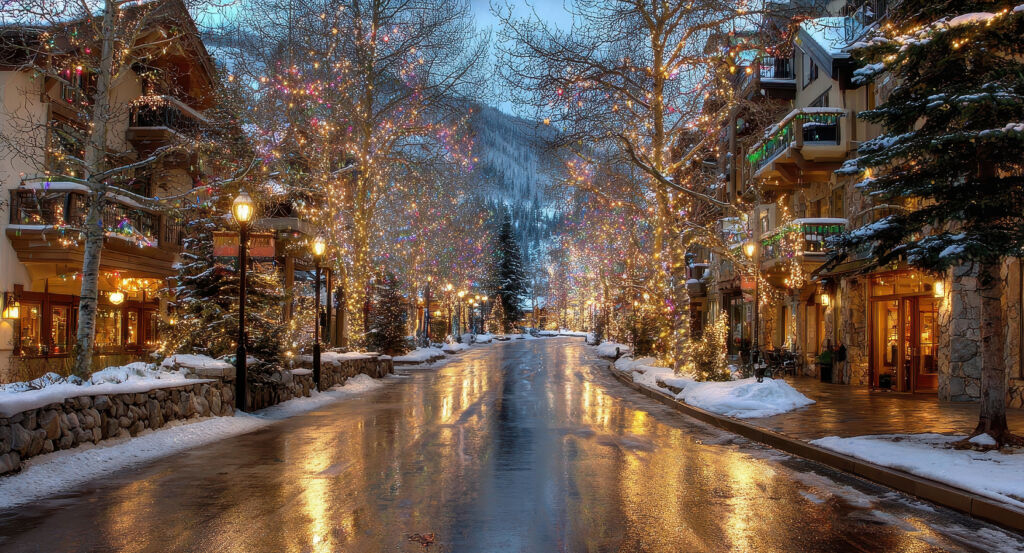
Why Vail Village matters.
Vail Village is an Alpine-inspired pedestrian district where the Gore Valley's mountain recreation heritage meets the European architectural traditions, postwar ski culture and ambitious resort planning that established Vail as an internationally recognized Colorado mountain community.
Positioned along Gore Creek between Golden Peak and Lionshead, the historic village occupies the southern side of the Gore Valley beneath Vail Mountain, with Bridge Street connecting its central pedestrian district to the covered crossing near South Frontage Road and Interstate 70. Narrow stone-paved streets wind between steep-roofed buildings, timber balconies and commercial courtyards, establishing a compact arrangement of shops, restaurants and mountain accommodations. Public plazas accommodate outdoor dining, seasonal markets and gatherings beneath the surrounding peaks. Pedestrian passages connect the commercial streets with ski lifts, creekside paths and landscaped open spaces, maintaining direct access between the village and the mountain. The result is a carefully planned Alpine community whose intimate street network, mountain architecture and year-round public spaces preserve the founding ambitions of Colorado's modern ski-resort era.
What defines Vail Village.
Vail Village is best known for its European-inspired architecture and pedestrian-oriented planning, developed alongside Vail Mountain's opening in 1962 through the efforts of ski entrepreneur Pete Seibert, local mountaineer Earl Eaton and a group of investors determined to establish a new resort in the Gore Valley. The surrounding mountains had long formed part of the seasonal territory of the Ute people before nineteenth-century settlement introduced ranching, mining and transportation corridors to the Eagle River watershed. During World War II, Seibert served in the United States Army's 10th Mountain Division, training at nearby Camp Hale before fighting in Italy and sustaining injuries during the Battle of Riva Ridge. His military experience and subsequent work in Colorado skiing informed his ambition to develop a major mountain resort. Eaton, who had explored the surrounding terrain, joined Seibert in identifying the mountain's extensive skiable slopes and high-elevation bowls. On March 19, 1957, the partners climbed the mountain from the valley floor, examining terrain that subsequently became central to their development plans. Investors organized Vail Associates in December 1959, assembling the financial resources necessary to construct lifts, mountain facilities and a settlement at the base. The company acquired former ranchland and secured federal permission to develop skiing infrastructure on National Forest land. Construction accelerated during 1962, establishing the original village buildings alongside the mountain's first lift system. Vail Mountain opened on December 15, 1962, with a gondola, two chairlifts and lift tickets priced at five dollars. Architect Fitzhugh Scott contributed to the original village plan, including the curved alignment of Bridge Street, which established the intimate proportions of its commercial center. Austrian ski instructor and hotelier Pepi Gramshammer became an influential early resident, introducing European hospitality traditions and helping establish the community's international character. The Town of Vail incorporated in 1966, providing municipal government for a rapidly expanding settlement. Subsequent planning regulations guided building heights, architectural details and pedestrian circulation, preserving the Alpine character of the original commercial district amid increasing development pressure. The village's evolution connected the experience of American military ski veterans with European mountain architecture and the growth of Colorado's destination skiing industry.
Bridge Street forms the principal historical axis of the village, following a gently curving route between the creek crossing and the mountain-facing commercial blocks. Its irregular alignment creates changing views of shopfronts, rooflines and surrounding peaks, lending the street the proportions of a traditional European mountain settlement. The Clock Tower building, developed during the resort's earliest years, provides a recognizable architectural focal point through its steep roof, elevated clock and position among the original commercial structures. Timber balconies, stucco façades and projecting eaves draw upon Austrian and Swiss building traditions, with stone foundations and ground-level retail spaces adapted to Colorado's mountain climate. Narrow passages branch from the principal streets into courtyards containing restaurants, galleries and specialty shops. The pedestrian district accommodates outdoor dining during warmer months, when flower boxes, landscaped terraces and public seating occupy the spaces between buildings. Winter conditions alter the streetscape through snow-covered roofs, illuminated trees and direct pedestrian access to mountain recreation. Gondola One departs from the eastern end of the village, carrying skiers and sightseeing passengers toward the upper mountain. The lift's location preserves the historical relationship between the commercial settlement and the original gondola corridor. Ski equipment shops maintain an important commercial presence, connecting the district's retail economy with the technical requirements of alpine recreation. European-inspired restaurants and bakeries occupy buildings alongside contemporary American dining establishments, extending the founders' international influences into the village's food traditions. Art galleries and public sculptures contribute to the cultural character of the streets, incorporating mountain landscapes, wildlife and contemporary artistic subjects. Gore Creek follows the district's northern edge, with pedestrian paths providing access to riparian vegetation, bridges and views toward the surrounding slopes. Public transportation facilities near the northern entrance connect the pedestrian core with surrounding residential neighborhoods and other parts of the valley. The concentration of accommodation, dining, shopping and mountain access within a compact district sustains Vail Village's distinctive relationship between pedestrian urban planning and alpine recreation.
How Vail Village fits.
Vail Village works as the central pedestrian destination for a Vail itinerary connecting the history of Colorado skiing, the preservation of high-elevation botanical environments and the development of performing arts within the Gore Valley.
Begin at Colorado Snowsports Museum, located beside the village's principal parking structure near South Frontage Road. The institution preserves artifacts associated with the development of skiing and snowboarding throughout Colorado, including equipment, photographs, clothing and historical displays. Its exhibitions examine the 10th Mountain Division, whose soldiers trained in the Colorado Rockies before serving in Italy during World War II. Additional collections trace the evolution of ski equipment, competitive skiing and the development of major mountain resorts. The Colorado Snowsports Hall of Fame recognizes athletes, instructors, innovators and industry figures whose contributions shaped the state's winter sports history. Continue to Betty Ford Alpine Gardens, situated within Ford Park east of the village center. Founded in 1985 and named in honor of former First Lady Betty Ford, the gardens preserve and cultivate alpine plants from mountainous regions around the world. The high-elevation botanical collections contain species adapted to short growing seasons, intense sunlight and challenging mountain conditions. Rock gardens, waterfalls and carefully arranged planting beds demonstrate the ecological relationships between elevation, soil and vegetation. Educational exhibits address alpine conservation and the environmental pressures affecting fragile mountain habitats. Conclude at Gerald R. Ford Amphitheater, the open-air performing arts venue situated beside the gardens in Ford Park. Named for President Gerald Ford, whose family maintained a longstanding connection with Vail, the amphitheater opened in 1987 and became an important center for summer cultural programming. Its covered stage and terraced lawn accommodate concerts, dance performances and community events against a mountain backdrop. The venue hosts the Vail Dance Festival and performances associated with Bravo! Vail, connecting the mountain community with internationally recognized artistic organizations. The progression moves from Colorado's skiing heritage through the conservation of alpine plant life and culminates in the performing arts institutions that expanded Vail's cultural significance beyond winter recreation.
Where your story begins.
Foresyte Travel reveals places that feel extraordinary long before you arrive.
Enjoy editorial crafted for luxury travelers.
Foresyte may earn a commission when you book.


























































































































