Why the Matterhorn matters.
The Matterhorn isn't just a mountain, it's a monument to human awe.
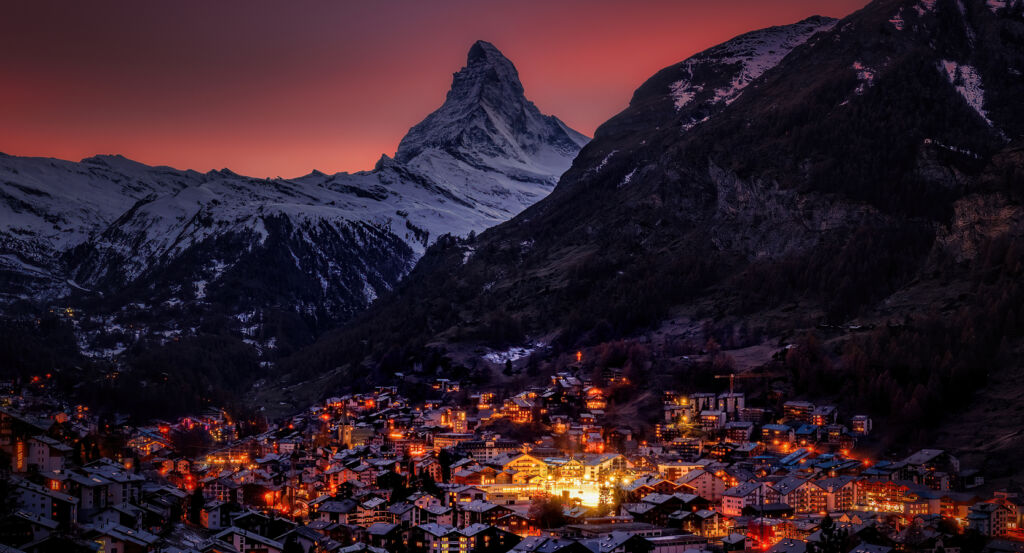
Rising like a blade between heaven and stone, it commands the horizon with such precision that it feels more imagined than real. Every ridge, every cut of shadow, looks sculpted by divine geometry. The closer you get, the quieter the world becomes; even the wind seems to move around it in reverence. The Matterhorn has a gravity all its own, not just the physical pull of rock and ice, but the resonant draw of something eternal. It's the kind of beauty that demands stillness, that asks you to stop taking pictures and just exist in its presence. From the village below, it glows with changing moods, pink at dawn, silver at noon, amber at dusk, a living clock that marks the passage of light itself. Whether you're tracing its reflection in Riffelsee, carving the runs beneath its shadow, or simply watching it from a terrace with a glass of wine in hand, the Matterhorn reminds you what untouched wonder feels like. It's not something to conquer, it's something to witness, to remember, to let rearrange you quietly from the inside out.
What defines the Matterhorn.
The Matterhorn's story isn't just carved in stone, it's written in obsession, triumph, and tragedy.
For centuries, locals feared it, calling it “the Mountain of Mountains,” believing its summit belonged to spirits, not men. Then came July 14, 1865, when Edward Whymper led the first ascent, a feat that made headlines across Europe for all the wrong reasons. The climb succeeded, but the descent ended in disaster when four of the seven men fell to their deaths, the rope snapping midair. That single moment transformed the Matterhorn into legend, a place where glory and grief became inseparable. Since then, more than 500 climbers have perished on its faces, each one chasing a dream that the mountain rarely forgives. Yet the fascination never fades. Today, mountaineers still wake before dawn at Hörnli Hütte, tracing Whymper's route by headlamp, the mountain's edges glowing faintly in moonlight. But the Matterhorn isn't just a mountaineer's obsession; it's a symbol that shaped an entire nation's identity. Its likeness crowns Swiss chocolate bars, watches, and travel posters, an emblem of precision, endurance, and impossible beauty. Even its Italian side, Monte Cervino, holds its own mythology, a mirror of grace and danger reflected across the border. Beneath the fame lies something far more enduring: a sense that this mountain doesn't belong to any country or climber, it belongs to the earth itself, unbothered by who's watching.
How the Matterhorn fits.
The best way to meet the Matterhorn is to let it reveal itself slowly.
Arrive in Zermatt by train and resist the urge to rush upward. Spend your first morning in the village, catching glimpses of its peak between rooftops and steeples, letting anticipation build. Then take the Gornergrat Railway, an engineering marvel that has been carrying travelers to the clouds since 1898, and watch as the mountain rises with every curve. At the summit, the air is thin and crystalline, the silence absolute. Step out and you'll see the Matterhorn framed by 29 other 4,000-meter peaks, each one humbled by its geometry. For a closer connection, ride the gondola to Klein Matterhorn, home to Europe's highest cable car station, and walk through the Glacier Palace, a frozen cathedral carved into living ice. In summer, hike to Riffelsee or Schwarzsee, both lakes capture its reflection so perfectly it looks like a trick of the light. In winter, ski the Matterhorn Glacier Paradise, gliding across runs that straddle the Swiss-Italian border with the mountain at your shoulder. Stop for lunch at a mountain hut like Chez Vrony or Adler, where alpine fare tastes different under that view, heartier, earned. As evening falls, return to Zermatt and watch the mountain fade to silhouette, its edges catching the last color of the day. You'll realize the Matterhorn isn't about arrival or ascent, it's about surrender. You don't see it once and move on. You orbit it, you absorb it, and in the quiet that follows, you understand why it's been called the soul of the Alps.
Where your story begins.
Foresyte Travel reveals places that feel extraordinary long before you arrive.
Enjoy editorial crafted for luxury travelers.
Foresyte may earn a commission when you book.