
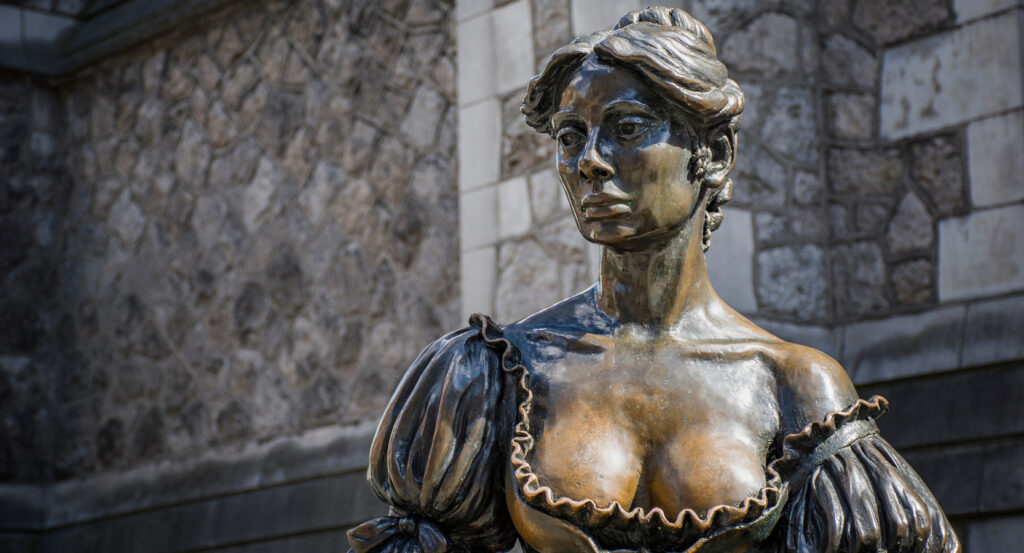
Why you should experience Molly Malone Statue in Dublin, Ireland.
In the heart of Dublin's thriving streets, Molly Malone Statue stands as a lyrical example of Ireland's most enduring folk heroine.
Her story is woven into the city's soul, immortalized in the song “Cockles and Mussels,” sung by generations of Dubliners and travelers alike. The statue captures her mid-stride, hands gripping a wooden cart brimming with seafood, eyes cast toward the horizon as if listening for the rhythm of the River Liffey nearby. Crafted by sculptor Jeanne Rynhart in 1988 for Dublin's Millennium celebrations, the bronze figure of Molly Malone feels more alive than still, her flowing dress and tousled hair capturing the raw vibrancy of a street vendor who worked, loved, and lived in the heart of the city. Today, the statue stands just off Grafton Street, surrounded by laughter, buskers, and the steady hum of daily Dublin life, an eternal reminder that stories, like songs, never truly fade. To stand before her is to stand in the intersection of legend and life, where Dublin's charm becomes something you can feel, not just hear.
What you should know about Molly Malone Statue.
Molly Malone's origins blur the line between fact and fable, a mystery that makes her legacy even richer.
Though historians debate whether she ever truly existed, the song that bears her name dates back to the late 19th century, quickly becoming an unofficial anthem of Dublin. Her tale, that of a beautiful fishmonger who tragically died young, resonated with the spirit of the Irish people, whose lives were often marked by hardship, humor, and resilience. When the statue was first unveiled near Trinity College, it sparked as much affection as controversy, with some critics calling her attire too revealing. Yet this very boldness only deepened her symbolism: Molly Malone was never meant to be demure, she was Dublin personified, strong, rebellious, and unashamed. In 2014, she was moved to Suffolk Street during city construction, where she remains a centerpiece of Dublin's storytelling landscape. Visitors rub her bronze arm for luck, leaving her polished from years of shared superstition and affection. What few realize is that Rynhart designed Molly with the intent to celebrate women who defined Dublin's resilience, vendors, mothers, and dreamers whose labor built the city's heartbeat.
How to fold Molly Malone Statue into your trip.
Seeing Molly Malone Statue isn't just a sightseeing stop, it's a cultural baptism.
Begin your walk from Trinity College, where the Book of Kells whispers Ireland's medieval soul, and follow the flow of pedestrians until you reach Suffolk Street. There, you'll hear the distant hum of musicians playing “Molly Malone” before you even spot her. Pause, listen, and join the chorus if you know the tune, no one minds a few off-key notes in Dublin. Snap a photo, of course, but then linger. Watch how locals pass without a glance while travelers linger in awe; it's a study in how myth and reality coexist seamlessly here. From the statue, stroll down Grafton Street toward St. Stephen's Green, soaking in the same energy that once filled Molly's cart-lined lanes. Pop into nearby pubs like The Hairy Lemon or Kehoe's for a pint and live music, chances are, you'll hear her song echo again before the night is over. As Dublin glows beneath its old streetlamps, you'll understand what Molly Malone represents: a city that endures not through monuments or history books, but through melody, memory, and the immortal warmth of its people.
Where your story begins.
Foresyte Travel reveals places that feel extraordinary long before you arrive.
Experience premium editorial crafted for luxury travelers.














































































































