
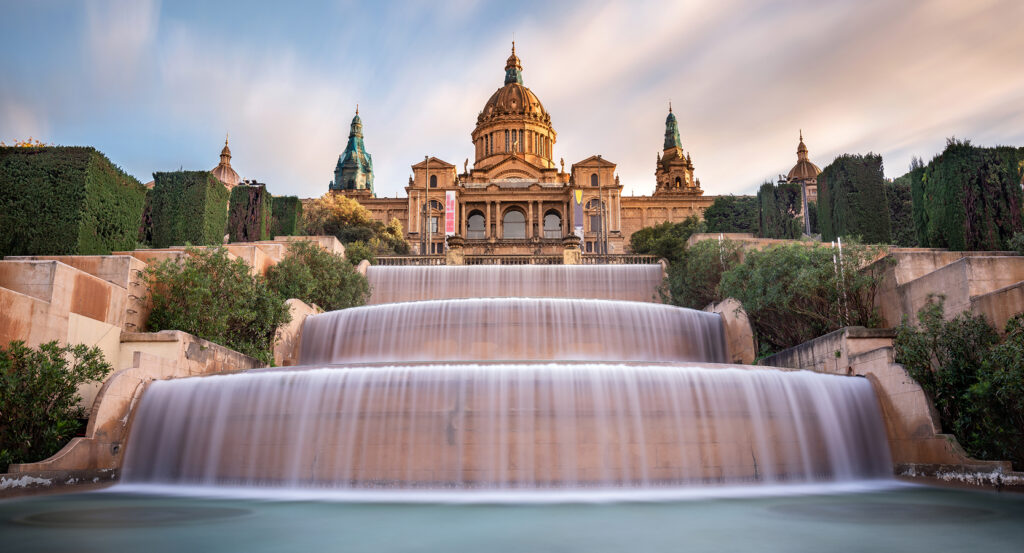
Why Montjuïc Castle matters.
Perched high above the city, Montjuïc Castle stands as both sentinel and storyteller, a fortress that has witnessed Barcelona's triumphs, tragedies, and transformations for more than 350 years.
Its position atop Montjuïc Hill commands breathtaking views of the Mediterranean, the port, and the sprawling city below, but it's the atmosphere of the place that leaves a deeper mark. Walking through its stone gates feels like stepping into another century. The thick bastions and wide ramparts, softened now by ivy and sea breeze, whisper of cannon fire, revolutions, and resistance. Beneath the stillness lies the weight of history, from the War of the Spanish Succession to the dark years of political repression under Franco. Yet today, the fortress has shed its past as an instrument of control to become a place of reflection and perspective, both literal and resonant. It's here that the pulse of Barcelona slows, and the city's complex history can be seen, and felt, in one sweeping gaze.
What defines Montjuïc Castle.
The fortress began as a simple watchtower in the 1600s, built to guard against pirate attacks on the port below.
In 1640, during the Catalan Revolt, the first fortifications took shape, expanding over the next century into the imposing star-shaped citadel that stands today. Its design, with angular bastions and panoramic sightlines, followed the principles of Vauban, Europe's foremost military engineer of the era. Over time, Montjuïc Castle's role evolved from protector to oppressor, serving as a military prison during the 19th and 20th centuries. It became infamous as the site of political executions, most notably that of Catalan leader Lluís Companys in 1940. When Franco's dictatorship fell, the castle was turned over to the city in 1960 and slowly reimagined as a cultural and civic landmark. Today, its restored walls house exhibitions on peace, history, and architecture, while the surrounding grounds bloom with gardens and open-air art installations. Few realize that from 2010 onward, Montjuïc Castle officially ceased all military functions, symbolically returning its watchtower to the people it once subdued.
How Montjuïc Castle fits.
Visiting Montjuïc Castle is an experience that blends history, beauty, and quiet introspection.
Take the cable car from the base of Montjuïc Hill, the ride alone is a memory, with sweeping views of the port and skyline that make the ascent feel cinematic. Once at the summit, walk across the drawbridge into the courtyard, where cannons line the walls and the stonework radiates centuries of endurance. Stroll the ramparts for unmatched views, to the north, the city unfolds like a mosaic; to the south, the Mediterranean glows in shifting shades of blue. Plan to visit in the late afternoon when the light turns golden and shadows stretch across the parapets, bringing out every curve of the fortress walls. Inside, the exhibits are thoughtfully curated, shedding light on the castle's evolution from weapon to witness. After the tour, linger on the esplanade to watch the sunset descend over Barcelona, a city that has learned, again and again, to turn pain into beauty. Montjuïc Castle is no longer a fortress of fear; it's a monument to endurance, reflection, and the power of reclaiming one's story.
Where your story begins.
Foresyte Travel reveals places that feel extraordinary long before you arrive.
Enjoy editorial crafted for luxury travelers.
Foresyte may earn a commission when you book.














































































































