
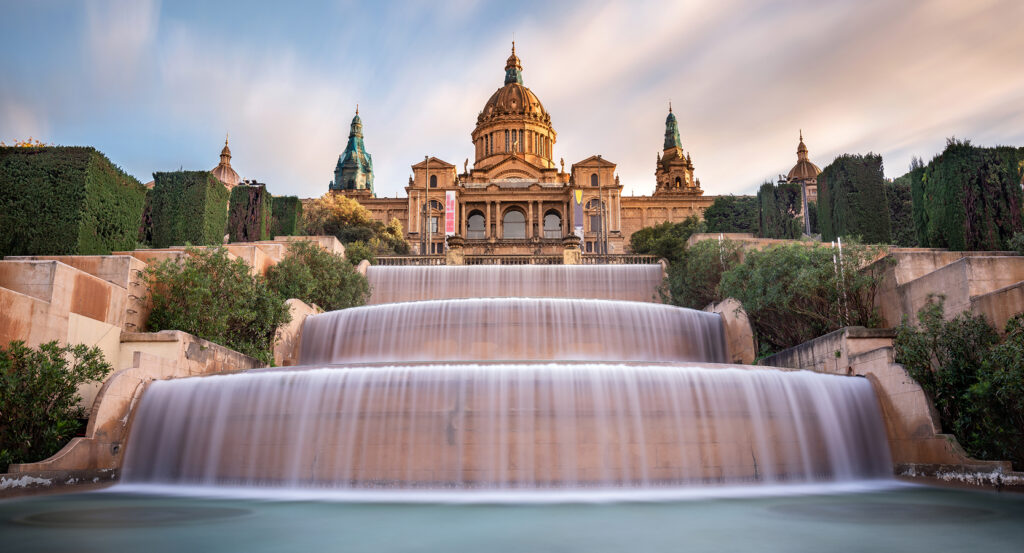
Why you should experience Lluís Companys Olympic Stadium in Barcelona, Spain.
Lluís Companys Olympic Stadium in Barcelona isn't just a sports venue, it's a symbol of rebirth, resilience, and the moment the city introduced itself to the world anew.
Perched on Montjuïc Hill, the Estadi Olímpic Lluís Companys radiates a sense of history that transcends its concrete walls. Its pale stone façade, elegant arches, and sweeping terraces blend the dignity of early 20th-century design with the optimism of modern Spain. When Barcelona hosted the 1992 Olympic Games, this stadium became the beating heart of that transformation, the place where the city turned a global spotlight into a declaration of identity. The cheers that once filled its seats still echo in the air; walking inside, you can almost feel the collective joy of a nation uniting in purpose. Yet beyond its Olympic legacy, the stadium now stands as a monument to progress, a versatile cultural space hosting concerts, ceremonies, and moments that continue to define Barcelona's spirit.
What you should know about Lluís Companys Olympic Stadium.
Built in 1927 for the 1929 International Exposition, Lluís Companys Olympic Stadium was designed by architect Pere Domènech i Roura, and it very nearly never became what it is today.
After the Spanish Civil War, the stadium fell into disuse, surviving decades of neglect before being reborn for the 1992 Games. Rather than demolish the original structure, Barcelona chose to honor its past, preserving the historic façade while rebuilding the interior with state-of-the-art design. This blend of old and new mirrors the city's own evolution, balancing reverence for heritage with bold innovation. Few realize that the stadium's renaming also carries deep resonant weight: it honors Lluís Companys, the president of Catalonia executed in 1940 under Franco's regime, a symbol of courage and unity in the face of oppression. The 1992 Olympics, hosted in this revitalized arena, became the event that reintroduced Barcelona to the world, a city no longer shadowed by dictatorship, but illuminated by creativity and openness. Today, the stadium continues to serve as both a living monument and a functional venue, hosting international concerts, athletic events, and celebrations that keep its spirit alive.
How to fold Lluís Companys Olympic Stadium into your trip.
A visit to Lluís Companys Olympic Stadium is a journey through time, one that pairs panoramic views with a powerful sense of purpose.
Start the exploration at the Olympic Ring, where the stadium anchors a vast plaza surrounded by the Palau Sant Jordi, the Calatrava Communications Tower, and the Olympic Esplanade. Stroll through this open-air museum of modern design, then step inside the stadium to walk the very track where athletes once made history. The site now includes a museum and exhibits showcasing the city's Olympic legacy, including the torch, uniforms, and artifacts from 1992. From the upper terraces, the view stretches across Montjuïc and down toward the Mediterranean, reminding you why this hill was chosen as the Games' stage. Visit in the late afternoon for golden-hour light and quieter surroundings, when the sun casts long shadows through the arches and the breeze carries the scent of pine from the nearby gardens. Whether you're a sports fan or a lover of history, Lluís Companys Olympic Stadium captures the essence of Barcelona's spirit, proud, creative, and eternally striving toward something greater than itself.
Where your story begins.
Foresyte Travel reveals places that feel extraordinary long before you arrive.
Experience premium editorial crafted for luxury travelers.














































































































