
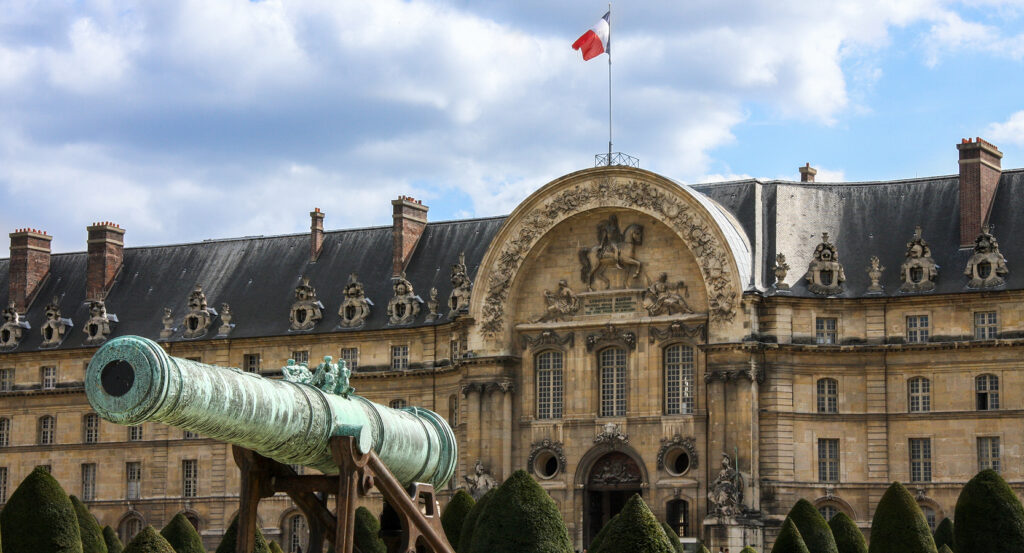
Why Musée de l'Armée matters.
Musée de l'Armée is a formidable military museum where Invalides' ceremonial character meets five centuries of arms and armor, France's successive military regimes and the vast seventeenth-century complex Louis XIV created for his veterans.
Set along Rue de Grenelle near Boulevard des Invalides and just steps from Esplanade des Invalides, the museum occupies the immense Hôtel national des Invalides, where Libéral Bruant's arcaded courtyards, long classical facades and Jules Hardouin-Mansart's gilded dome create a military precinct extending across an entire section of the 7th Arrondissement. The Cour d'Honneur establishes the physical center through two levels of arcades surrounding an open quadrangle lined with historic artillery. Long galleries lead into wings originally built around the daily requirements of thousands of pensioners, with Saint-Louis-des-Invalides and the Dôme rising along the central axis behind them. The northern facade opens toward the broad lawns of the Esplanade des Invalides and the Seine, giving the enclosed courtyards a direct connection with one of western Paris's largest ceremonial landscapes. The result is a museum whose collections unfold inside the surviving architecture of the military institution that preceded it by more than two centuries.
What defines Musée de l'Armée.
Musée de l'Armée is best known for uniting two major nineteenth-century military collections at Hôtel des Invalides in 1905, creating an institution whose holdings now approach 500,000 works spanning military history from prehistoric archaeology to contemporary conflict. Its oldest institutional lineage runs through the Musée d'Artillerie, whose holdings drew upon the Arsenal artillery depot, the Garde-Meuble de la Couronne, Revolutionary seizures and Napoleonic conquests before moving from the cloister of Saint-Thomas-d'Aquin to Hôtel des Invalides in 1871. A second lineage emerged from the Exposition universelle of 1889, where the Ministry of War pavilion on the Esplanade des Invalides stimulated interest in a museum devoted to French military history. Édouard Detaille, Ernest Meissonier, Paul Marmottan and General Émile Vanson belonged to La Sabretache, the society that promoted the project. A decree created the Musée historique de l'Armée in October 1896, concentrating its collections on soldiers, officers, units and military campaigns during a period still shaped by the French defeat of 1870. The two institutions coexisted at Hôtel des Invalides until a presidential decree of July 26, 1905 merged them into Musée de l'Armée. Subsequent gifts and acquisitions brought major private holdings associated with Vanson, Detaille, the Prince de la Moskowa, Georges Paulhiac and brothers Raoul and Jean Brunon into the collection. State transfers expanded the holdings further through Napoléon III's arms and armor from Château de Pierrefonds, the Musée Franchet d'Espèrey collection after Algerian independence and equipment transferred when the Saint-Étienne and Tulle arms factories closed between 1998 and 2001. Wartime events altered the collection itself: enemy trophies entered the Cour d'Honneur during the First World War, German occupation forces removed objects during the Second World War and director General Henri Blanc subsequently led recovery missions in Germany.
The museum's arms and armor holdings preserve a separate technical history in which changing methods of warfare remain visible through the objects themselves. Royal armor stands beside tournament equipment, edged weapons, firearms and artillery, allowing successive solutions to protection, mobility and firepower to be examined across centuries. Uniforms, standards, orders and decorations extend that material history into the systems through which armies distinguished rank, unit and service. Paintings, sculpture, prints, drawings and photography broaden the collection beyond weapons, preserving visual representations of combat and military life alongside the equipment used within them. Archaeological objects and extra-European ethnographic holdings extend the chronological and geographic reach beyond modern French campaigns. The Hôtel itself deepens that material sequence: Louis XIV founded Hôtel des Invalides in 1670, Libéral Bruant directed construction from 1671 to 1675 and Hardouin-Mansart assumed responsibility for its churches in 1676. The soldiers' church was complete in 1679, followed by Louis XIV's inauguration of the royal Dôme church in 1706, establishing the architectural division between veterans and sovereign within a single religious composition. Napoleon's remains later entered the Dôme, with the emperor placed in 1861 in the tomb developed from Louis Visconti's design. Musée de l'Armée consequently places the technical history of warfare inside a building created by the monarchy for the people who had survived it.
How Musée de l'Armée fits.
Musée de l'Armée works as the anchor for a daytime exploration through the 7th Arrondissement using three nearby sites that move from an eighteenth-century private residence converted through an artist's personal bequest through a royal military academy into a princely palace transformed into France's legislative chamber.
Begin at Musée Rodin, housed in the Hôtel Biron, the residence Jean Aubert developed for financier Abraham Peyrenc de Moras between 1727 and the 1730s. Marshal Louis-Antoine de Gontaut-Biron acquired the property in 1753 and enlarged its celebrated gardens; the Society of the Sacred Heart later occupied the estate from 1820 until 1904. Artists subsequently rented rooms there, including Jean Cocteau, Henri Matisse, Isadora Duncan and Clara Westhoff, whose husband Rainer Maria Rilke introduced Rodin to the property. Rodin took four ground-floor rooms in 1908 and occupied the entire mansion from 1911. His three donations to the French state were accepted by law in 1916 on the condition that the Hôtel Biron become his museum, which opened in 1919. Continue to École Militaire, founded by Louis XV through an edict of January 1751 after Marshal de Saxe, Madame de Pompadour and financier Joseph Pâris Duverney promoted a school capable of training officers beyond the costly academies available to noble families. Ange-Jacques Gabriel received the architectural commission for a complex conceived with exceptional royal ambition. Napoleon Bonaparte entered the institution in 1784 and completed his training the following year, giving the academy a direct connection with the artillery officer who later reshaped France and Europe. The site subsequently accumulated higher military teaching and research institutions, with figures including Ferdinand Foch and Charles de Gaulle connected to its later history. Conclude at Palais Bourbon, built with the adjoining Hôtel de Lassay between 1722 and 1728 for the duchesse de Bourbon and the marquis de Lassay. Giardini, Lassurance, Jacques Gabriel and Jean Aubert successively directed a residence conceived between court and garden before the Revolution converted it into national property. The Conseil des Cinq-Cents occupied the palace from 1795, Bernard Poyet added the Seine-facing twelve-column portico between 1806 and 1810 and Jules de Joly reconstructed the legislative chamber after the state acquired the building in 1827. Eugène Delacroix later painted the library ceilings, embedding a major nineteenth-century artistic commission inside the parliamentary complex. The progression moves from Rodin's conversion of an eighteenth-century residence into the permanent home of his work through Gabriel's royal academy for officer education into a Bourbon palace repeatedly rebuilt for representative government, extending the visit across three institutions whose functions changed as France moved through monarchy, empire and republic.
Where your story begins.
Foresyte Travel reveals places that feel extraordinary long before you arrive.
Experience premium editorial crafted for luxury travelers.
Foresyte Travel may earn a commission when you book through the link on this page.














































































































