Why you should experience Olympic Ring in Barcelona, Spain.
Olympic Ring of Montjuïc is more than a collection of venues, it's a symbol of Barcelona's rebirth, a place where the city reintroduced itself to the world with confidence, creativity, and heart.
Spread across Montjuïc Hill, the complex feels almost celestial from above, circular forms echoing the sun, the sea, and the rhythm of sport. At its center stands the striking Telecommunications Tower by Santiago Calatrava, a futuristic white spire that tilts skyward like an athlete poised for flight. Around it, the Palau Sant Jordi arena, the Olympic Stadium, and the Bernat Picornell Pools form an architectural harmony that captures the optimism of the 1992 Games. Walking through the esplanade, you can still feel the hum of that historic summer, the cheers, the anthem, the shared belief that Barcelona had entered a new era. Today, Olympic Ring remains one of the city's most inspiring open spaces, part monument, part park, and entirely alive with the echoes of achievement.
What you didn’t know about Olympic Ring.
When Barcelona was chosen to host the 1992 Olympicsïc, long underused and overlooked, was transformed into the city's heart of innovation.
The original Estadi Olímpic Lluís Companys dated back to 1927 and was built for a never-held 1936 People's Olympiad meant to oppose fascism; decades later, it was modernized but not replaced, preserving its historic façade while adding state-of-the-art interiors. Calatrava's Telecommunications Tower was designed not only as an artistic centerpiece but also as a functional sundial, its shadow marks time across the plaza throughout the day. The Palau Sant Jordi, designed by Japanese architect Arata Isozaki, remains one of the most acoustically and structurally advanced arenas in Europe, hosting concerts and cultural events alongside sports. The layout of Olympic Ring follows geometric principles of balance and sightline alignment, ensuring every major structure frames either the sea or the mountains, a deliberate dialogue between nature and human design. What began as an Olympic dream became a lasting architectural statement of unity and progress.
How to fold Olympic Ring into your trip.
Visiting Olympic Ring is like stepping into a chapter of modern legend.
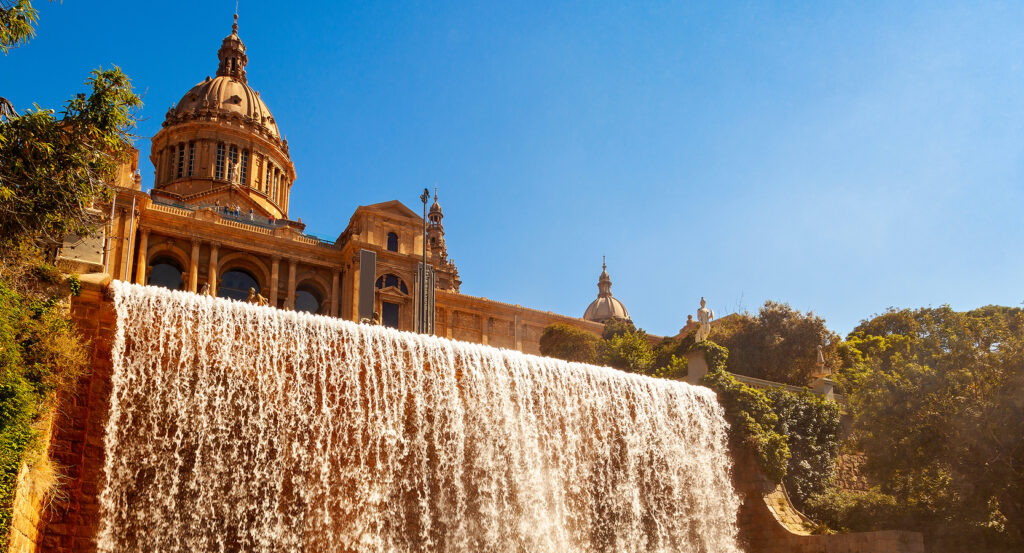
Start your walk from the Palau Nacional and follow the wide, open avenues that ascend gently toward the plaza, each step revealing new angles of the hill and city below. Wander through the main esplanade where fountains shimmer between the stadium and Calatrava's tower, and let yourself feel the scale, the way space, sky, and structure seem to breathe together. Visit the Estadi Olímpic to walk the same track where the torch once burned, or explore Palau Sant Jordi's sleek curves, still buzzing with cultural life. From the terraces, you'll catch sweeping views of the Mediterranean and Barcelona's skyline, framed by the ring's graceful geometry. Stay through sunset, when the white of the tower glows pink against the sky and the hill grows quiet except for the whisper of the breeze. Olympic Ring of Montjuïc isn't just a relic of 1992, it's a testament to vision, where a city once again dared to dream on a global scale and has been shining ever since.
Hear it from the Foresyte community.
Just enough life around you not to be overwhelming. Right pace.
Where your story begins.
Start your planning journey with Foresyte Travel.
Experience immersive stories crafted for luxury travelers.