
Why Palau Nacional matters.
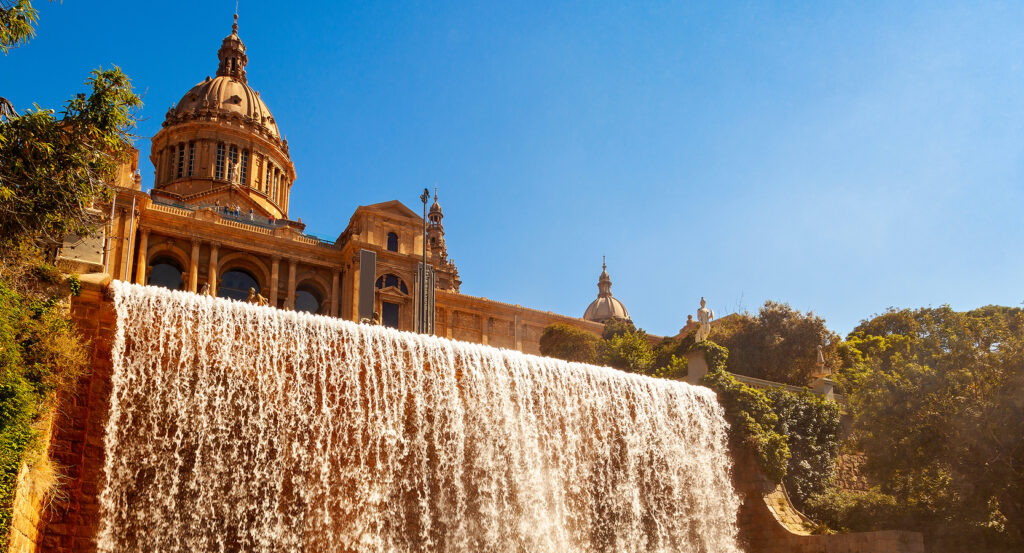
The Palau Nacional is one of Barcelona's grandest architectural statements, a palace that crowns Montjuïc Hill with grand grace and stands as a symbol of Catalonia's creative and cultural pride.
Its sweeping dome, cascading staircases, and stately colonnades feel like something out of an Italian Renaissance dream, yet its essence is distinctly Catalan, powerful, proud, and filled with soul. Originally built for the 1929 International Exposition, the Palau Nacional was designed to awe, and nearly a century later, it still does. Approach it from Plaça d'Espanya, and you'll feel its magnetic pull long before you arrive: the rhythmic rush of fountains, the scent of stone warmed by the sun, the hum of the city echoing far below. Inside, it now houses the National Art Museum of Catalonia, where the story of a people unfolds through centuries of art. But even stripped of its exhibitions, the Palau Nacional itself is art, a masterpiece of form, symmetry, and light that reflects Barcelona's eternal dance between tradition and modernity.
What defines Palau Nacional.
The Palau Nacional was constructed in record time, just under three years, as the centerpiece of the 1929 Barcelona International Exposition.
Architects Eugenio Cendoya and Enric Catà designed it in a Spanish Renaissance style meant to evoke timeless grandeur, with a massive central dome inspired by St. Peter's Basilica in Rome and flanked by elegant towers symbolizing Spain's historic regions. The palace originally served as a showcase for Spanish art, science, and industry, featuring 6,000 exhibits during the exposition. After the event, it fell into disuse before being reborn in 1934 as the home of Catalonia's national art collection, a transformation that gave it new purpose and prestige. Few visitors realize that much of its marble detailing is actually painted plaster, a brilliant illusion created to save time and cost during its rapid construction. The building's enormous dome, weighing over 2,000 tons, remains a feat of early 20th-century engineering. Its vantage point on Montjuïc was carefully chosen to symbolize vision, a literal and metaphorical lookout over the heart of Barcelona.
How Palau Nacional fits.
Visiting the Palau Nacional is as much about atmosphere as it is about architecture.
Start the ascent from Plaça d'Espanya and take the escalators that carry you past the Magic Fountain, a dazzling prelude to the palace above. Climb the final steps on foot; each terrace reveals a broader view of the city stretching toward the Mediterranean. Once at the top, take time to wander the exterior before entering, the sheer scale of its façades, domes, and staircases is worth savoring. Inside, explore the grand oval hall with its massive arches and intricate ceiling paintings, then make your way to the galleries of the National Art Museum of Catalonia, where centuries of creativity unfold. Afterward, step onto the rooftop terrace for one of Barcelona's most cinematic views. As dusk falls, the city glows below like a sea of light, the Palau Nacional illuminated behind you, timeless and triumphant. It's not just a landmark; it's the spiritual crown of Montjuïc, where art, architecture, and horizon meet in perfect balance.
Where your story begins.
Foresyte Travel reveals places that feel extraordinary long before you arrive.
Enjoy editorial crafted for luxury travelers.
Foresyte may earn a commission when you book.














































































































