Why National Gallery Singapore matters.
National Gallery Singapore is a visionary art museum where Downtown Core's civic legacy, Southeast Asia's artistic imagination, architectural preservation, and Singapore's cultural character converge within the nation's most important historic institutions.
Set along St. Andrew's Road near Coleman Street and just steps from Padang, this extraordinary museum unfolds through soaring atriums, restored colonial chambers, contemporary galleries, and dramatic architectural interventions that unite history with artistic innovation. Light-filled exhibition spaces reveal centuries of creative expression as paintings, sculpture, photography, installations, and multimedia works trace the evolution of Southeast Asian art across diverse cultures and political transformations. Elegant bridges, carefully restored interiors, and striking contemporary additions create a discussion between heritage architecture and modern museum design that enriches every gallery experience. The experience ultimately unites artistic excellence, historical continuity, and architectural ingenuity into one of Asia's foremost cultural destinations.
What defines National Gallery Singapore.
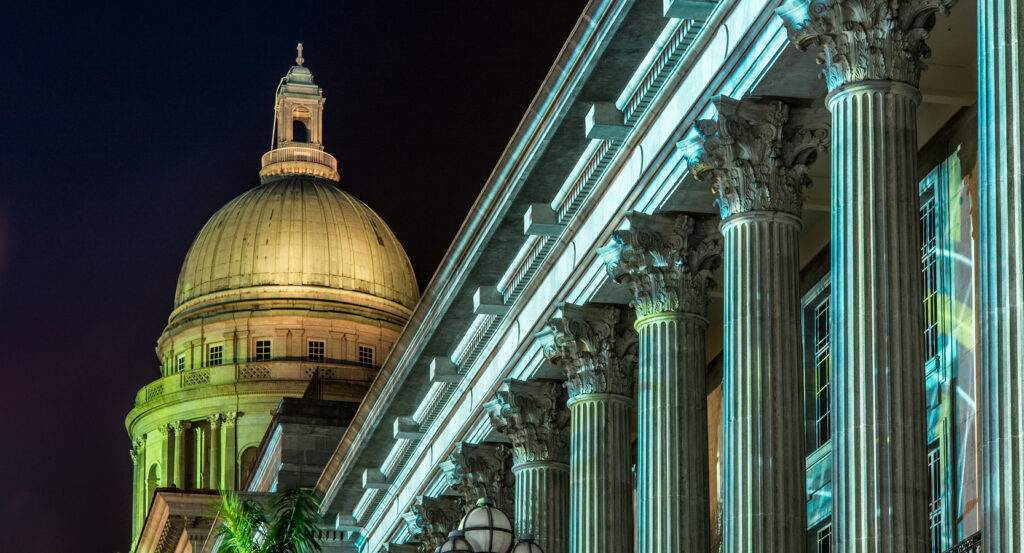
National Gallery Singapore is best known for opening on 24 November 2015 inside the meticulously restored former Supreme Court and City Hall, creating the world's largest public collection of modern Southeast Asian art with more than 9,000 works while transforming two of Singapore's most historically significant civic buildings into a unified museum devoted to the artistic histories of Singapore and the wider region. The museum emerged following an ambitious decade-long redevelopment led by Studio Milou Architecture in collaboration with CPG Consultants, carefully preserving the neoclassical character of the Supreme Court, completed in 1939 to the designs of Frank Dorrington Ward, alongside the former City Hall, completed in 1929 under Municipal Architect A. Gordon with partner S. D. Meadows. Both buildings occupy central places in Singapore's national story: the Supreme Court served as the colony's highest judicial institution for more than six decades, while City Hall witnessed Admiral Lord Louis Mountbatten's acceptance of Japan's surrender in Southeast Asia in 1945 and Prime Minister Lee Kuan Yew's inauguration following Singapore's attainment of self-government in 1959. The museum's collection spans nineteenth-century colonial-era painting through contemporary practice, preserving masterworks by pioneers including Georgette Chen, Cheong Soo Pieng, Liu Kang, Chen Wen Hsi, Latiff Mohidin, Affandi, Raden Saleh, Anita Magsaysay-Ho, and many of Southeast Asia's most influential artists. Permanent galleries examine artistic movements shaped by colonialism, independence, nationalism, migration, abstraction, modernism, and contemporary experimentation, while major international exhibitions, scholarly research, conservation laboratories, and educational initiatives reinforce the institution's position as the leading center for Southeast Asian art. Sophisticated architectural interventions, including dramatic glass-and-steel canopy structures spanning the rooftops and environmentally controlled galleries seamlessly integrated within historic interiors, demonstrate how adaptive reuse can preserve civic heritage while creating one of Asia's foremost cultural institutions.
Thoughtfully choreographed galleries encourage visitors to experience Southeast Asian art as an interconnected narrative, revealing centuries of shared influences across the region through exceptional scholarship and curatorial depth. Courtrooms, ceremonial chambers, grand staircases, and restored civic spaces remain integral components of the visitor experience, allowing the buildings themselves to communicate Singapore's constitutional, judicial, and political evolution alongside the artworks they now protect. Advanced conservation facilities, carefully calibrated lighting, and internationally recognized exhibition design preserve fragile masterpieces while continually expanding public understanding of Southeast Asia's artistic legacy. Art, architecture, national history, and cultural scholarship ultimately combine to create one of the continent's most intellectually rewarding museum experiences.
How National Gallery Singapore fits.
National Gallery Singapore works as the centerpiece of an exploration through Downtown Core's historic civic district.
Begin at Padang, where Singapore's ceremonial green introduces the nation's civic heart before entering National Gallery Singapore to explore Southeast Asia's foremost artistic collections. Continue to Victoria Theatre and Concert Hall, whose distinguished architecture reinforces the district's enduring cultural character along the Singapore River. Conclude at St. Andrew's Cathedral, where graceful Gothic Revival architecture provides a fitting finale celebrating the civic, spiritual, and artistic traditions that have shaped modern Singapore. The progression moves naturally from national civic space to world-class artistic discovery before concluding through one of the city's finest ecclesiastical ensembles, revealing why Downtown Core remains the cultural heart of Singapore.
Where your story begins.
Foresyte Travel reveals places that feel extraordinary long before you arrive.
Enjoy editorial crafted for luxury travelers.
Foresyte may earn a commission when you book.