
Why Lluís Domènech i Montaner matters.
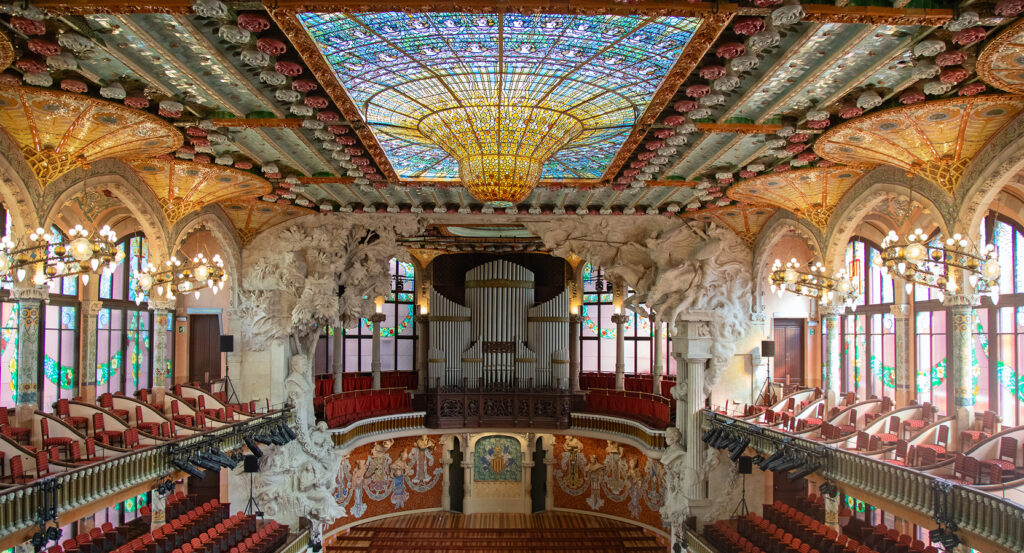
The sculptures conceived by Lluís Domènech i Montaner for the Palace of Catalan Music aren't just decoration, they are living extensions of the building's soul.
Walk along the façade or step inside, and you'll feel as if the entire structure is breathing art. Figures burst from walls, angels play instruments from balconies, and allegorical forms seem to emerge from the stone mid-song. Montaner envisioned architecture as a symphony, one in which sculpture, light, and color all played in harmony, and nowhere is that more vivid than here. The sculptural ensemble captures the ideals of Catalan Modernism: expressive, organic, and deeply human. On the façade, Saint George - Catalonia's patron, emerges heroically above a choir of villagers, his presence both protective and symbolic of artistic freedom. Inside, muses and musical deities weave through the arches and ceilings, guiding every visitor toward the heart of creation. Standing among them feels less like viewing art and more like being welcomed into a world where sound has taken form.
What defines Lluís Domènech i Montaner.
Every sculptural detail within the Palau was the product of collaboration between Montaner and a team of master artisans, each contributing their own genius to the vision.
The most celebrated is Miquel Blay's façade group, La Cançó Popular Catalana (“The Catalan Folk Song”), depicting Saint George watching over a chorus of singers, a direct metaphor for Catalonia's resilience through culture. Above them, busts of classical composers, Beethoven, Bach, and Palestrina, remind visitors that Catala character is inseparable from the universal language of music. Inside, Eusebi Arnau and other sculptors crafted ethereal female figures that blend seamlessly with the architecture, angels carved into capitals, floral reliefs unfurling across the proscenium, and stone instruments that seem poised to play. Montaner's vision was revolutionary: sculpture was not to be appended to architecture but to become architecture. The result is a building that feels alive, every curve, every gesture, every face contributing to a unified expression of joy, freedom, and artistic awakening. Few realize that many of these sculptural elements also serve practical purposes, concealing acoustic and structural supports beneath their beauty. It is engineering disguised as art, and art disguised as worship.
How Lluís Domènech i Montaner fits.
To experience Montaner's sculptures fully, take your time, both outside and within the Palace of Catalan Music.
Start on the street, facing the façade from across Carrer de Sant Pere Més Alt. Let your eyes follow the figures of Saint George and his chorus as they rise toward the sky, a moment of movement frozen forever in stone. Then, book a guided tour of the interior to uncover the sculptures that most visitors overlook: the angels poised along balconies, the carved musicians above the stage, and the delicate ornamentation that seems to hum with sound. The blend of shadow and light changes everything, return at midday when sunlight streams through the stained glass, transforming the marble and plaster into living forms. If possible, attend a concert in the evening, when warm lighting reveals the sculptures in their most theatrical state, glowing as if animated by the music itself. Take one last look as you leave: you'll realize that Montaner's sculptures were never meant to be seen in silence. They were meant to be heard, in the laughter of visitors, the echo of instruments, and the unbroken song of Barcelona's artistic heart.
Where your story begins.
Foresyte Travel reveals places that feel extraordinary long before you arrive.
Enjoy editorial crafted for luxury travelers.
Foresyte may earn a commission when you book.














































































































