Why the Pfarrkirche St. Mauritius matters.
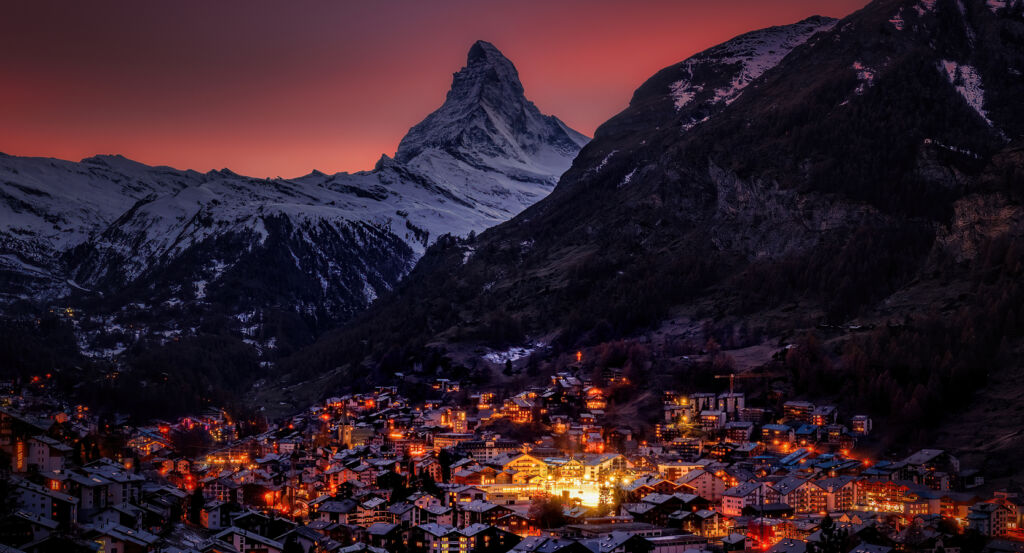
The Pfarrkirche St. Mauritius in Zermatt, Switzerland, isn't just a church, it's the village's quiet heartbeat, where faith, history, and mountain life intertwine beneath the watchful eye of the Matterhorn.
Standing proudly at the center of town, this neo-Romanesque parish church feels less like a landmark and more like a living presence. Its tall stone tower rises above Zermatt's rooftops, its bells marking the rhythm of life in a place where time seems to slow with the snow. Step inside, and the world hushes. The air smells faintly of wax and pinewood, and sunlight filters through stained-glass windows that tell the story of alpine devotion, shepherds, saints, and climbers rendered in color and light. Though it's been rebuilt several times since its origins in the 13th century, the church's soul hasn't changed. It's where locals gather for baptisms, farewells, and the first snowfall's blessing. The Matterhorn may symbolize Zermatt's strength, but St. Mauritius represents its spirit, enduring, unpretentious, and grounded in something greater than the mountain itself.
What defines the Pfarrkirche St. Mauritius.
Behind its calm exterior, the Pfarrkirche St. Mauritius holds a layered story, one that mirrors Zermatt's evolution from remote alpine hamlet to world-renowned mountain village.
Dedicated to St. Maurice, the patron saint of the Valais, the church's first incarnation stood near the old cemetery in the 1200s, serving as a refuge for travelers crossing the perilous mountain passes. The building, completed in 1916, replaced an earlier structure destroyed by fire, combining Romanesque sturdiness with subtle Art Nouveau details. Its interior is unexpectedly elegant: carved wooden pews, vaulted ceilings painted with delicate alpine motifs, and an altar framed by golden saints that seem to glow in candlelight. The stained-glass windows were added in the mid-20th century, crafted by Swiss artisans who captured both the piety and peril of mountain life. Perhaps most poignant is the church's proximity to the Mountaineers' Cemetery, which sits just behind it, a silent reminder of how faith and loss often coexist here. For locals, this proximity isn't somber; it's fitting. In Zermatt, to live near the mountain is to live near the divine.
How the Pfarrkirche St. Mauritius fits.
Visiting the Pfarrkirche St. Mauritius is a moment to slow your pace, to step out of the postcard views and into the village's living heart.
Located just off Bahnhofstrasse, Zermatt's main promenade, the church is easy to find and worth lingering in, whether for a quick prayer or quiet reflection after a long hike. Morning light pours through the windows, casting warm hues across the nave, while evenings often bring the soft echo of organ rehearsals that drift into the square. Plan the visit around the hour mark to hear the bell tower chime, its deep notes roll through the valley like a benediction. Combine your stop with a visit to the Matterhorn Museum - Zermatlantis, just steps away, to understand how the town's spiritual and mountaineering histories are inseparable. In summer, sit on the nearby bench overlooking the Mountaineers' Cemetery, or in winter, pause outside the church after dusk, when the tower lights shimmer against falling snow. The Pfarrkirche St. Mauritius isn't a grand cathedral, it's something rarer: a place where beauty whispers, faith feels tangible, and the mountains outside seem to bow their heads in quiet respect.
Where your story begins.
Foresyte Travel reveals places that feel extraordinary long before you arrive.
Enjoy editorial crafted for luxury travelers.
Foresyte may earn a commission when you book.