
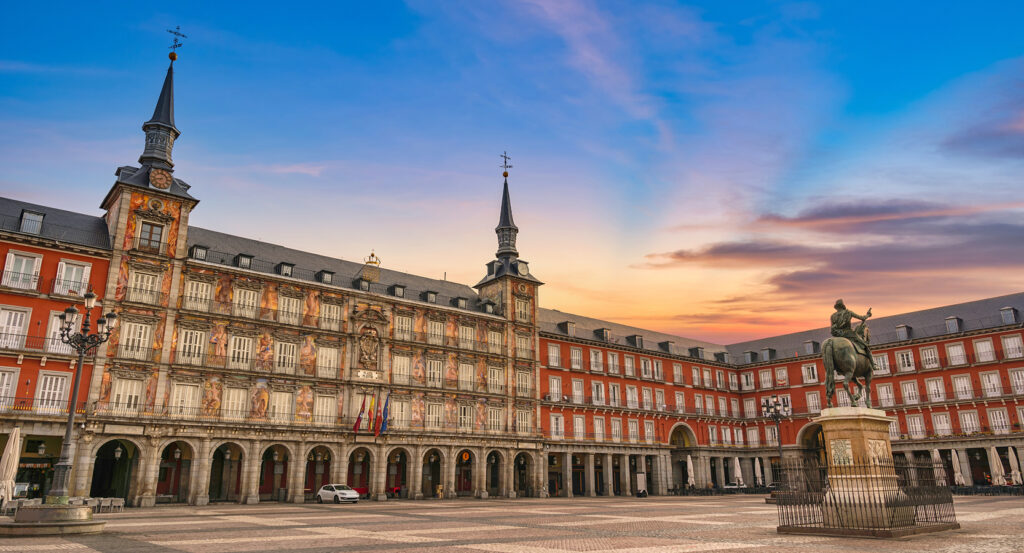
Why Arco de Cuchilleros matters.
Arco de Cuchilleros, or Arch of Cuchilleros, is Madrid's most cinematic entrance, a steep, shadowed portal where the grandeur of Plaza Mayor meets the pulse of the old city.
Descending from the southwest corner of the square, its sloping staircase spills into the tangle of medieval streets below, like a ribbon unrolling through time. The arch's brick vault frames a perfect view of the plaza's red façades above, while the stone steps lead down into the hum of taverns, knivesmiths, and laughter echoing off centuries-old walls. Walking through it feels less like leaving the square and more like being lowered into its living roots. The scent of roasted garlic drifts from the cellars, musicians play from doorways, and sunlight flickers through the arch like a secret invitation. It's one of those rare spaces where transition becomes art, a threshold that connects majesty to the mundane, still carrying the heartbeat of every generation that's passed beneath it.
What defines Arco de Cuchilleros.
Arco de Cuchilleros owes its name, “arch of the knife makers”, to the craftsmen who once worked in the street below, forging blades for the nearby butchers' guild at Plaza Mayor.
The structure dates back to the 17th century, when architect Juan Gómez de Mora redesigned the square after its first major fire. Because Plaza Mayor sits atop uneven terrain, the ground level of its southern edge required this dramatic, sloped gateway to connect the elevated plaza to the Lower La Latina district. The result was not just functional but iconic, an accidental masterpiece of perspective and proportion. Its deep brick vault, lined with stone voussoirs, frames one of the city's most photographed stairways. For centuries, the arch served as the plaza's busiest passage, merchants hauling goods, soldiers marching in formation, and locals descending into the tavern-filled quarter below. In the 19th century, the area became famous for its tabernas castizas, traditional taverns whose vaulted ceilings and tiled walls still evoke Madrid's old soul. Few visitors realize the arch's structure is self-supporting, the pressure of the surrounding buildings holds the vault in perfect equilibrium, a feat of early urban engineering that's endured every earthquake and fire since. Today, the Arch of Cuchilleros remains more than an entrance, it's a living symbol of connection, where Madrid's regal core meets its everyday heart.
How Arco de Cuchilleros fits.
Enter the arch from inside Plaza Mayor, ideally in the late afternoon when the light glows amber across the square's façades.
Walk toward the southwest corner and look for the steep descent, the arch frames a postcard-perfect view of Calle de Cuchilleros below. Pause beneath its curve to admire the blend of light and shadow, then begin your descent down the worn stone steps. Stop midway and glance back, the plaza behind you rises like a stage set, its symmetry now framed in brick and history. At the base, you'll find some of Madrid's oldest taverns, including Sobrino de Botín, the world's oldest restaurant, and Las Cuevas de Luis Candelas, a cave-like eatery named after a renowned 19th-century bandit who once hid in these tunnels. Sit for a glass of Rioja and a plate of roast lamb, and let the arch become your backdrop, a reminder that even thresholds can tell stories. When you climb back up toward the plaza at night, the lanterns will cast the arch in gold and shadow, and you'll understand why every Madrileño considers it more than an entrance, it's a passage between worlds, carved into the city's soul.
Where your story begins.
Foresyte Travel reveals places that feel extraordinary long before you arrive.
Enjoy editorial crafted for luxury travelers.
Foresyte may earn a commission when you book.














































































































