
Why Pont des Invalides matters.
Pont des Invalides is a resilient river crossing where the Invalides quarter's ceremonial character meets nineteenth-century engineering, Second Empire sculpture and a Seine crossing repeatedly rebuilt after technical failure and natural disaster.
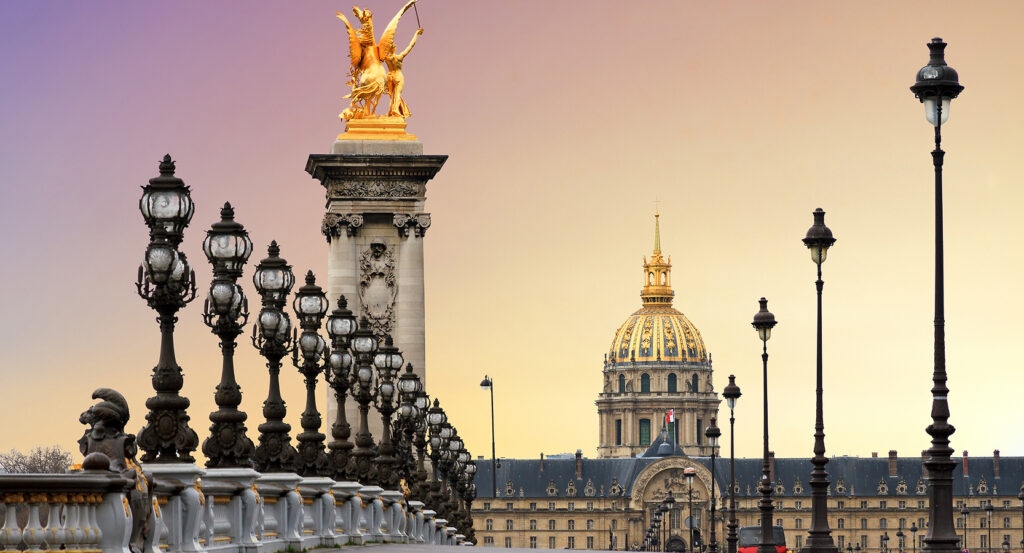
Set across the Seine between Quai d'Orsay and Cours la Reine and just steps from Esplanade des Invalides, the bridge occupies a broad river corridor where tree-lined quays, embankment walls and long perspectives toward the golden Dôme des Invalides open between the dense blocks of the 7th and 8th Arrondissements. Four shallow masonry arches carry the roadway across the water, their low profile preserving wide views along both banks. Stone piers divide the span into a measured sequence beneath a deck carrying traffic between Avenue Franklin D. Roosevelt and Boulevard de La Tour-Maubourg. Military trophies and sculptural groups embedded into the piers introduce concentrated ornament below a comparatively restrained roadway. The result is a low, strongly horizontal Seine crossing whose engineering and imperial decoration connect the Invalides precinct with the avenues extending north toward the Champs-Élysées.
What defines Pont des Invalides.
Pont des Invalides is best known for emerging from three successive nineteenth-century engineering schemes, beginning with Claude Navier's technically ambitious attempt to carry a suspension bridge across the Seine. Navier developed his proposal in the early 1820s for a site directly aligned with Hôtel des Invalides, and construction began in 1824 before structural problems condemned the unfinished work. Preservation of the Invalides perspective contributed to moving the replacement downstream, where Marie Fortuné de Vergès and Bayard de la Vingtrie developed a three-span suspension bridge authorized by royal ordinance on December 6, 1827. Their iron-chain structure opened in 1829 with two river piers and a principal span measuring 67.8 meters, yet deterioration forced restrictions on its use by 1850. Preparations for the Exposition Universelle of 1855 brought another reconstruction, placing Paul-Martin Gallocher de Lagalisserie and Jules Savarin in charge of replacing the suspension structure with masonry arches. The engineers retained the two existing river piers, inserted a third central pier and created four shallow arches measuring 34, 36, 36 and 34 meters across their openings. Contractor Gariel executed the work, producing a 152-meter bridge with a 14-meter carriageway and two 2-meter sidewalks. The crossing entered service in May 1856, carrying forward physical components of the 1829 bridge within a fundamentally different structural system. Pont des Invalides condenses an unusually concentrated sequence of French bridge engineering, moving from Navier's unrealized single-span experiment through iron-chain suspension into the masonry structure that survives.
Sculpture transformed the utilitarian river supports into a Second Empire commemorative program tied to French military power. Nicolas-Victor Vilain created La Victoire terrestre for the upstream face of the central pier, placing a martial allegory above the Seine. Georges Diébolt supplied La Victoire maritime for the downstream side, connecting the bridge with the sculptor whose work also entered the contemporary Pont de l'Alma. Astyanax-Scévola Bosio developed military trophies carrying imperial arms for the two older piers inherited from the suspension bridge. Structural trouble returned during the 1870s despite the masonry reconstruction, with restoration of the arch stones undertaken in 1876 and settlement measuring 25 to 30 centimeters appearing in 1878. Severe winter conditions then subjected the Seine infrastructure to another destructive test in 1880. Ice struck the bridge and its temporary works, and two arches collapsed under the pressure before reconstruction restored them by the close of the year. Twentieth-century intervention remained limited, with sidewalk widening in 1956 carried on projecting supports beyond the earlier deck. The surviving bridge joins Second Empire sculpture with physical evidence of nineteenth-century structural adaptation, including piers inherited from its predecessor and arches rebuilt after the Seine ice disaster.
How Pont des Invalides fits.
Pont des Invalides works as the anchor for a daytime exploration across the Seine using three nearby sites that move from Louis XIV's purpose-built military institution through the exhibition architecture of 1900 into the underground engineering that modernized nineteenth-century Paris.
Begin at Hôtel des Invalides, founded by Louis XIV in 1670 to house soldiers left wounded, elderly or unable to continue military service. Libéral Bruant directed construction from 1671 to 1675, arranging the institution as a vast quadrilateral behind a long principal facade and around a central court. Jules Hardouin-Mansart replaced Bruant in 1676 for the religious buildings, completing the soldiers' church in 1679 before developing the royal church crowned by the gilded dome. Louis XIV inaugurated the Dôme in 1706, and Napoleon's remains entered the building during the nineteenth century before installation of his tomb there in 1861. The Musée de l'Armée has occupied the complex since 1905, extending a military institution founded under the Bourbon monarchy into a national historical collection. Continue across the river to Petit Palais, created by Charles Girault for the Exposition Universelle of 1900 as part of the new ensemble developed with Grand Palais and Pont Alexandre III. Girault had won the Petit Palais commission through the 1896 architectural competition and combined classical references, reinforced concrete and large exterior openings within a building conceived for permanent use after the exhibition. The City of Paris received the palace in 1901, and the Musée des Beaux-Arts opened there in 1902. Eugène and Auguste Dutuit's bequest that year substantially expanded the holdings, followed by donations associated with Edward and Julia Tuck, Ambroise Vollard, Carpeaux, Courbet and Roger Cabal. Decorative work continued from 1903 to 1925, including Albert Besnard's four Symbolist vestibule panels and Maurice Denis's later cupola decoration. Conclude at Musée des Égouts de Paris, which opens another nineteenth-century chapter through the infrastructure constructed beneath the capital. Public descents into the sewer system were already operating in 1867, the year of another Paris Exposition Universelle, when sewer workers guided groups underground by boat and wagon-vanne. Royal figures, engineers and members of the public entered a network whose expansion became one of the defining engineering undertakings of modern Paris. The present museum carries that history into the physical sewer system itself, converting infrastructure hidden beneath the Left Bank into an account of the technologies that supported the capital's enormous nineteenth-century growth. The progression moves from Bruant and Hardouin-Mansart's seventeenth-century institution for soldiers through Girault's permanent exhibition palace into the subterranean infrastructure opened to public inspection in 1867, connecting three ambitious public works across the territory surrounding Pont des Invalides.
Where your story begins.
Foresyte Travel reveals places that feel extraordinary long before you arrive.
Enjoy editorial crafted for luxury travelers.
Foresyte may earn a commission when you book.














































































































