
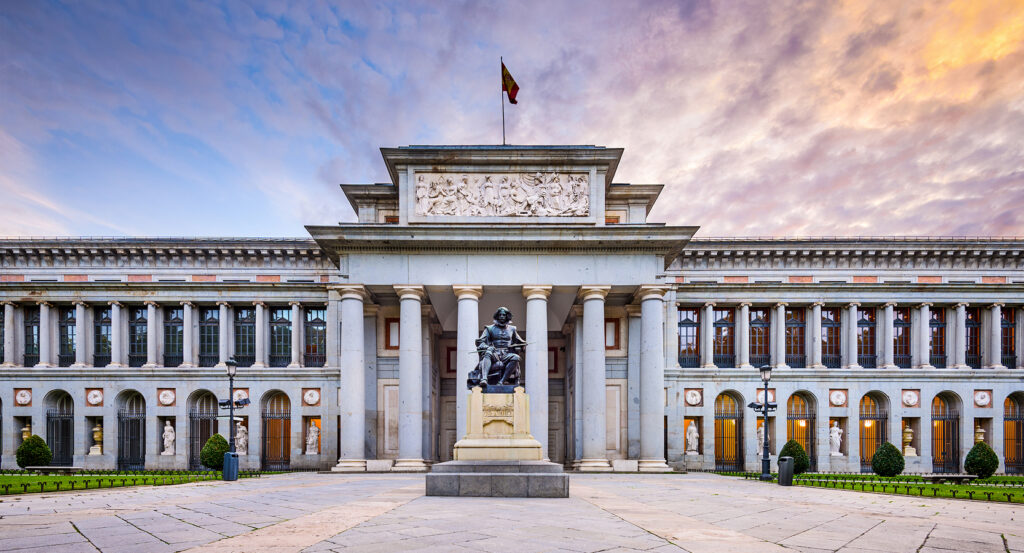
Why you should experience Goya Statues at Prado Museum in Madrid, Spain.
Goya Statues at Prado Museum in Madrid are more than monuments, they are Madrid's discussion with its conscience.
Standing guard near the north entrance of Prado Museum, the sculpted likeness of Francisco de Goya watches over the crowds with the same penetrating gaze that once unmasked kings, saints, and monsters. Bronze and unblinking, he holds his painter's tools in hand, brush and palette balanced like instruments of truth. Around him, the city hums; taxis rush, trees murmur, museum doors open. Yet Goya remains motionless, a figure caught between reverence and rebellion. Every angle reveals something different: compassion from the front, defiance from the side, genius from below. His presence feels less commemorative than eternal, as if Madrid itself still draws breath from his rebellious spirit.
What you should know about Goya Statues at Prado Museum.
The most famous of the Goya monuments, the bronze figure opposite the Prado's northern façade, was sculpted in 1902 by Mariano Benlliure, among Spain's greatest sculptors of the late 19th century.
Commissioned to mark the 75th anniversary of Goya's death, Benlliure's statue captures the painter not as a court portraitist, but as a visionary burdened by what he saw. Unlike traditional heroic monuments, Goya's stance here is contemplative, the brush lowered, the eyes turned inward. The pedestal beneath him bears reliefs of La Maja Desnuda and La Maja Vestida, echoing the dualities that defined his art: sensuality and shame, power and powerlessness, reason and madness. A second, lesser-known Goya statue stands further down the Paseo del Prado, near the Fountain of Neptune, serving as an axis of artistic pilgrimage connecting the Prado, Thyssen-Bornemisza, and Reina Sofía museums, together forming Madrid's “Golden Triangle of Art.” Few visitors realize that the statues' alignment with the Prado's entrance and the Church of San Jerónimo el Real was intentional, a symbolic gesture uniting Goya's art with faith and mortality, the same themes that haunted his Black Paintings. Over the years, these monuments have become quiet shrines: locals leave flowers on his birthday; art students sketch his likeness in every light. The bronzes have weathered sun, smoke, and protest banners, yet the face of Goya remains unflinching, a mirror for the city's evolving soul.
How to fold Goya Statues at Prado Museum into your trip.
Begin your visit outside the Prado Museum's north entrance, near the staircase that leads down to the statue's pedestal.
Arrive in the morning when the bronze catches the first gold of the sun filtering through the plane trees of the Paseo del Prado. Walk a slow circle around the monument, note how Goya's expression changes as you move, shifting from serenity to scrutiny. Stand at the base and trace the sculpted reliefs that commemorate his most famous works, then look up to the museum façade rising behind him, the home of The Third of May, Saturn Devouring His Son, and The Nude Maja. From here, stroll south along the tree-lined boulevard toward Plaza de Cánovas del Castillo; the second Goya statue appears in the median beyond the Fountain of Neptune, its smaller scale echoing the first like a refrain. Pause there for a few minutes, the traffic noise fades beneath the canopy of trees, and the rhythm of the city seems to steady. If you return after sunset, the lamps cast the bronzes in amber, and Goya's gaze grows almost human, soft, tired, immortal. The Goya Statues along the Paseo del Prado are more than memorials; they are Madrid's conscience made visible, eternal witnesses to beauty and its cost.
Where your story begins.
Foresyte Travel reveals places that feel extraordinary long before you arrive.
Experience premium editorial crafted for luxury travelers.














































































































