
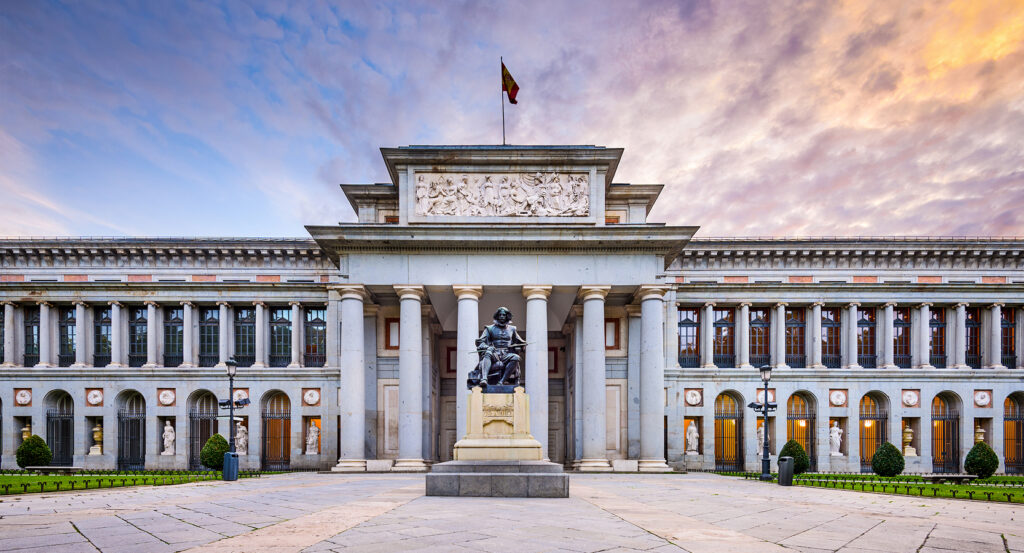
Why you should experience Puerta de Goya in Madrid, Spain.
Puerta de Goya in Madrid is Prado Museum's ceremonial breath, the threshold where the outside world falls away and art begins.
Named in honor of Francisco de Goya, the entrance faces the Paseo del Prado with an understated grace that belies its significance. Beneath its neoclassical columns, visitors stream upward into light, their footsteps echoing against limestone steps that have carried scholars, artists, and wanderers for generations. The façade itself seems to inhale the morning sun, its symmetry echoing the museum's timeless rhythm. Yet this isn't just a doorway, it's an overture. The bronze doors open into a sanctuary of human genius, inviting you to step not only into a gallery, but into conversation with centuries of beauty and truth.
What you should know about Puerta de Goya.
While the Prado Museum was designed by Juan de Villanueva in 1785, Puerta de Goya was only formalized in the early 20th century as the museum's principal access point.
Its placement on the north façade was deliberate, aligning the building's grand axis with the Paseo del Prado, then Madrid's most elegant promenade. The entrance replaced the earlier Puerta de Murillo as the symbolic front door to Spain's national collection, allowing visitors to ascend directly toward the galleries of Goya, Velázquez, and El Greco. In 1902, a bronze statue of Goya by sculptor Mariano Benlliure was unveiled directly before it, transforming the doorway into an architectural discussion between artist and institution. Few visitors realize that the alignment between the statue's gaze and the doorway's central axis was calculated so that Goya “faces” his own works inside, a gesture of eternal return. The stone balustrades and Doric pilasters framing the entrance follow Villanueva's original Enlightenment-era proportions, a fusion of classical order and modern function. During the Spanish Civil War, the Puerta de Goya was fortified to protect the museum's masterpieces as they were evacuated for safekeeping; after the war, it became the site of ceremonial reopenings and state visits, including the 200th anniversary of Goya's death. Beneath the stairs lies one of the museum's oldest foundations, remnants of Villanueva's original retaining walls, discovered during restorations and left intact as silent witnesses to the building's endurance.
How to fold Puerta de Goya into your trip.
Begin your visit along the tree-lined Paseo del Prado, approaching from the north where the Goya statue anchors the museum's presence.
Pause at the base of the steps and look up, the colonnade frames the sky, and beyond it, the doors glint in soft bronze. Take a moment with Goya himself; circle his statue, noticing how his gaze aligns perfectly with the museum's entrance. Then ascend the steps, each one feels like a gradual release from the city's noise into quiet expectation. Once inside, the atrium opens before you, its light diffused across marble and stone, guiding you naturally toward the central galleries. This is the Prado's most theatrical transition: a movement from daylight to history, from the modern to the eternal. When you leave, step back out through the same doorway and look once more toward the boulevard, the trees swaying, the fountain murmuring, Goya waiting where you left him. Puerta de Goya is more than an entrance; it's a ritual. A passage between worlds that reminds every visitor that art's greatest power lies not only in what it shows, but in the reverence it asks of those who enter.
Where your story begins.
Foresyte Travel reveals places that feel extraordinary long before you arrive.
Experience premium editorial crafted for luxury travelers.














































































































