
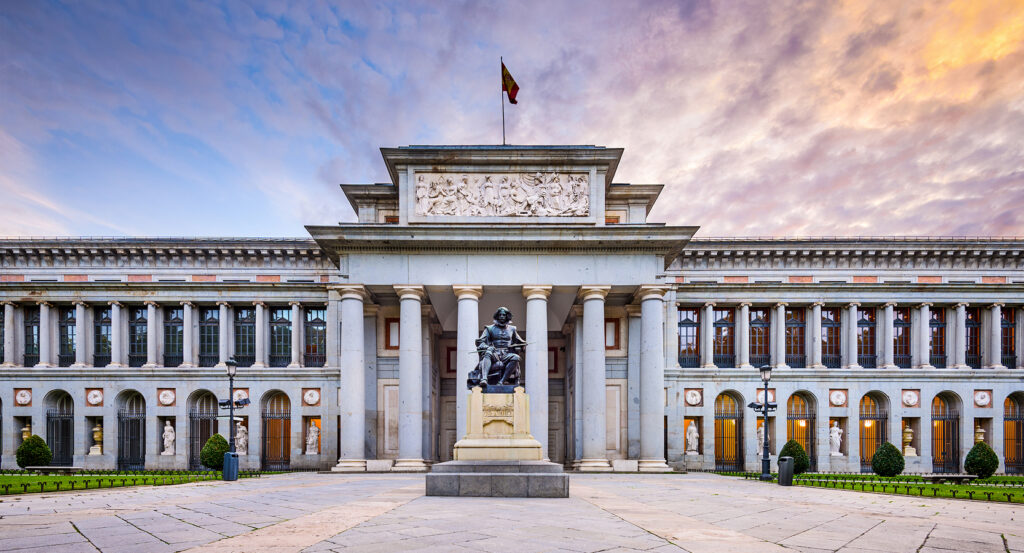
Why you should experience Monumento a Velázquez in Madrid, Spain.
Monumento a Velázquez, or Statue of Velázquez, at Prado Museum in Madrid stands like a sentinel of genius, quiet, watchful, and eternally at work.
Positioned before the Prado Museum's central entrance, it greets visitors not as a monument, but as a mirror, a sculpted echo of the man whose vision helped define Spain's artistic soul. Seated with brush and palette in hand, Diego Velázquez gazes forward with the same calm intensity that animates his masterpieces. Behind him, the Prado's neoclassical façade rises like a temple he unknowingly built, its very character shaped by his art. Around him, tourists pass, unaware that they are being observed by the painter who first taught the world to see. In that stillness, the statue transcends bronze, it becomes perspective itself, frozen in three dimensions.
What you should know about Monumento a Velázquez.
The statue was unveiled in 1899, two centuries after the painter's death, to honor his central role in Spain's cultural canon.
Sculpted by Aniceto Marinas, among the foremost Spanish sculptors of the late 19th century, the monument was commissioned by King Alfonso XIII and placed deliberately at the north entrance of the Prado, the same doorway visitors now use to enter the gallery where Las Meninas hangs. The choice of placement was intentional: Velázquez sits facing his masterpiece, forever welcoming guests into his own artistic universe. Unlike traditional statues of court painters, Marinas portrayed Velázquez with humility, seated rather than standing, working rather than posing. His tools rest naturally in his lap, and the folds of his cloak ripple with subtle movement, as though he has just paused mid-brushstroke. The pedestal bears the Latin inscription “Al pintor de los pintores”, “To the painter of painters”, a phrase borrowed from Édouard Manet, who called Velázquez the master of all who followed. Few realize that the statue's bronze was cast using a technique derived from Renaissance foundries, ensuring lifelike texture and depth; even the veins in his hands are visible when touched by sunlight. The monument's proportions align with the Prado's main portico, creating a seamless axis between artist and architecture, a conversation between creator and creation that endures across centuries.
How to fold Monumento a Velázquez into your trip.
Approach the Prado Museum from the Paseo del Prado and let the statue come into view gradually, framed by the museum's grand colonnade.
Stand before Velázquez in the early morning, when the sun rises behind the trees and the bronze takes on a warm, golden tone. Circle slowly, from the front, his gaze is calm; from the side, his focus sharpens; from behind, the brush and palette reveal their perfect stillness. Pause on the steps above him and look down, from that height, the statue aligns directly with the museum's entrance, a visual symmetry that feels intentional, almost divine. If you're visiting the Prado itself, make the statue your starting and ending point. Before entering, stand at his feet and imagine him lifting his brush toward you; when you leave, return to the same spot and see him anew, as if he's been painting you all along. Visit again at dusk if you can, the bronze darkens, the façade glows, and Velázquez seems to dissolve into the night air, as though he's still quietly sketching Madrid's shifting light. Monumento a Velázquez isn't just a tribute, it's an axis of meaning. It reminds every passerby that art, once born, never stops observing the world that created it.
Where your story begins.
Foresyte Travel reveals places that feel extraordinary long before you arrive.
Experience premium editorial crafted for luxury travelers.














































































































