
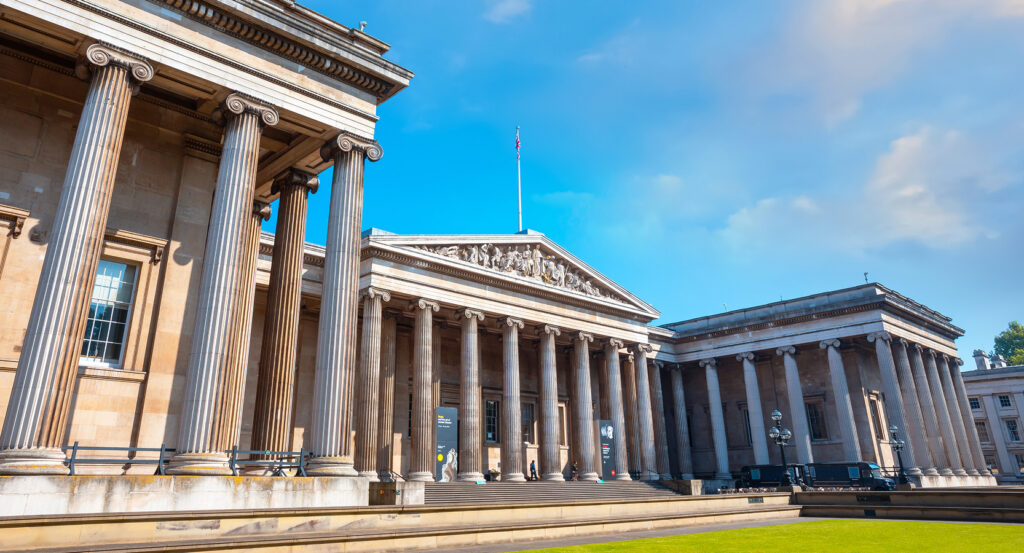
Why you should experience Rosetta Stone at The British Museum in London, England.
The Rosetta Stone Gallery British Museum London holds one of humanity's greatest intellectual keys, a slab of dark granodiorite that unlocked the lost language of ancient Egypt.
It stands quietly behind glass, yet its presence commands the entire room. Visitors press close, faces reflected in the polished surface, tracing the carved lines of hieroglyphs that once sealed centuries of silence. The stone itself is not ornate, weathered, fractured, imperfect, and that is its beauty. It's a bridge between civilizations, proof that knowledge endures translation and time. To see it in person is to feel a pulse of history, the exact moment when mystery yielded to meaning. The Rosetta Stone doesn't just reveal linguistic, it defines revelation.
What you should know about Rosetta Stone at The British Museum.
Discovered in 1799 by French soldiers near the Nile Delta during Napoleon's campaign, the Rosetta Stone was carved in 196 BCE and inscribed with a royal decree honoring King Ptolemy V.
Its power lies in its trilingual text, written in hieroglyphic, demotic, and ancient Greek, which allowed scholars to finally decode Egyptian hieroglyphs after 1,400 years of obscurity. When British forces defeated the French, the artifact was taken to London under the 1801 Treaty of Alexandria, becoming the British Museum's most visited landmark. The breakthrough came in 1822, when French linguist Jean-François Champollion deciphered the hieroglyphic system by comparing the scripts. His discovery not only restored Egypt's lost voice but reshaped archaeology itself, giving rise to modern Egyptology. Few visitors notice the subtle details: the faint pink flecks of the granite, the delicate chisel marks where centuries of study began. The stone is both artifact and epiphany, an object that turned language into resurrection.
How to fold Rosetta Stone at The British Museum into your trip.
Find the Rosetta Stone in Room 4 of the British Museum, near the Egyptian Sculpture Gallery, it's impossible to miss, surrounded by an aura of reverent hush.
Arrive early if you can, before the crowds gather, and stand quietly in front of it. Read the placard slowly, then look beyond the words to imagine the scholars who once obsessed over every groove and glyph. Circle around to view the edges, the fractures and imperfections that make it human. Afterward, continue through the adjoining galleries to see how the decipherment of hieroglyphs illuminated statues, coffins, and scrolls that once spoke only in mystery. For deeper context, stop by the Enlightenment Room, where 19th-century curiosity still lingers in glass cases and inked maps. End with a walk through the Great Court, letting the scale of discovery sink in. The Rosetta Stone doesn't just reveal linguistic, it captures the human will to understand, reminding every visitor that meaning, once found, can echo forever.
Where your story begins.
Foresyte Travel reveals places that feel extraordinary long before you arrive.
Experience premium editorial crafted for luxury travelers.














































































































