
Why Rua de Santa Justa matters.
Rua de Santa Justa is where Lisbon begins to lift itself toward the sky.
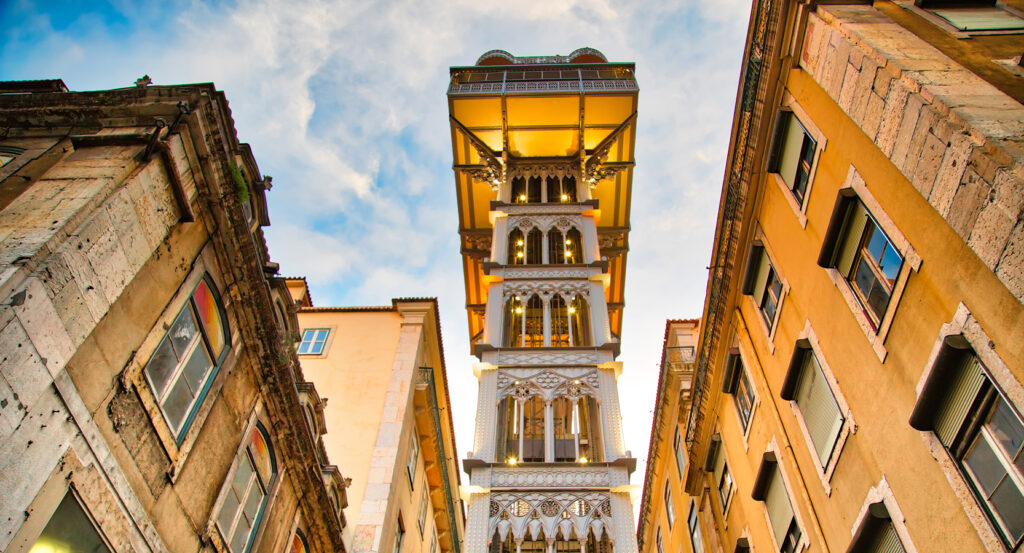
Running between the patterned paving of Baixa and the soaring iron tower above, this narrow passage feels alive with motion, café chatter spilling from doorways, the rhythm of footsteps echoing off tiled façades, the occasional shimmer of sunlight reflecting off the elevator's latticework. The corridor doesn't just frame the Santa Justa Elevator; it introduces it. It's the architectural overture before the crescendo, a funnel of perspective that draws your eyes upward, past wrought-iron balconies and gilded shop signs, until the full height of the tower appears like a vision at the end of the street. Every city has its secret angles, but few are as cinematic as this one. The air hums faintly with the vibration of trams from nearby Rossio, the scent of roasted coffee drifts from side cafés, and for a brief moment, time feels perfectly suspended between the ground and what lies above.
What defines Rua de Santa Justa.
Rua de Santa Justa was part of the Marquis of Pombal's 18th-century reconstruction plan following the 1755 earthquake, among the first European streets built on a fully rational, earthquake-resistant grid.
Its straight, symmetrical design was revolutionary in a city once defined by winding medieval lanes. When the Santa Justa Elevator was added in 1902, it transformed the corridor into one of Lisbon's most photographed perspectives, bridging Enlightenment-era order with Industrial Age innovation. The iron tower was intentionally positioned to terminate the street's visual axis, a deliberate alignment that makes the corridor itself feel like a frame for the structure. The paving beneath your feet still bears the black-and-white calçada portuguesa patterns laid in the early 1900s, their motifs symbolizing Lisbon's maritime identity. Few realize that the corridor hides a subtle incline, just enough to heighten the sensation of ascent as you approach the elevator base. The façades on either side retain many of their original cast-iron balconies and tiled panels, survivors of both the 1988 Chiado fire and the modernization waves that followed. Here, the old and new still live in harmony, each footstep echoing two centuries of Lisbon's evolution.
How Rua de Santa Justa fits.
To feel the corridor's rhythm, approach it the way Lisbon intended, on foot, from the direction of Rossio Square.
As you turn onto Rua de Santa Justa, let your pace slow. Notice how the light narrows and deepens as the buildings close in, guiding your gaze toward the iron tower ahead. Stop halfway and look up, this is the city's most iconic sightline, where Lisbon's architectural precision meets its romantic spirit. Step aside near the small café halfway down the corridor; order a bica and watch the procession of travelers pause, crane their necks, and fall briefly silent. Visit in the late morning, when the sunlight hits the tower at an angle that turns its metal filigree to gold. At night, the corridor transforms, street lamps cast long shadows across the patterned pavement, and the elevator glows like a lantern suspended between earth and sky. Before you enter the Baixa Elevator Platform, turn back once more: the corridor now looks like a river of light, flowing toward Lisbon's past and future at once. Rua de Santa Justa isn't just a passageway, it's the city's prologue, a living frame for the structure that taught Lisbon how to rise.
Where your story begins.
Foresyte Travel reveals places that feel extraordinary long before you arrive.
Enjoy editorial crafted for luxury travelers.
Foresyte may earn a commission when you book.














































































































