
Why Se Cathedral matters.
Sé Cathedral, or Catedral de Santa Maria Maior, stands as Lisbon's enduring anchor, a sacred fortress of faith and resilience that has watched over the city for nearly nine centuries.
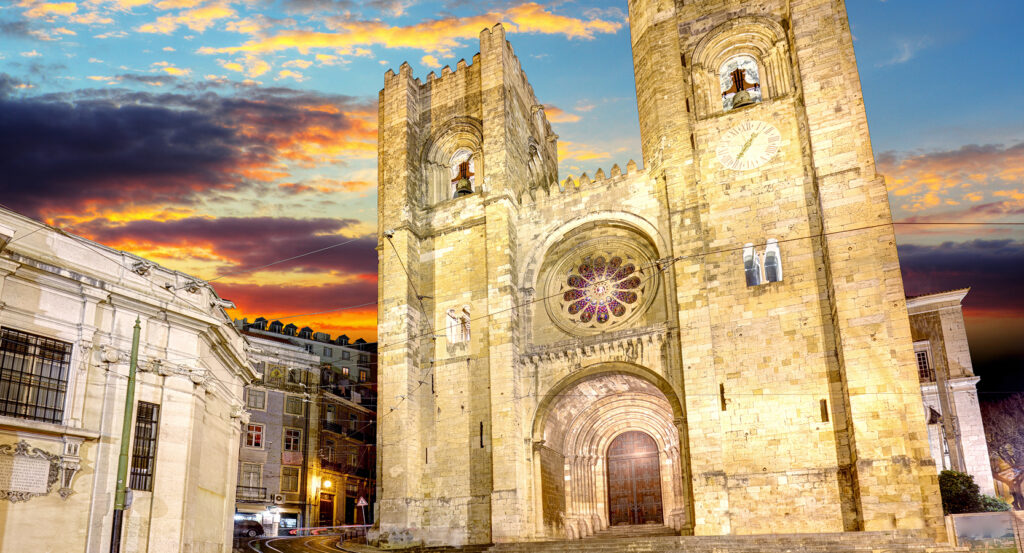
Perched on one of the oldest hills in Alfama, its weathered façade and Romanesque towers feel like the city's heartbeat rendered in stone. The cathedral's massive silhouette, with twin bell towers flanking an intricately carved portal, greets visitors arriving from the winding cobblestone streets below, an image that captures both the city's soul and its scars. Built shortly after Portugal's first king, Afonso Henriques, reclaimed Lisbon from the Moors in 1147, Sé Cathedral is as much a chronicle of conquest as it is of devotion. Step inside, and the air shifts to cool stillness, the scent of candle wax mingling with the faint notes of incense. Shafts of sunlight pierce the ancient stone through narrow Romanesque windows, illuminating the nave's arched columns and worn marble floors. Every corner holds echoes of the past: Gothic cloisters where orange trees grow in quiet symmetry, and side chapels adorned with azulejos, Portugal's signature blue-and-white tiles. Unlike many European cathedrals defined by opulent splendor, Sé's beauty lies in its stoic simplicity. Its stones bear the weight of Lisbon's trials, earthquakes, fires, and empires rising and falling, yet it remains, immovable and eternal. To enter is to step into the marrow of Portuguese history, where faith and endurance have been interwoven since the first dawn of the nation.
What defines Se Cathedral.
Sé Cathedral's story is inseparable from Lisbon's own, an unbroken line of history stretching back to the city's medieval rebirth.
The cathedral was constructed atop the ruins of a former mosque, its foundation marking the literal and spiritual reclaiming of Lisbon in 1147. King Afonso Henriques ordered its construction to symbolize Portugal's independence and Christian triumph, dedicating it to the Virgin Mary. Over the centuries, Sé has been reshaped by earthquakes and artistic evolution, resulting in an extraordinary blend of styles, Romanesque strength at its core, Gothic arches unfolding in its cloisters, and Baroque ornamentation enriching its later chapels. Few visitors realize that beneath its foundations lie ancient archaeological layers: remnants of Moorish homes, Roman mosaics, and even Iron Age artifacts unearthed during restoration. Each excavation revealed another era, turning the cathedral into a living museum of Lisbon itself. The cloisters, added in the 14th century, are among its most serene treasures, framing the sunlight in perfect symmetry and offering glimpses of the city through arched colonnades. The treasury, hidden deep within, holds relics of saints, medieval manuscripts, and gold chalices that speak of both devotion and dynastic wealth. One of the cathedral's most enduring legends is tied to St. Anthony of Padua, who was baptized here in the late 12th century, a connection that makes Sé one of the holiest sites in Portuguese Catholicism. The great 1755 earthquake nearly destroyed the cathedral, but its Romanesque bones survived, while later restorations in the 20th century carefully peeled back layers of ornament to restore its medieval austerity. Even the mismatched stones on its façade tell a story, not of imperfection, but of perseverance, an architectural layering written by centuries of faith, war, and renewal.
How Se Cathedral fits.
To experience Sé Cathedral properly, you must let yourself slow to the rhythm of Alfama - Lisbon's oldest quarter, where time itself seems to soften.
Begin your journey at the base of the hill, following the clang of the iconic yellow Tram 28 as it winds up toward the cathedral's front steps. From the plaza, pause to take in the façade's fortress-like geometry, its towers standing sentinel above the narrow streets, its rose window catching the sun like an ancient jewel. Step inside and give your eyes a moment to adjust to the dim light. Wander slowly down the central nave, where columns carved 900 years ago still hold their weight with quiet dignity. Let your hand brush against the cool stone, smooth from generations of pilgrims. Venture into the cloisters, where sunlight filters through the arches and you can glimpse the archaeological excavations below, a rare chance to see Lisbon's millennia of history laid bare. If you climb the narrow staircase to the upper gallery, you'll be rewarded with views of the nave below, the Tejo River glimmering in the distance through the western windows. In the treasury, linger before the intricate gold reliquaries and illuminated manuscripts, fragile, glowing fragments of devotion that have outlasted kingdoms. When you step back outside, let the moment breathe: stand by the bell towers as they toll across Alfama's rooftops, echoing through the maze of alleys where Fado music drifts like memory. For the most cinematic experience, return at dusk, when the cathedral's limestone façade blushes pink under the setting sun, and the lights of the city begin to shimmer below. Sé Cathedral isn't just Lisbon's oldest monument, it's the city's soul carved in stone. Within its walls, the entire history of Portugal seems to pulse, faith, resilience, beauty, and survival all bound together in one eternal rhythm. To stand here is to feel the unbroken heartbeat of a nation that, like its cathedral, endures.
Where your story begins.
Foresyte Travel reveals places that feel extraordinary long before you arrive.
Enjoy editorial crafted for luxury travelers.
Foresyte may earn a commission when you book.














































































































