
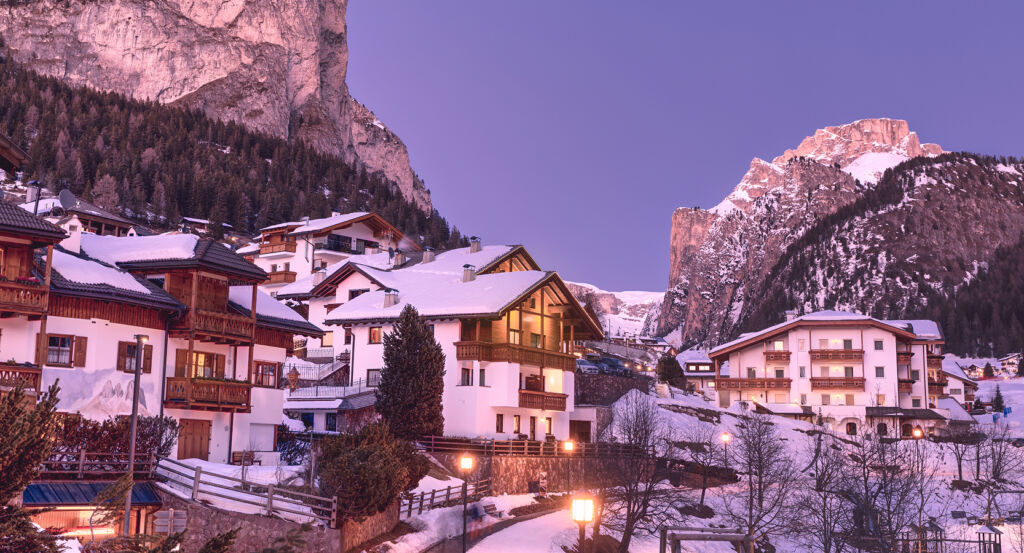
Why you should experience the Sella Group in Italy.
The Sella Group isn't just a mountain range, it's the heart of the Dolomites, a colossal limestone fortress that feels almost alive under shifting light.
Rising dramatically between Selva di Val Gardena, Arabba, Canazei, and Corvara, this massif is the axis around which the entire Dolomite world turns. From below, it looks like a single mountain, but climb closer and it unfolds into a labyrinth of ridges, plateaus, and vertical walls that defy geometry. The cliffs blaze orange at sunrise and melt into silver at dusk, a daily metamorphosis that never repeats itself. For locals, the Sella Group is more than landscape, it's identity. Its peaks, like Piz Boè and Sass Pordoi, are pilgrimage sites for hikers, climbers, and skiers who come not just to move through the mountains but to be changed by them. The silence up here has its own weight; it presses against you until all that's left is awe.
What you should know about the Sella Group.
Geologists call the Sella Group a “fossilized coral reef,” a remnant of an ancient sea that rose skyward over 200 million years ago, but no one really needs science to feel how otherworldly it is.
This massive plateau is bordered by four alpine passes: Sella, Pordoi, Gardena, and Campolongo, all of which form the skeleton of the renowned Sellaronda ski circuit. Each face tells a different story, the western wall glows amber above Val Gardena, while the eastern ridges catch the first light over Arabba. Beneath those cliffs lie a network of via ferrata routes, carved during World War I by soldiers who fought amid the snow and stone. Their iron ladders and tunnels still trace the rock today, connecting climbers to both history and hardship. The Sella's central peak, Piz Boè, rises to 3,152 meters, offering one of the most surreal panoramas in the Alps, a 360-degree sweep of the Dolomites that makes even seasoned mountaineers pause. In summer, the slopes burst into color: pink alpine roses, yellow gentians, purple crocuses. In winter, snow smooths it all into silence, the massif looming like a sleeping titan. Every season redefines it, yet the Sella never loses its essence, wild, unyielding, and im magnetic.
How to fold the Sella Group into your trip.
The best way to meet the Sella Group is to move around it, to circle it, climb it, and let it dominate your horizon until it feels like a living presence.
Base yourself in Selva di Val Gardena for the most direct access, especially if you plan to ski or hike the Sellaronda. In winter, take the Dantercepies lift or head toward Passo Sella, where perfectly groomed pistes wrap around the massif like ribbons. Skiers can complete the full circuit in a day, linking four valleys in an unbroken loop of snow and sky. Summer travelers should trade skis for hiking boots or e-bikes, the Piz Boè ascent is a must for those craving altitude, while the Sella Towers near the Gardena Pass offer world-class climbing routes. For something quieter, drive the loop at dawn, watching the massif ignite in color before the crowds arrive. Stop at one of the rifugios perched on the ridges, like Rifugio Forcella Pordoi or Rifugio Boè, and linger over polenta, speck, and a glass of Lagrein as the clouds drift past at eye level. Evenings back in Selva have their own rhythm: the hum of conversation, the scent of pine from nearby fireplaces, the silhouette of the Sella glowing faintly under starlight. You don't just visit the Sella Group, you orbit it, absorb it, and leave knowing part of you still lives somewhere on its cliffs.
Where your story begins.
Foresyte Travel reveals places that feel extraordinary long before you arrive.
Experience premium editorial crafted for luxury travelers.




















































































































