Why you should experience Pendley Homestead House in Sedona, Arizona.
Pendley Homestead House is the soul of Oak Creek Canyon, the weathered bones of Sedona's earliest dreamers still standing against the red rock.
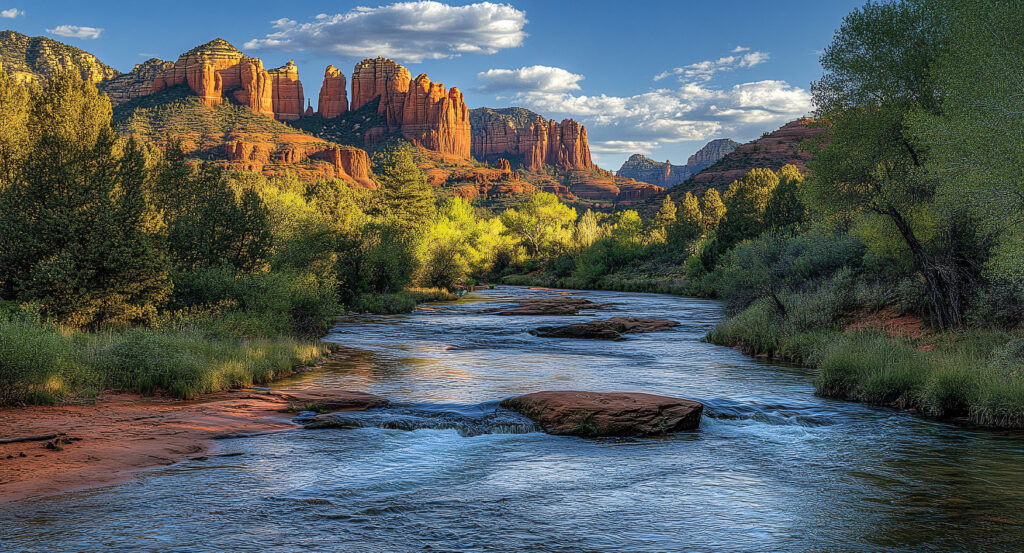
Tucked within the scenic expanse of Slide Rock State Park, these remnants of the Pendley family's pioneering orchard settlement reveal a different kind of Sedona: one built not on mysticism, but on sheer determination. The moment you step onto the sunbaked soil, the canyon hums with echoes of the early 1900s, wooden cabins slumped with age, stone foundations half-swallowed by wild grasses, and irrigation ditches that still glint with water under the Arizona sun. The setting feels frozen in time. Red cliffs rise on every side, yet here at their base, the ruins whisper stories of life and endurance, of families who learned to bend the land to their will. Each collapsed beam and rusted hinge tells of sweat, survival, and quiet devotion to the earth. The homestead isn't grand or glamorous, but its simplicity holds the power of truth. It's the reminder that before Sedona was an icon, it was a home.
What you should know about Pendley Homestead House.
The homestead that once stood here was more than a family dwelling, it was a vision realized by Frank L. Pendley, among Sedona's most ingenious settlers.
Pendley claimed this land in 1910 under the Homestead Act and transformed it from rugged wilderness into a thriving orchard and ranch. With limited tools and no modern infrastructure, he engineered a gravity-fed irrigation system that diverted water from Oak Creek through hand-dug channels and wooden flumes, a design so effective that traces of it still operate today. The main structures of the homestead included a family cabin, a bunkhouse for seasonal workers, a barn, and root cellars carved into the canyon walls. Though much of it has succumbed to time, fragments remain, foundation stones, iron implements, and the outlines of walls that once enclosed generations of daily life. The ruins are now carefully preserved as part of the state park's heritage zone, allowing visitors to glimpse the ingenuity that defined Arizona's frontier era. Few realize that Pendley's orchard helped feed not just local families, but also travelers along the old canyon road, an oasis of green in an otherwise arid corridor. His work laid the foundation for what would later become one of Arizona's most beloved natural preserves, blending history, ecology, and endurance into one living monument.
How to fold Pendley Homestead House into your trip.
Exploring Pendley Homestead House offers a quiet counterbalance to the park's lively water slides and swimming holes.
Start the visit early in the day or during golden hour, when the ruins glow amber in the soft light filtering through the canyon. Begin at the Pendley Homestead Trailhead, an easy, half-mile loop that guides you through the remains of the original orchard, irrigation system, and family structures. Interpretive plaques share snippets of the Pendley family's story, bringing context to what you see: the old apple-drying sheds, the corral remnants, the walls built from river stone and salvaged lumber. Take time to linger and imagine what life might have been like, the steady rhythm of chores, the echo of footsteps on creaking wood, the scent of ripe apples drifting through the canyon air. Combine your stop with the nearby Orchard Trail for a fuller historical walk, or end your visit with a refreshing dip in Oak Creek below. Wear comfortable shoes and bring water; though short, the trails are exposed to the sun. Pendley Homestead House is the root of Sedona's spirit, preserved in red dust and memory, still standing quietly in the canyon where it all began.
Where your story begins.
Foresyte Travel reveals places that feel extraordinary long before you arrive.
Experience premium editorial crafted for luxury travelers.