Why Spiegelgasse matters.
Spiegelgasse is a historic Altstadt corridor where revolutionary politics, avant-garde creativity, literary achievement, and medieval character converged to reshape twentieth-century history.
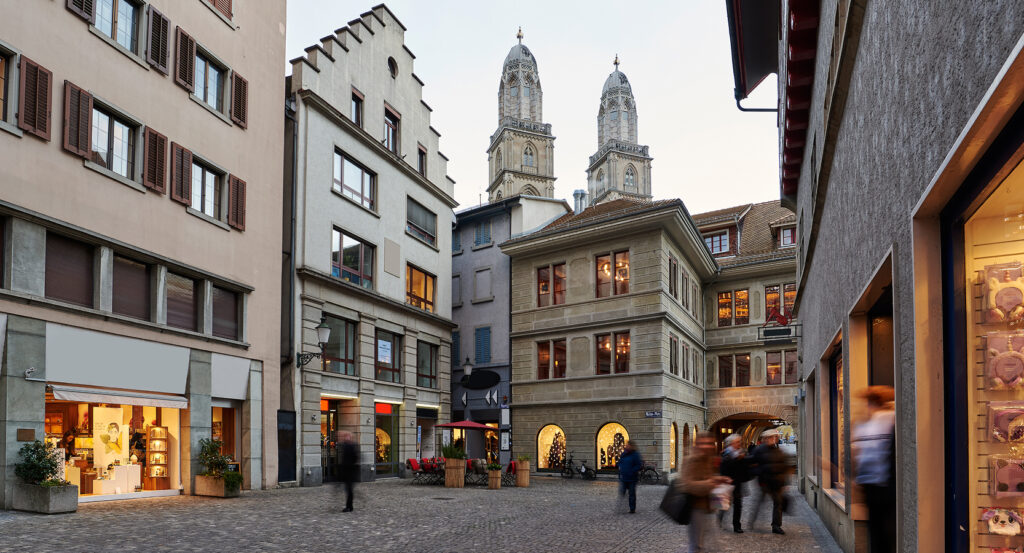
Running through Rathaus between Münstergasse and Neumarkt, this intimate cobbled lane winds past centuries-old townhouses, medieval façades, cultural institutions, and preserved residences that became an extraordinary gathering place for Europe's most influential revolutionaries, artists, writers, and intellectuals. Quiet architectural details belie a remarkable concentration of world-changing ideas born within only a few hundred feet, where artistic rebellion and political transformation unfolded almost simultaneously. Every step reveals a streetscape whose influence extends far beyond its modest dimensions. The result is a corridor defined by intellectual history, cultural innovation, and one of Europe's most consequential urban streets.
What defines Spiegelgasse.
Spiegelgasse is best known for becoming the birthplace of the Dada movement when Hugo Ball and Emmy Hennings founded Cabaret Voltaire at Spiegelgasse 1 on February 5, 1916, joined by artists including Tristan Tzara, Hans Arp, Marcel Janco, Richard Huelsenbeck, and Sophie Taeuber-Arp, whose dramatic performances permanently transformed modern art, literature, theater, and design. Only days later, Vladimir Ilyich Lenin moved into Spiegelgasse 14, where he lived from February 21, 1916 until April 2, 1917 while preparing for his return to Russia before the October Revolution, creating one of history's most extraordinary intersections of political and artistic revolution on a single medieval street. Spiegelgasse had already secured an important literary legacy decades earlier when German dramatist Georg Büchner completed Leonce und Lena and much of Woyzeck while living at number 12 before his death from typhus in 1837, while theologian and philosopher Johann Caspar Lavater was born at number 11 in 1741, transforming this 160-meter-long street into one of Europe's most significant concentrations of literary, philosophical, artistic, and political history.
The remarkable coexistence of Dada's rejection of convention and Lenin's revolutionary political planning continues defining Spiegelgasse as one of the most intellectually influential streets in Europe. Carefully preserved medieval buildings now house museums, galleries, cafés, and cultural institutions that celebrate the corridor's extraordinary legacy while allowing visitors to experience the same intimate urban setting where revolutionary ideas in art, literature, and politics permanently altered the modern world.
How Spiegelgasse fits.
Spiegelgasse works as an exploration through Zürich's celebrated Old Town and revolutionary cultural heritage.
Begin at Cabaret Voltaire, where the birth of Dada immediately establishes the corridor's extraordinary artistic legacy before strolling the length of Spiegelgasse past its historic residences and medieval architecture. Continue to Grossmünster, whose Romanesque towers and central role in the Swiss Reformation reveal another defining chapter of Zürich's intellectual history. Conclude at Lindenhof, where panoramic views across the Limmat River provide a memorable finale celebrating the city's remarkable blend of history, philosophy, politics, and culture. The progression moves naturally from artistic revolution to religious history before concluding at Zürich's historic birthplace, revealing why Spiegelgasse remains one of Europe's most fascinating historic corridors.
Where your story begins.
Foresyte Travel reveals places that feel extraordinary long before you arrive.
Enjoy editorial crafted for luxury travelers.
Foresyte may earn a commission when you book.